Citizen Power | November 2026
Energy Assistance ~ Regulatory Roundup ~ Data Center Digest ~ CAC Shoutout ~ CAC in the News
If you qualify, it's time to apply for energy assistance!
Fall is here, and that means it’s time to submit your application for Indiana’s Energy Assistance Program (EAP), which is how the State disburses the federal Low-Income Home Energy Assistance Program (LIHEAP) dollars allocated to Indiana.
 EAP can help you pay your heating and electric bills, with an average benefit for participating customers that was slightly over $500 in Fiscal Year 2024. In addition, utilities are prohibited from disconnecting EAP customers’ electric service in the winter, as well as during extreme heat in summer months – protections that CAC fought hard for, and that don’t exist for other households.
Applications for EAP open each year at the beginning of October and close by the end of April, although it's best to apply as early as possible once enrollment begins so that you can receive your benefits as soon as possible.
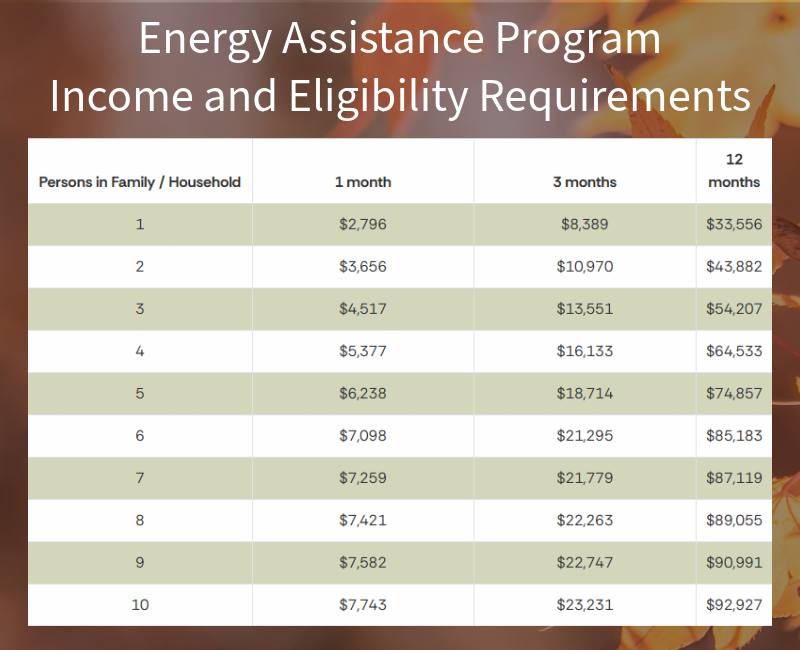
Indiana households that make 60% or less of the state median income may qualify for EAP benefits. Eligibility is based on the most recent three months of income, and scales up as the number of persons in a household increases, as shown in the eligibility table above.
Unfortunately, less than 1 in 5 eligible Hoosier households are served by EAP, and many Hoosiers are unaware that they are eligible for the program.
 Please help us spread the word about the EAP program so that more Hoosiers can apply and benefit from this key energy bill assistance program!
If you need help paying utility bills and are not eligible for EAP, contact Indiana 211 to learn about local resources that can help you.
With gratitude,
The CAC Team

Regulatory Roundup
**IURC Approves AES Indiana-Google Contract Despite Concerns Over Costs, Transparency**
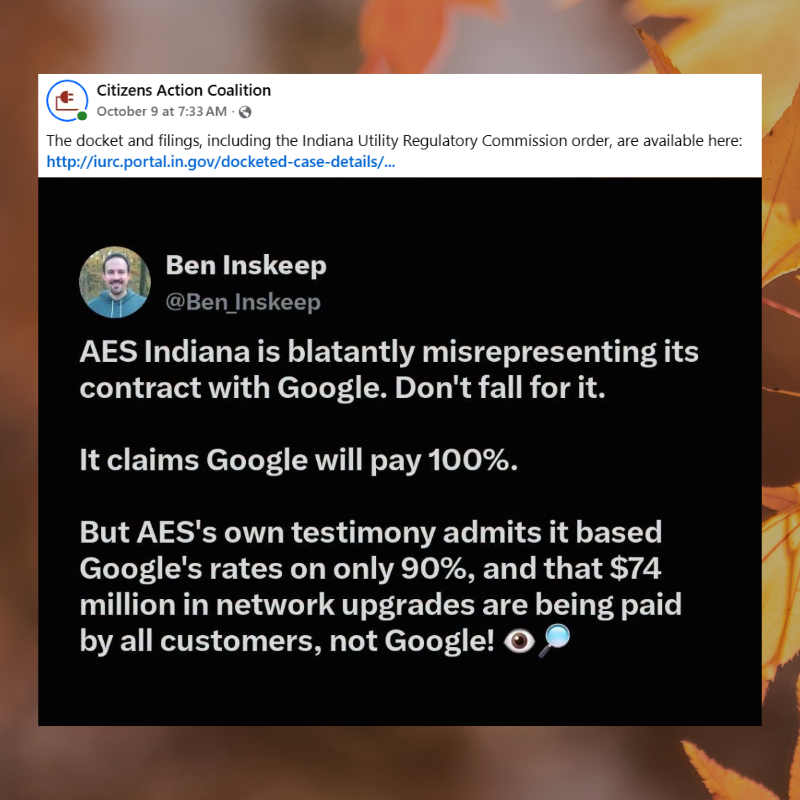 The IURC issued an order in Cause Number 46394 approving a special contract between AES Indiana and the first 390 megawatts (MW) of capacity at Google’s data center under construction in Monrovia. AES Indiana transmission filings at MISO indicate the data center could ultimately triple in size to 1,200 MW.
CAC’s advocacy in this case focused on making the data center pay its full and fair share of costs and increasing transparency about the deal. Some of the terms are kept secret from the public behind a non-disclosure agreement, including the length of time Google is committing to remain a customer and the rates Google will pay for electricity.
Furthermore, even though AES Indiana has claimed that Google will pay for 100% of its energy and infrastructure costs, CAC’s analysis showed – and AES Indiana’s own expert was forced to admit – that AES is actually making all of its customers pay for the $74 million in transmission infrastructure needed for the data center. AES Indiana also calculated Google’s electric rates as if it was only using 90% of its planned power. CAC provided recommendations to fix these and other issues, but unfortunately the IURC did not adopt our suggestions.
**IURC Complaints Skyrocket Amid Monopoly Rate Hikes, Billing Problems**
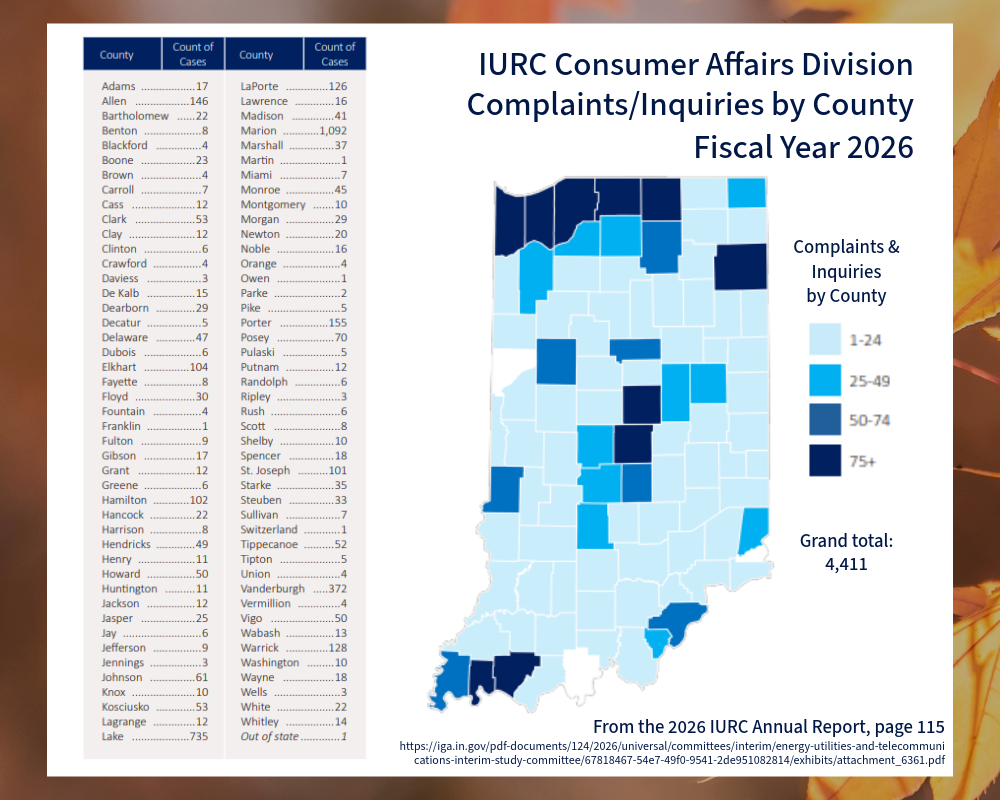 The number of complaints Hoosiers filed against monopoly utilities in Indiana more than doubled from Fiscal Year 2025 (7/1/24 to 6/30/25) to FY 2026 (7/1/25 to 6/30/26), according to the IURC’s annual reports. Complaint / inquiries increased from 2,089 in FY 2025 to 4,411 in FY 2026, which the IURC notes is the highest number in the last decade.
During the same period, NIPSCO Electric, Duke Energy Indiana, and CenterPoint implemented base rate increases, and NIPSCO Gas identified and began correcting a metering issue that had resulted in at least 6,800 gas customer being double-charged for usage for a period potentially spanning decades, and hundreds more undercharged, but NIPSCO did not inform customers of the issue until March 2026.
Data Center Digest
-
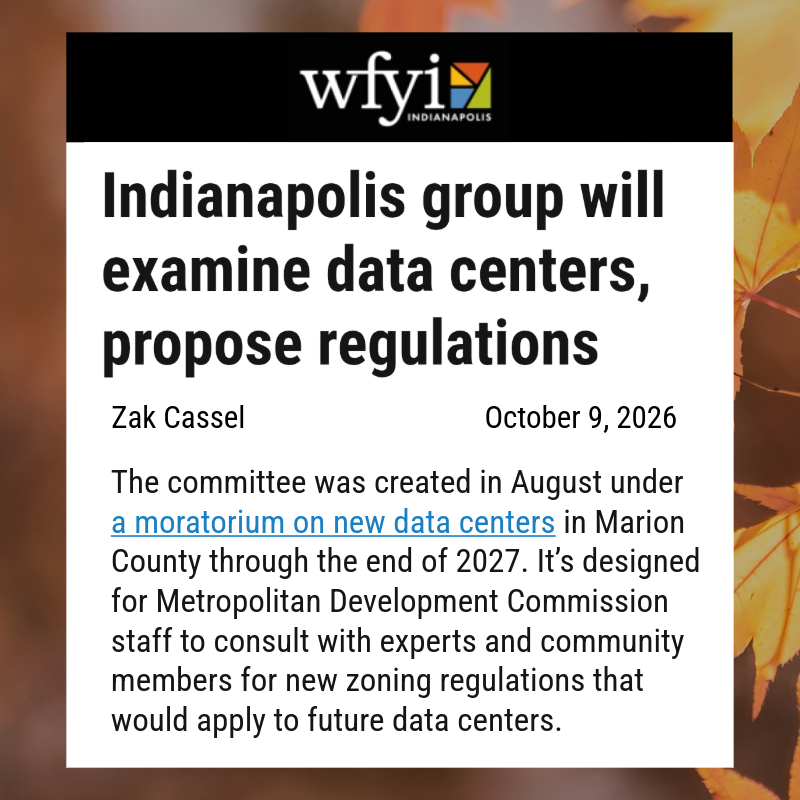 A CAC representative has been appointed to serve on a new Indianapolis City-County Council Data Center Advisory Committee that will study data centers, propose regulations for future development projects, and shape public engagement. A Community Kick-off is anticipated to be scheduled soon.
-
A new poll of likely voters in Indiana finds that 69% of Hoosiers oppose the construction of data centers, compared to only 18% in support.
The poll was conducted by Bellwether Research on behalf of Free Press Indiana, and it surveyed 896 registered Indiana voters. You can find the results here. The data center question is Q17.
-
Indiana Data Center Moratorium Updates:
-
Owen County adopted a 1-year data center moratorium.
-
The Evansville City Council unanimously approved a 180-day moratorium.
-
Starke County moved from a moratorium to an outright ban on data centers.
-
In Gary, Mayor Eddie Melton issued an executive order establishing a one-year moratorium.
-
In contrast, the Fort Wayne City Council rejected both a moratorium and a separate proposal for the creation of a committee to evaluate the environmental and community impact of data centers.
-
-
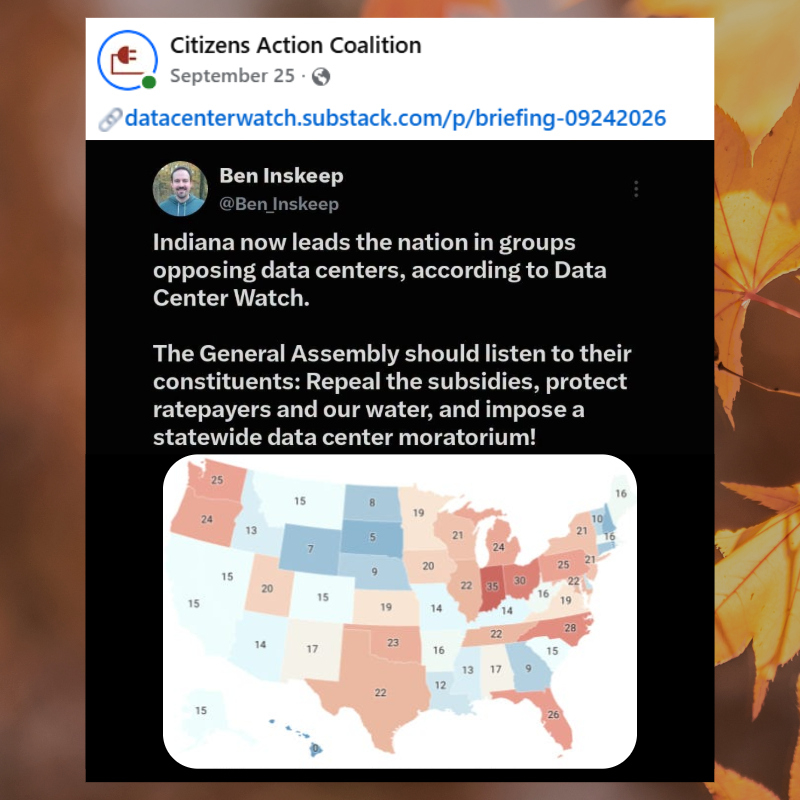 Indiana now leads the nation in the number of groups opposing data centers, according to a report by Data Center Watch.
-
A new investigation finds several examples of data centers in Indiana using non-disclosure agreements, although another 12 communities never responded to records requests issued by the journalists.
-
A White County judge voided the August 2025 land rezoning decision of 184 acres for a data center being developed by Blue Ladder Development at the Mid-America Commerce Park near Wolcott. The judge determined the ordinance required the submission of a notarized letter and a site plan, which Blue Ladder Development had failed to provide.
-
 Digital Realty announced plans for a 3-million-square-foot new data center (Project Bison) in Kokomo, on 476 acres at Industrial Park North. CAC uncovered that the data center’s Phase 1 power demand will ramp up to 300 MW, with a subsequent Phase 2 that will quintuple the size to an eye-watering 1,500 MW - equivalent to the electricity consumption of more than 1 million Hoosier households.
Kokomo created the industrial park, annexed it, and adopted data centers as a permitted use for industrial zoned areas earlier in 2026, while at the same time they were downplaying the potential for a data center to locate there.
-
NIPSCO announced a 20-year contract with Microsoft’s data center in La Porte beginning in 2028, backed by the addition of 1,100 MW of new generation resources, including 600 MW of battery storage, to be added by NIPSCO’s affiliate GenCo. The Microsoft data center could use 788 MW of power, according to a new NIPSCO transmission filing.
-
Hoosier Energy is proposing numerous transmission upgrades in Sullivan County that appear to be tied to new data center developments:
-
A 938 MW data center appears to be planned near Fairbanks, with at least a portion of the power coming from the Maple Creek natural gas plant being developed in the county.
-
An initial 700 MW data center, with potential ability to further scale to 2,000 MW, appears to be planned near Carlisle by Copia Power, a company that has been acquired by EQT Infrastructure VII. The transmission submissions indicate that a portion of the data center’s power demand would be met by two solar-plus-battery projects being developed in Sullivan County.
-
Hoosier Energy signed a memorandum of understanding with AtkinsRéalis to look into developing 8 nuclear reactors in Indiana totaling 6,000 MW of power. Hoosier Energy’s total peak power demand in 2023 was less than 1,600 MW, indicating that the nuclear power plants under consideration are likely for new data centers.
-
-
EQT Real Estate’s proposed data center in Hancock County appears to be planning to use 798 MW of power, according to a WVPA transmission project filing at PJM.
-
DataOne is proposing a 525 MW data center at the Logix Innovation Campus in Frankfort (Clinton County) that would contract for 350 MW of power from Indiana Municipal Power Agency, plus use 175 MW of Bloom natural-gas fuel cells, and an onsite liquified natural gas tank for backup. The city council voted 5-2 in favor of a resolution approving a community enhancement agreement. DataOne was recently fined more than $1 million by New Jersey regulators for flouting environmental laws by operating dozens of natural gas combustion turbines without applying for or obtaining a permit.
-
Google is more than doubling the number of backup diesel generators at its Fort Wayne data center, adding 231 generators and 231 storage tanks according to a new IDEM filing.
-
IDEM issued a Notice of Comment on a draft permit for Amazon’s New Carlisle data center. Amazon is proposing to add an additional 415 backup diesel generators and 428 diesel storage tanks to its site. Public comment is due by November 18, 2026.
-
IDEM issued a Violation Letter to the construction company building Fluidstack’s data center, Project Nova, at the Heartland Industrial Park in Sullivan County after it received numerous complaints about dust from the construction. Fluidstack also applied for an air pollution permit from IDEM, requesting approval of 38 backup diesel generators.
-
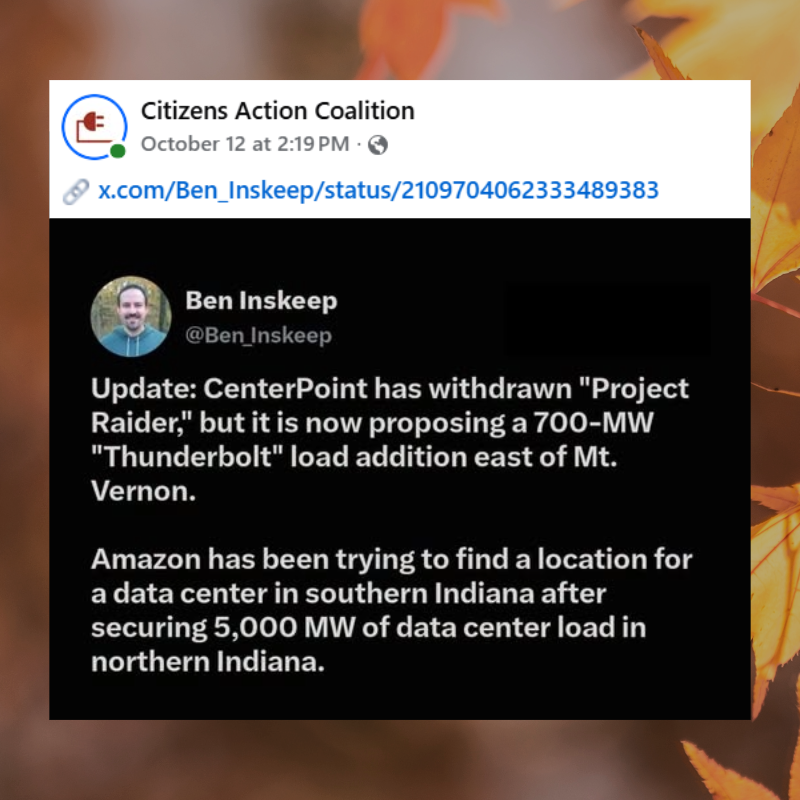 CenterPoint withdrew the 600 MW Project Raider from its transmission projects, but added a new 700 MW “Thunderbolt” load addition. Amazon is trying to develop a data center in Posey County, according to local news reports.
-
The Vermillion Rise Mega Park, which is the site of the former Newport Chemical Depot used to manufacture and store chemical weapons, is poised to transfer some land into a wildlife area. However, a separate parcel at the site is the location of a Terra Industry 8 MW crypto mine that now appears to be planning an expansion for a 40 MW data center.
CAC Shoutout
 CAC gives a shoutout this month to the Private Equity Stakeholder Project (PESP). PESP is a nonprofit watchdog organization focused on uplifting the voices of people directly impacted by the growing private equity and broader private funds industry.
PESP recently testified at the Interim Study Committee on Energy, Utilities and Communications on the role of private equity company Blackstone, which owns 19.9% of NIPSCO and 19.9% of GenCo, in exacerbating problems experienced by NIPSCO customers and staff.
You can find PESP's testimony here - choose "Tuesday, Sep. 29 - 10:00am" in the "Search for a meeting" dropdown box, and then fast forward to the ~4:52:20 mark.
CAC in the News
-
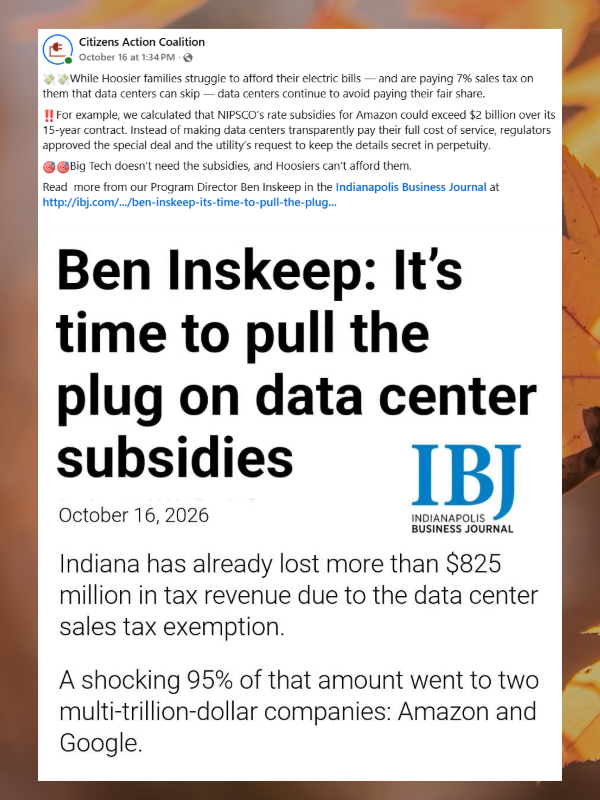 A new guest column by CAC Program Director Ben Inskeep in the IBJ argues “It’s Time to Pull the Plug on Data Center Subsidies.” Ben notes that more than $825 million in revenues have already been lost to date as a result of the state’s sales tax exemption, up from $611 million in May 2026 when totals were initially reported, but failed to include the full amount of Google’s subsidies.
Since then, the IEDC quietly updated the totals in its transparency portal (click on the link and filter by Fund Type "DATA," then download the results to see the subsidy amounts). The difference in the updated total is entirely attributable to the corrected values provided by the IEDC for Google’s Hatchworks LLC data center in Fort Wayne.
-
In a column in the IBJ, CAC Organizer Lindsay Haake wrote about the lack of public accountability of Indiana’s utilities, recommending a change to law to allow Hoosiers to elect utility regulators.
-
 CAC Lead Organizer Bryce Gustafson and Program Director Ben Inskeep were guests on the Fighting Fascism Podcast to discuss community opposition to Big Tech’s AI data centers.
-
CAC Executive Director Kerwin Olson spoke with the IndyStar about a federally funded project intended to strengthen grid reliability that proponents claim will save Hoosiers millions on utility bills. Olson pointed out that while it’s positive that non-ratepayer money will be used to benefit ratepayers, "It's always very easy to make these very broad claims, but at CAC we like to see the numbers and assumptions behind those claims. The public doesn’t have all the details now; all we have are claims of potential savings in the future."
-
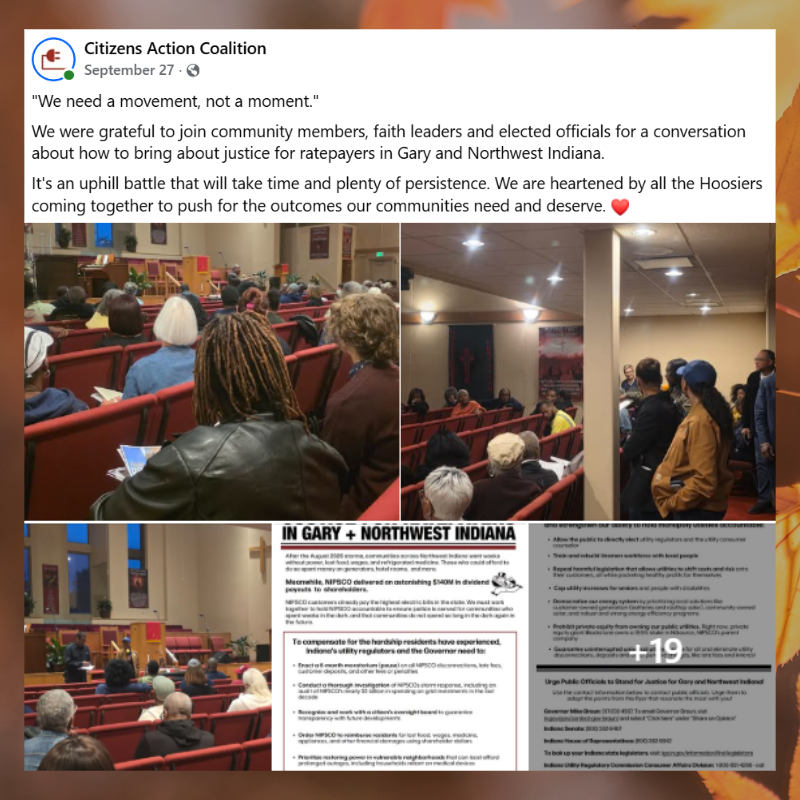 CAC Executive Director Kerwin Olson was a speaker at a Gary town hall meeting that discussed the extraordinarily long outages experienced by NIPSCO customers following an August storm, as well as NIPSCO’s high bills and poor quality service. Kerwin noted a significant shift in mood among Indiana lawmakers as their constituents demand utility affordability, the Chicago Tribune reported.
-
In a State Affairs article, CAC Program Director Ben Inskeep pointed out considerable deficiencies with the federal Ratepayer Protection Act, including that it's too late, and too weak: "We need far more action from our representatives to really address the crisis head-on, as opposed to doing a poor job of articulating what states should actually be requiring of data centers."