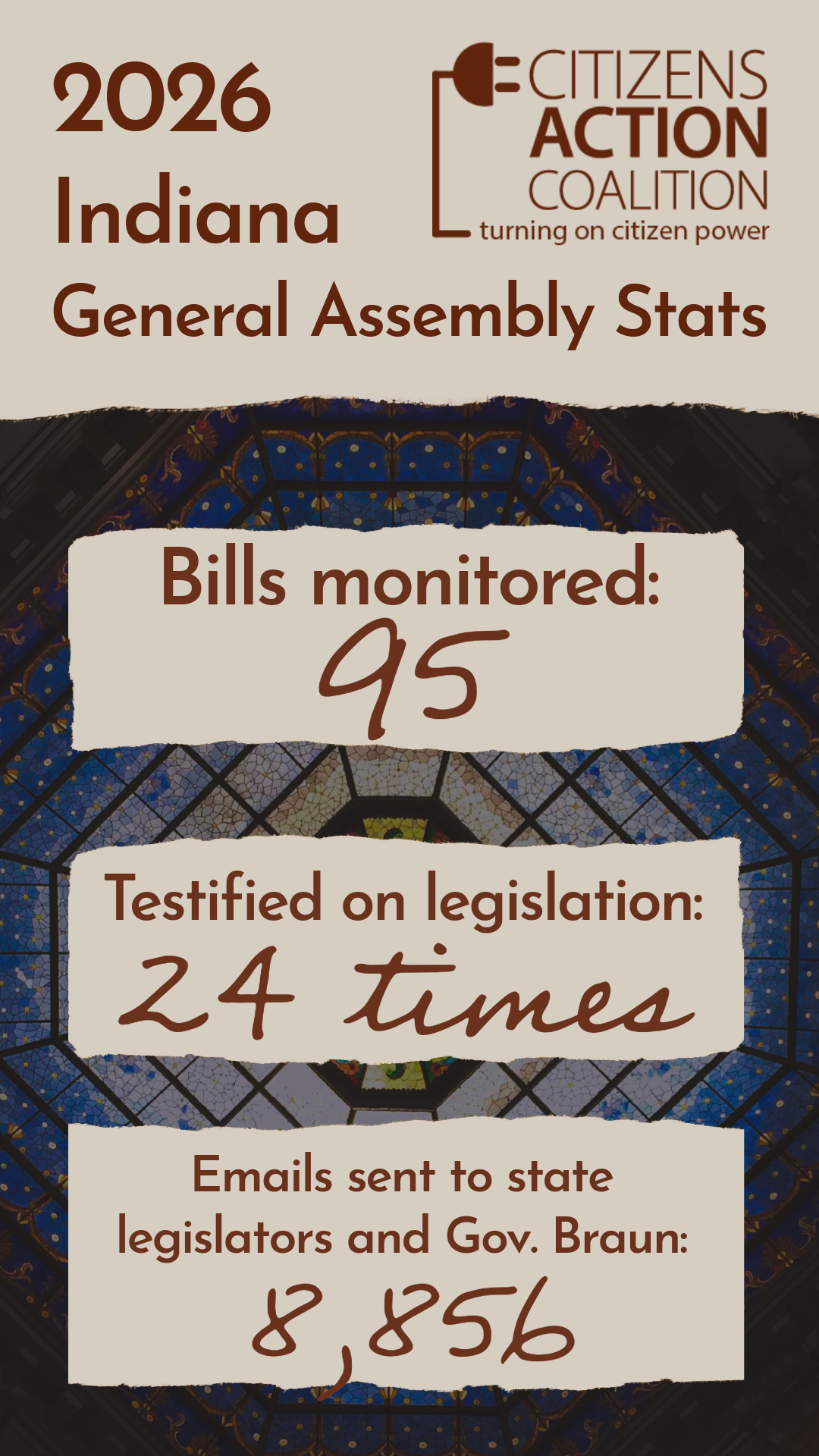
2026 Indiana General Assembly
The 2026 Session of the Indiana General Assembly began a month early in late 2025 to take up the issue of redistricting, which they rejected.
The 2026 session was a "short" session, meaning the session had to adjourn no later than March 14th, although due to the early start of the session, Statehouse leadership adjourned the session on February 27th.
The affordability crisis facing Hoosier consumers and the AI Data Center invasion largely drove the conversation around energy and utilities in this session of the Indiana General Assembly.

2026 Highlighted Bill CAC Supported
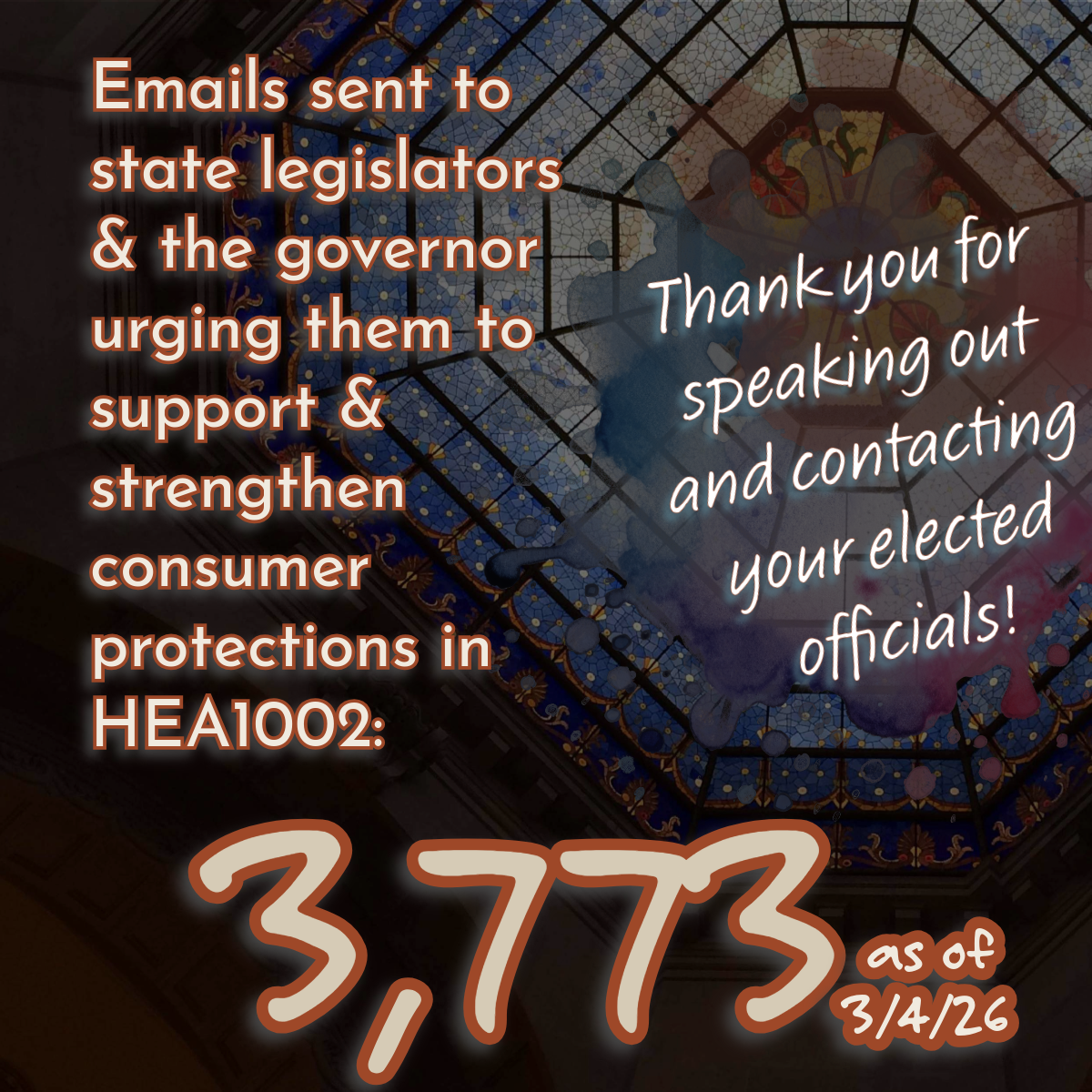 Thanks to a ton of public pressure over the past year, legislators finally began to address the utility affordability crisis during the 2026 Indiana General Assembly legislative session with House Enrolled Act 1002. Although there is still lots of work to be done in future sessions, HEA1002 is a good start at addressing some of the harmful effects unaffordable utility bills cause for vulnerable Hoosiers. We are pleased to see that state legislators passed HEA1002 and Gov. Braun signed it into law on 2/26/2026.
House Enrolled Act 1002 does the following:
-
Reforms the rate case process by requiring that the electric utilities file three-year Multi-Year Rate Plans. CAC would like to see this piece strengthened by removing trackers like TDSIC and CWIP from state law, because they should no longer be needed under this provision. At a minimum, the legislation should have specified that trackers should be treated the same way they currently get treated in base rate cases - they get absorbed into base rates, zeroed out, and reset.
-
Holds the utilities accountable through Performance Based Ratemaking. PBR allows the IURC to reward or penalize the utilities with small increases or decreases in their profit based on their performance around affordability and reliability.
-
Requires the utilities to report customer data on a quarterly basis, including items like customer arrears, number of disconnects, number of disconnect notices, etc. - something CAC has been working on for decades.
-
Requires the electric utilities to provide assistance to low-income qualified households. This is another thing CAC has been working on for decades, and the inclusion of this language is a big win. The legislation leaves the design of these programs up to each individual utility, which is not ideal. CAC strongly believes that the IURC, in concert with stakeholders, should be the ones to take the lead on designing the programs.
-
Creates a summer disconnection moratorium for low-income qualified households - yet another thing CAC has been working on for many years. The bill as introduced allowed for a moratorium only when an “extreme heat warning” was issued by the National Weather Service. The House Utilities Committee amended it to a moratorium for low-income qualified households from June 1st through September 23rd. The House then amended it to a temperature-based moratorium. We greatly prefer a month-based moratorium which would be consistent with our winter moratorium. A temperature-based moratorium is more difficult to administer, and will protect fewer people.
-
CAC did not support the mandate for all ratepayers to be placed on “levelized billing," more commonly known as "budget billing," which was removed in the Senate Utilities Committee. However, the mandate to be placed on levelized billing still applies to households that are enrolled in the Low-Income Home Energy Assistance Program (LIHEAP), which we oppose because we do not believe they should be treated differently than everyone else. LIHEAP-enrolled households will still be allowed to opt-out of levelized billing. CAC will work to influence the application process so that eligible households are notified of the automatic enrollment when they are signing up for the program, and offered the opportunity to opt out at that time, should they choose to do so.
HEA1002 could have been a lot better.
In both the House and the Senate, Democrat legislators offered a slew of amendments that were consistently voted down along mostly party-line votes. You can find links to the vote sheets here.
Most of the amendments offered contained language that was also offered in several standalone bills that were introduced but never heard, which you can find under "Good Bills" in our Consumer, Energy, & Utility Bill Watch List.
 These amendments would have made a tangible impact on your electric bills and included things like:
- Eliminating sales tax from utility bills.
- Freezing fixed monthly charges on utility bills.
- Making utility bills more transparent.
- Requiring utilities to notify senior citizens about utility bill payment assistance programs.
- Authorizing community solar.
- Revoking the sales tax exemption for data centers passed in 2019.
- Requiring IURC approval for utility mergers & acquisitions
- Eliminating deposits and reconnection fees.
- Re-establishing net metering for home solar installations.
- Disallowing utilities from charging customers for costs associated with lobbying, advertising, charitable giving, litigation, investor relations, etc.
- Disallowing utilities to raise bills by 3% or greater in a rate case.
- Preventing utilities from disconnecting customers for whom electricity is medically necessary.
- Requiring that utilities offer payment plans to customers who are behind on their bills, and disallowing the utilities from charging late fees to customers who in compliance with their payment plans.
As always, we will continue working in future sessions to get even better legislation passed that will have more meaningful impacts on utility affordability in Indiana.
That said, HEA1002 is a still good start to begin addressing the utility affordability crisis happening in Indiana right now. It's the first real step we've seen in this direction after more than a decade of legislative rate hikes that have landed us where we are right now.
2026 Highlighted Bills CAC Opposed
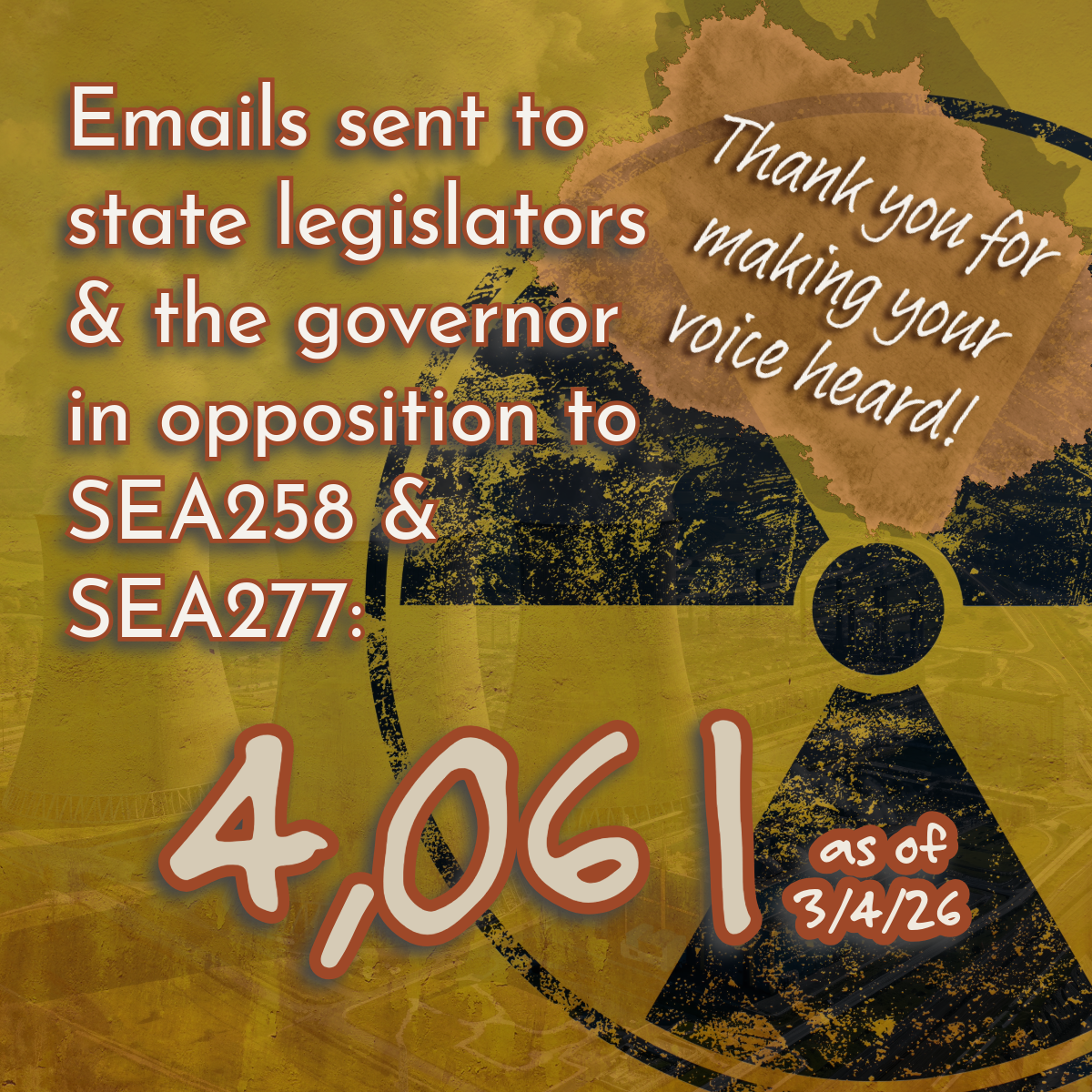 Senate Enrolled Act 258 silences Hoosier voices by revoking the authority of the IDEM Commissioner (Indiana Department of Environmental Management) to conduct public hearings about the environmental effects of the operations of proposed nuclear reactors. SEA258 also reduces state oversight of nuclear facilities by removing the current authority of IDEM to adopt rules and standards to protect Hoosier communities and residents from the hazards of radiation, and to issue permits related to those rules and standards. Sadly, state legislators passed both bills. Gov. Braun signed SEA258 into law on 2/17/26. SEA277 is now on Gov. Braun's desk, awaiting his action.
Senate Enrolled Act 277 significantly weakens environmental protections in Indiana by making IDEM's essential responsibilities discretionary and prioritizing special interests over protecting our air, water, and public health.
SEA277 originally had the same language in it as SEA258, but that language was removed after SEA258 was passed. Taken together, SEA258 & SEA277 are the wrong direction for Indiana, especially right now. State politicians have spent the past few years paving the way for risky and expensive Small Modular Nuclear Reactors (SMRs). They have passed a series of bills that force utility customers to pick up the enormous financial cost and risk required to develop SMRs. SEA258 & SEA277, which further deregulate Indiana's already weak environmental oversight, force Hoosiers to also pick up the tab for the environmental and public health risks associated with nuclear power.
Weakening environmental regulation and reducing the state’s ability to regulate nuclear power plants and radioactive waste at the same time politicians want to begin nuclear power generation puts Hoosier communities at risk.
Campaign Tools
2026 Weekly Statehouse Reports 2026 Bill Watch Lists These are the comprehensive lists of the legislation that CAC is working on at the Indiana Statehouse Help us fight for Hoosiers at the Indiana Statehouse! Resources How to Contact Your Legislators To look up and/or e-mail your Indiana legislators, visit: https://iga.in.gov/information/find-legislators The very best way to get a message to your State Senator and Representative is to call and leave a message with their Legislative Assistants, You will find the contact information to do so below. Indiana Legislator Direct Phone Numbers and Emails: Indiana Senate 200 W. Washington Street Indianapolis, IN 46204-2768 (800) 382-9467 Indiana House of Representatives 200 W. Washington Street Indianapolis, IN 46204-2768 (800) 382-9842 As always, CAC will continue working tirelessly and diligently on policies designed to hold monopoly utilities accountable and speed Indiana's transition away from dangerous, dirty, and expensive fossil fuels and nuclear energy. We remain committed to fighting for affordable utility bills with an eye towards vulnerable populations and moving policies that empower consumers to have more control over their energy costs, like community solar and customer-owned generation. Additionally, CAC will continue keeping a watchful eye on legislative proposals that will have an impact on our environment, natural resources, water availability and quality, and our democracy.