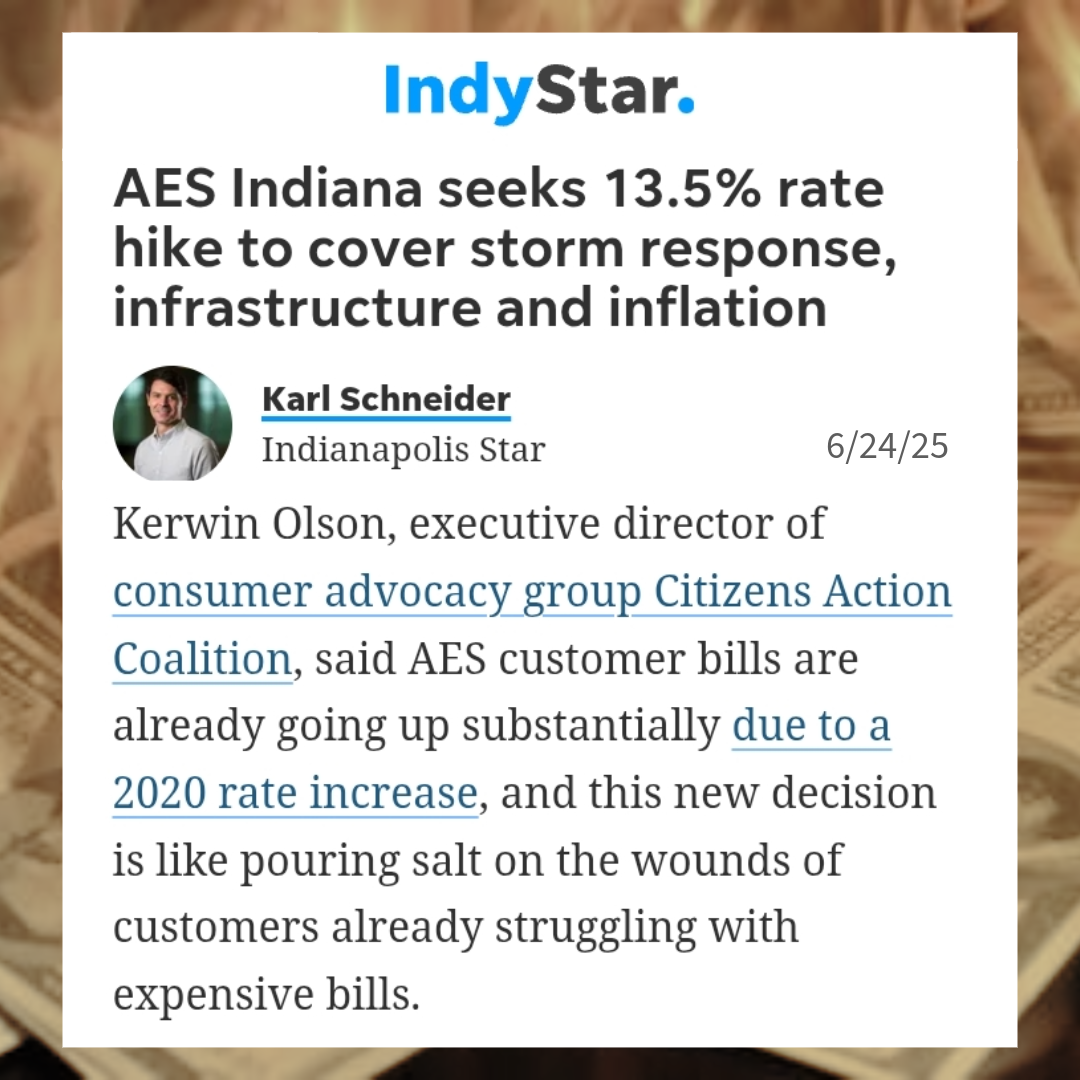
AES wants to hike your electric bill by $30/month
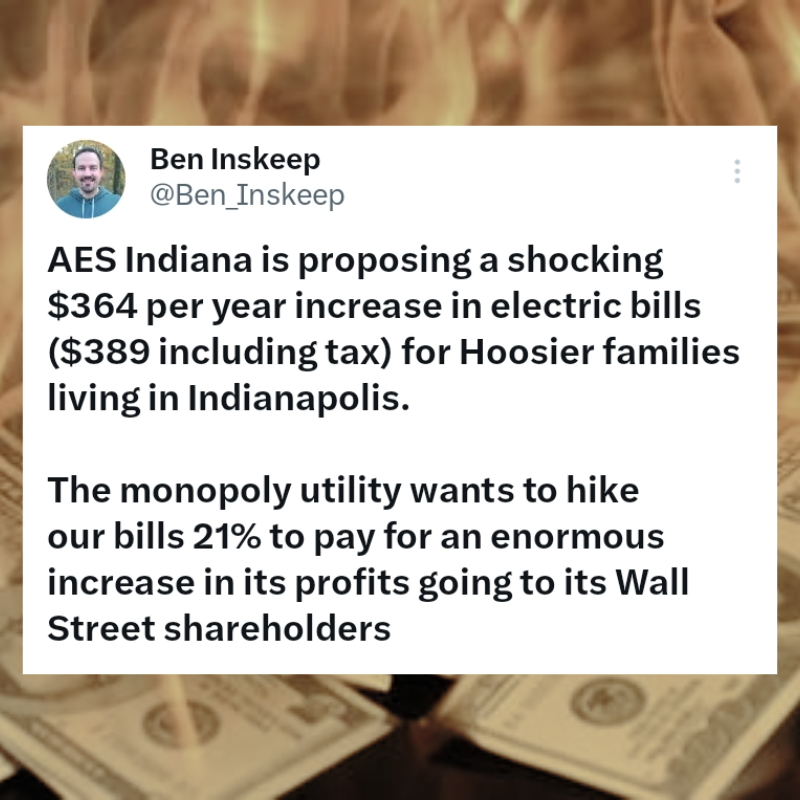
In June 2025, as many people in and around Indianapolis struggle to keep up with rising costs of food, housing, and healthcare, AES Indiana filed for a massive rate hike before the Indiana Utility Regulatory Commission (IURC).

Updates
 JULY 2026: CAC and the Office of Utility Consumer Counselor (OUCC) filed petitions with the IURC, asking them to reconsider the AES rate hike approval.
One of our biggest concerns is that the IURC ignored affordability for residential customers, who will bear the brunt of the burden of the rate hike because they got stuck with the largest increase of any customer class. We are also concerned that IURC’s final order failed to adequately address important issues raised during the rate case process, including ongoing issues with AES customer service deficiencies and regressive declining block rates. We also felt it was appropriate to file a motion for reconsideration because new information emerged after the rate case record closed, including AES Indiana’s agreements involving the Google Monrovia Data Center and the plan for a Blackrock-led consortium to buy AES Indiana’s parent company, The AES Corporation.
The IURC has 60 days to make a decision. The IURC could do nothing and let the rate hike decision stand, or they could change the order.
 JUNE 2026: The IURC approved a rate hike of $71.1 million per year. This is slightly less than the $90.7 million annual increase reached in the settlement agreement between AES, the City of Indianapolis and several large industrial customers, and dramatically less than the $192.9 million annual increase AES initially requested.
Despite the reduction in the overall annual increase, AES residential customers who are struggling to afford essential utility service will still be hit with significant increases in their monthly bills. The settlement reached by AES Indiana and large industrial customers, which was approved with modifications by the IURC, sticks households with the largest rate increase of any type of customer, forcing Hoosier households to subsidize the electric bills for large industry and commercial businesses.
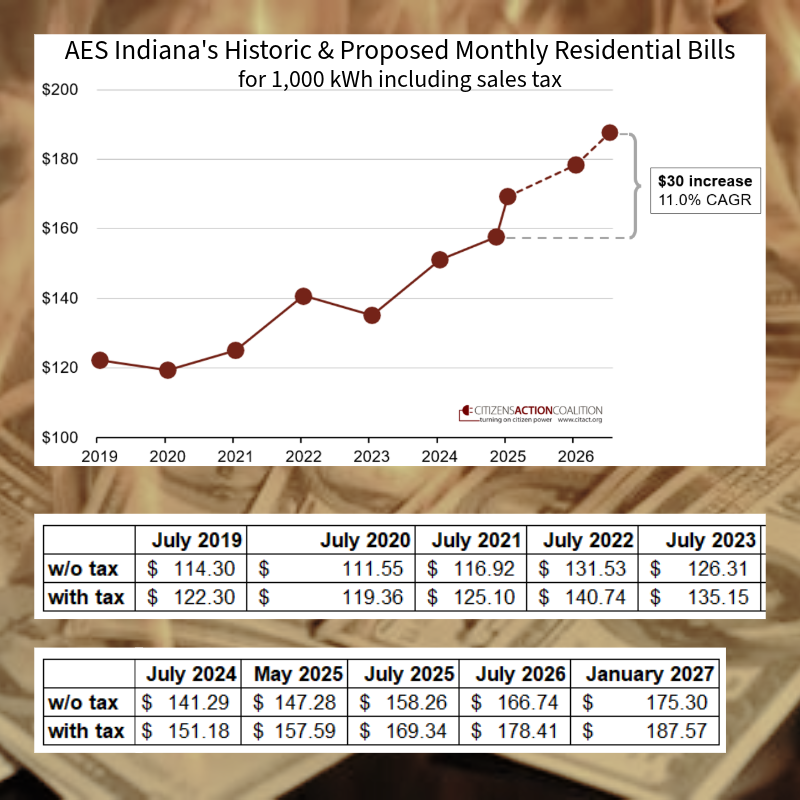
According to AES Indiana, a residential bill for 1,000 kWh increased by $20.82/month including sales tax between May 2025 and July 2026, which includes the Phase 1 rate increase. Once the Phase 2 rate increase from the rate case goes into effect in early 2027, AES Indiana estimates that the residential bill increase since May 2025 will total an extra $29.98/month including sales tax.
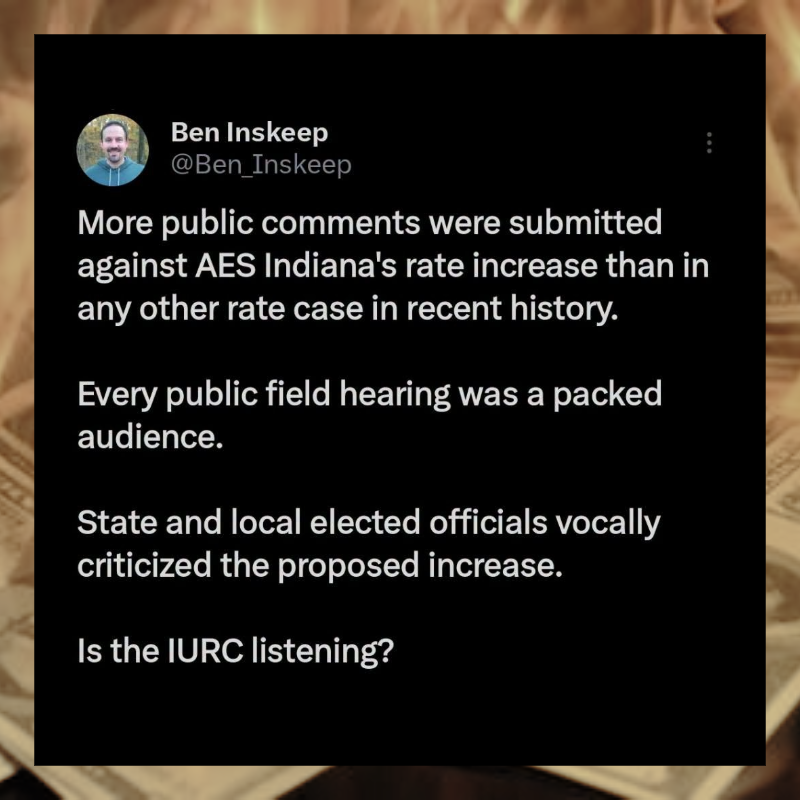
The IURC decision is especially concerning in light of the unprecedented outpouring of opposition from AES customers to elected officials. Recent AES Indiana filings show it is not only financially healthy, but earning excessive profits above its authorized level.
This AES rate case was a key test for the IURC, as it was the first major decision handed down since Governor Braun appointed 3 of the 5 new commissioners. The three Braun appointees each handled the decision differently: Chairman Zay supported for the increase, Commissioner Dieg opposed it, and Commissioner Swinger recused himself because he worked on the case at his previous job with the OUCC.
Immediately following the announcement of the increase, Governor Braun voiced his displeasure with the outcome. Indiana Utility Consumer Counselor Abby Gray, who was tapped last year by Governor Braun to lead the OUCC after decades of public service, called the order “an outrage.” Governor Braun quickly chimed in to express deep disappointment and say the decision was unacceptable, calling for a rehearing of the decision.
Five days later, Gov. Braun announced that he was promoting Commissioner Anthony Swinger to Chairman of the IURC effective immediately, resulting in the demotion of then-Chairman Andy Zay to Commissioner.
Soon after, Commissioner David Veleta, who also voted in favor of the AES Indiana rate hike, announced his resignation from the IURC effective August 31, 2026, or sooner should his replacement be ready to assume the role.
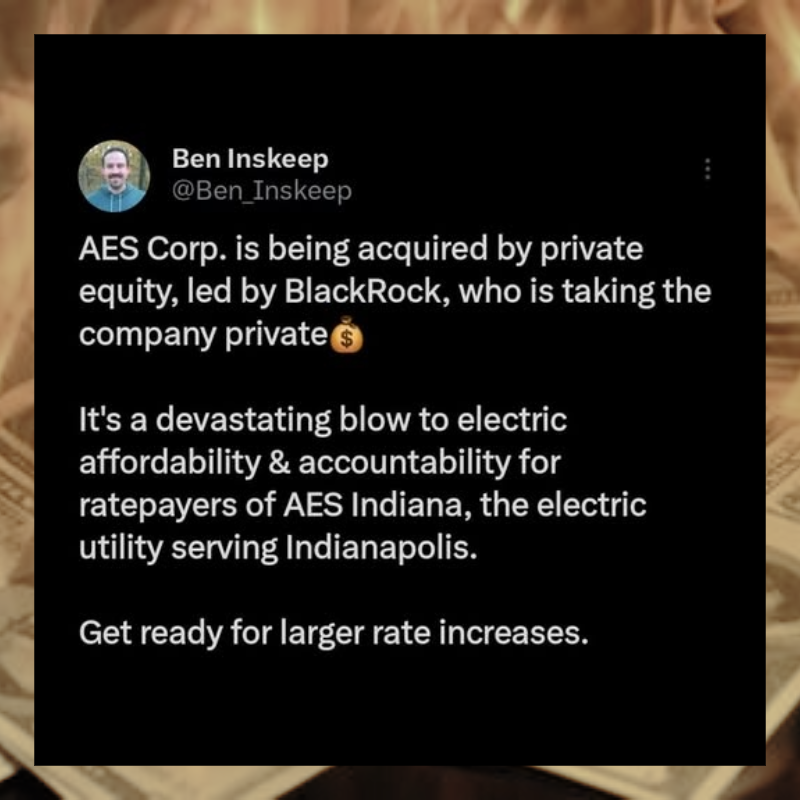 MARCH 2026: A BlackRock-led consortium announced that they will purchase AES Corp., which will go from a publicly traded company to a private company. The consortium includes BlackRock’s Global Infrastructure Partnership and EQT Infrastructure VI, along with co-underwriters California Public Employees’ Retirement System (CalPERS) and Qatar Investment Authority. AES Indiana’s majority owner is currently and will continue to be AES Corp. The transaction is expected to close in late 2026 or early 2027.
This acquisition highlights an alarming trend by private equity gobbling up utilities and infrastructure companies. Private equity owners are even more likely to put unreasonable expectations on utilities like AES Indiana to wring more profit out of its ratepayers.
Indiana is one of the only states in the country where such acquisitions of a utility’s parent company do not have to be approved by state regulators, leaving consumers vulnerable.
NOVEMBER 2025: Adding insult to injury, in addition to this rate hike, AES's latest billing error tacked hundreds of dollars in erroneous deposit fees to customer bills. About 9,000 customers were impacted. AES caught 6,000 of their mistakes before charging people extra, but about 3,000 people had to pay erroneous deposit fees. This is a continuation of the billing error saga they have put customers through as a result of their 2023 billing system "upgrade."
OCTOBER 2025: AES negotiated a proposed settlement with the City of Indianapolis and several other industrial and commercial electric customers loaded with sweetheart deals for them at the expense of residential customers.
The settlement would result in a 6.51% base rate increase for residential customers, whereas the increase would be 3.19% for large commercial customers, and 4.12% for large industrial customers.
CAC will vigorously oppose this unfair and unaffordable deal and do everything we can to continue fighting for AES residential customers.
SEPTEMBER 2025: As intervenors in this case, CAC filed testimony recommending that Indiana utility regulators deny AES Indiana's rate hike in its entirety.
If regulators approve any increase, they should:
-
Deny AES’s request to increase its profit (ROE) and significantly reduce AES Indiana’s current profit.
-
Deny AES’s proposed allocation of costs which forces residential customers to pay a much higher percent increase than large commercial and industrial users. Instead, the IURC should approve a more balanced approach in which residential customers do not end up with a rate increase higher than the system average.
-
Deny Phase 2 rates that are proposed to take effect January 2027. AES’s has refused to provide information about the data centers that could be its customers within the next two years or so. Stakeholders and regulators cannot determine whether Phase 2 rates will be just and reasonable with the game changing addition of data centers, and so should not approve these rates.
We further recommended that regulators should:
-
Open an investigation into AES Indiana’s billing system issues and deny cost recovery related to the new billing system, or the ACE Project.
-
Deny AES Indiana’s proposed increase in the monthly fixed customer charge and modify its request to continue using declining-block rates.
-
Establish a new and lower monthly fixed customer charge for residential customers in multi-family housing.
-
Direct AES Indiana to adopt a security deposit cap of $25 for households who qualify for the Low-Income Home Energy Assistance Program (LIHEAP), and adopt a security deposit cap of $50 for non-LIHEAP residential customers who attest to having a household income below the statewide median household income.
-
Direct AES Indiana to pause residential disconnections for nonpayment for an additional 1-year period, discontinue all disconnections for nonpayment for Medical Alert customers, and eliminate the reconnection charge for residential customers resuming service after being disconnected for a delinquent bill.
-
Direct AES Indiana to automatically waive the first two late payment charges a residential customer gets over a 12-month rolling basis.
-
Reject AES Indiana’s request to force customers to pay for the Company’s expenses related to filing for a rate increase, like experts and lawyers.
-
Establish a new Affordable Power Rider designed to promote economic stability through bill discounts applied to qualifying residential customer bills.
-
Take any other actions necessary to protect residential ratepayers and ensure affordability is appropriately considered and addressed.
AES Rate Hike Background
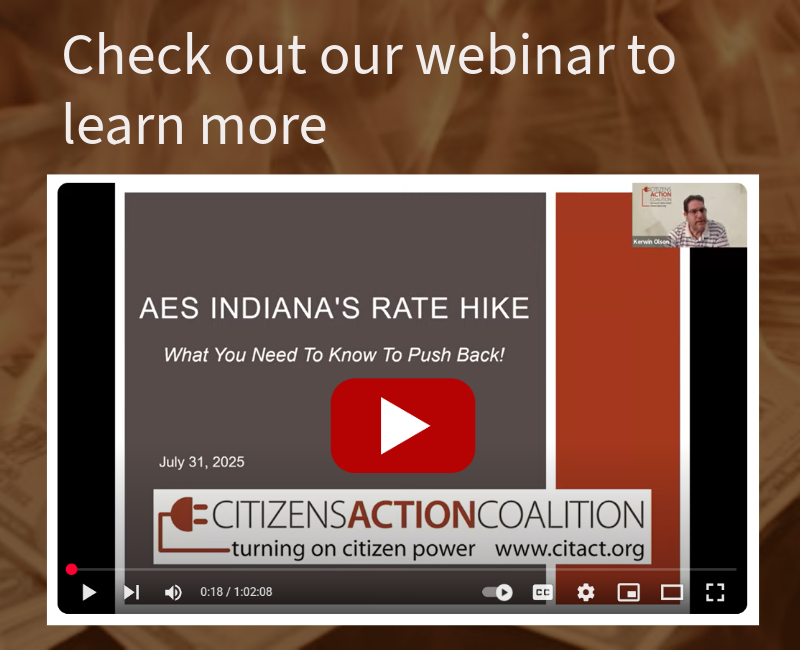
 This request - Cause Number 46258 - was filed in June 2025, and came barely a year after their last $9+/month rate hike was approved by state utility regulators in April 2024.
CAC is working to protect Hoosiers from AES's greedy request to collect another $192.9 million every year. We have intervened in this case and will advocate for AES customers throughout the entire rate case.
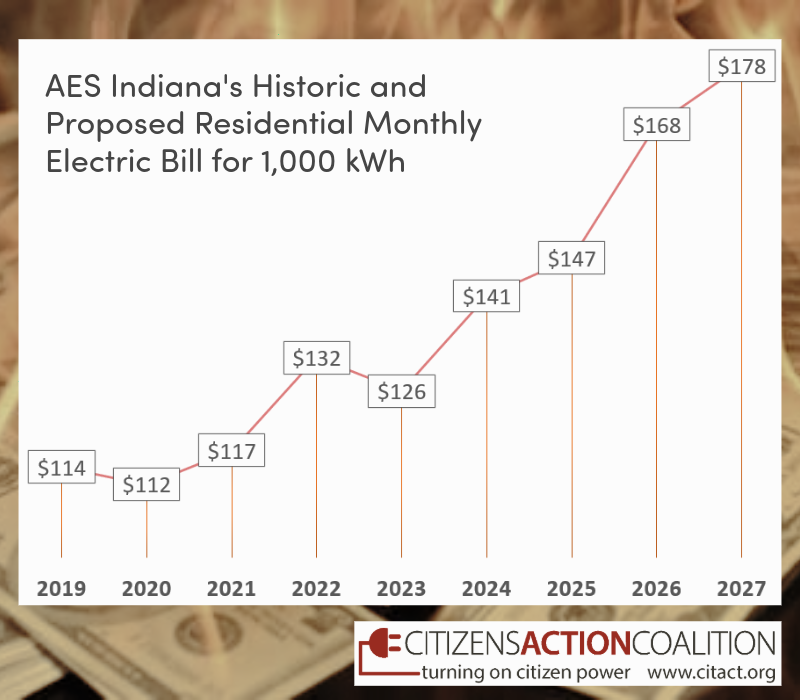 Combined with other, already approved rate increases - for things like transmission and distribution and environmental compliance for polluting fossil-fuel power plants, all enabled by state legislators - the overall increase hitting customer bills is an astonishing $468 million by January 2027.
If this new request is approved as filed, AES monthly bills will increase $30.32 by January 2027.
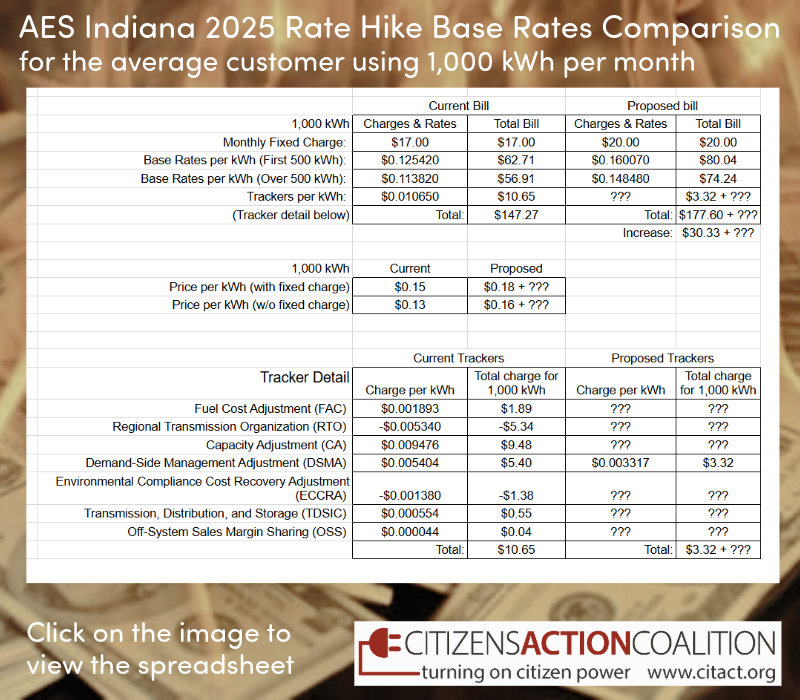
In this rate case, AES wants:
-
To collect another $192.9 million from their Indiana customers every year. AES is requesting a 10.1% increase in its annual revenue requirement. If approved, AES will collect $2.11 billion annually from their Indiana customers - residential (households), commercial (big retailers), and industrial (data centers and big manufacturers).
-
To significantly increase their profit. AES already has the highest profit margin (return on equity, or ROE) out of all the investor-owned electric utilities in Indiana at 9.9%. But that’s apparently not enough for this monopoly, which wants regulators to approve an obscene 10.7% ROE for their shareholders. If approved, AES’s annual profit would skyrocket from $260.9 million in 2024 to $417.2 million in 2026, a $156.3 million increase in their net income.
-
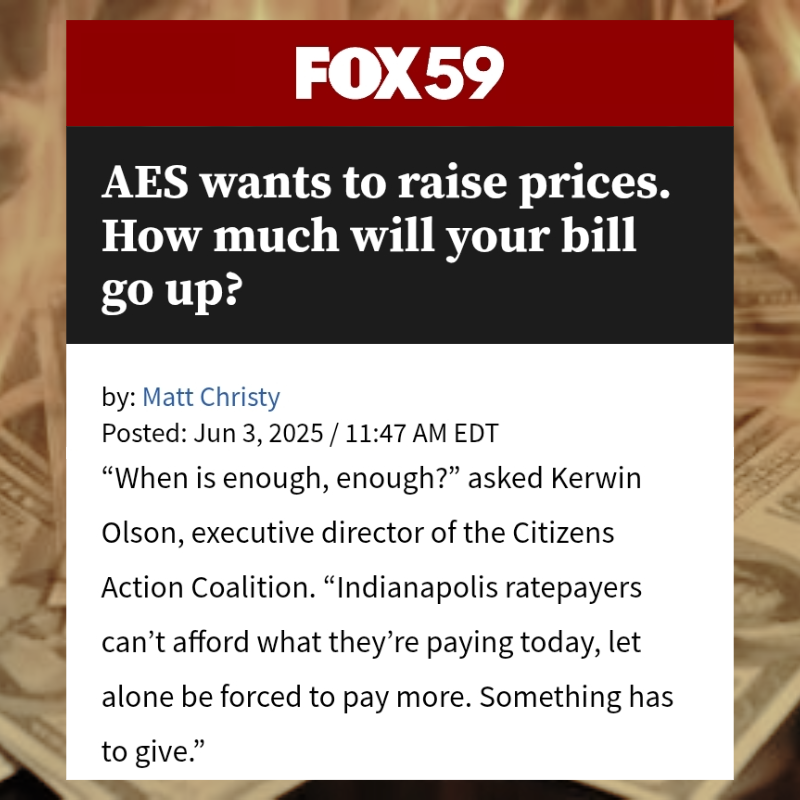 To force residential customers to subsidize the electric bills for large corporate customers by forcing residential customers to pay a higher percentage of the rate increase than large corporations have to pay. AES is proposing the largest rate increase (13.45%) for residential customers, with much smaller rate increases proposed for businesses, including a 6.18% increase for small commercial customers, a 8.72% increase for medium commercial, and a 2.5% increase for large industrial customers (which includes big factories and data centers).
 -
To charge you the highest fixed charge out of all big utilities in Indiana. AES wants to raise the fixed charge for most residential customers from $17 up to $20. The fixed charge, also known as a customer charge, is the fee you pay every month regardless of how much energy you use.
-
To continue using declining block rates, an absurd and regressive rate structure that forces those who use the least energy to pay the highest rates per kilowatt hour.
High fixed charges and declining block rates are certainly beneficial for AES’s bottom line, but they disproportionately impact low-and fixed-income households (seniors, people with disabilities, households with children, and other vulnerable populations) and penalize households that conserve energy and make their homes more efficient.
The fact that AES Indiana has the gall to ask for higher profits at this point is disturbing.
 It's been a chaotic and distressing few years for AES customers. Around the time AES filed their last rate case in June 2023, thousands of AES customers were without power, including some for up to 5 days, due to a severe storm. Another recent storm in June 2025 knocked out power to over 60,000 AES customers, and over 10,000 AES customers were still without power as an extreme heat wave moved into the area. For years, AES customers have been communicating concerns about the length of time it takes AES to restore power in the aftermath of storms.
But struggling without power isn’t the only challenge that AES customers have faced in recent years. At the end of 2023, AES's billing system "upgrade" was a complete disaster, causing 60,000 customers to experience a range of billing issues, including being charged for the same bill multiple times. It took all of 2024 and part of 2025 to get these issues resolved.
Campaign Tools
Submit your comments Use the form below to email your comments about AES's rate hike request to Indiana’s Utility Consumer Counselor Abby Gray, urging her office - the OUCC - to oppose the rate hike, and urging the IURC to deny the rate hike. Be sure to reference Cause Number 46258. Help us fight for Hoosiers! Public Comments & Field Hearings We want to thank everyone who submitted comments and testified at the public field hearings! You all submitted over 6,800 comments that the OUCC filed in the AES rate case - thank you so much for speaking out! Between the four IURC public field hearings, there were around 500 folks who attended. There was just over 9 hours of testimony given by around 90 people who spoke directly to utility regulators, and gave oftentimes gut-wrenching testimony about how this rate hike will impact them and their families. Here are links to 3 of the 4 field hearings, recorded by Government Access Television Channel 16: Public Field Hearing #1, 8/18/25 - West Perry Branch Library Public Field Hearing #2, 8/21/25 - Southeast Community Services Public Field Hearing #3, 8/25/25 - New Augusta Public Academy AES Rate Hike Town Hall We want to send out a big thank you to everyone who joined us at our office on August 6th to learn more about the AES rate hike and how to fight back! If you missed it, you can check out the recording below. As bills escalate dramatically, AES offers no support to vulnerable households. As of May 2025, a residential monthly bill for AES customers using 1,000 kilowatt hours (kWh) is $147.27 (excluding sales tax). With this new rate hike factored in, AES is forecasting that monthly bills will increase to $177.60 by January 2027. This results in a $30.32 bill increase over the next year and a half, but AES customers have already been seeing and will continue to see drastic increases in their bills. If this request gets approved, in the 3.5 years between July 2023 and January 2027, AES bills will have increased by an unconscionable $51 per month. These massive bill hikes come at a time when the number of households at or near poverty in Central Indiana continues to grow. In Marion County, over 1 in 3 households is living in or near poverty, the highest percentage of all 7 Central Indiana counties. On the other hand, AES Indiana is a monopoly subsidiary of AES Corporation, a massive US-based Fortune 500 corporation that operates in 12 countries across 4 continents, that pays their executives generously and spends tons of money on political contributions. In other words, AES is doing just fine. So it is disturbing that AES is not proposing any new programs to assist vulnerable households, who already can’t afford their monthly utility bills, and who will struggle even more should the IURC approve this egregious rate hike. This is especially concerning because Indiana offers minimal consumer protections to electric utility customers. Positive legislation that would help keep more vulnerable Hoosiers connected to utility service died at the Indiana Statehouse in the 2025 session, as it did in previous years. Additionally, the federally funded Energy Assistance Program (LIHEAP) is under threat. LIHEAP serves as the primary form of meaningful bill assistance available to vulnerable Hoosier households. All of the workers that administer LIHEAP at the federal level were fired in April, and federal budget proposals have called for eliminating LIHEAP funds entirely. Federal uncertainty, lack of action from the Statehouse, and disinterest in meaningful support from monopoly utilities themselves puts Hoosiers and our health at risk. All Hoosiers deserve uninterrupted access to essential services. No one should have to choose between paying for food, shelter, healthcare or utilities. Our most vulnerable neighbors are put in dangerous positions - even risking their health and well-being - when utility bills are unaffordable.