Citizen Power | June 2026
The Backlash to the Data Center Backlash ~ News & Views ~ Data Center Digest ~ CAC Shoutout ~ CAC in the News
The Backlash to the Data Center Backlash
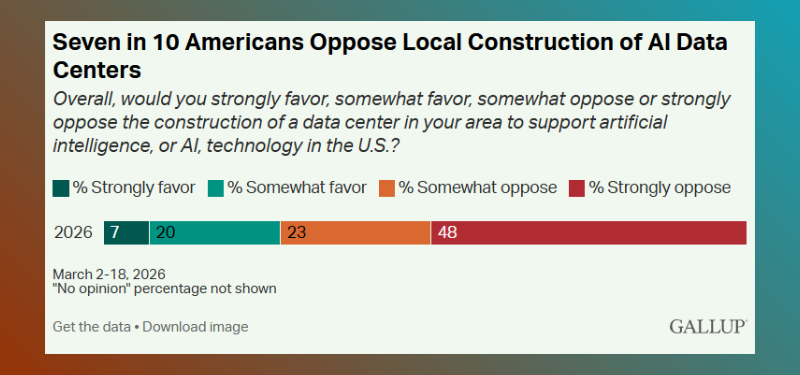 It’s no secret that folks are growing increasingly wary of the impacts of AI and the energy- and water-guzzling data centers that are needed to power Big Tech’s latest techno-fad. A new Gallup poll shows that a stunning 7 in 10 Americans now oppose constructing AI data centers in their community. For comparison, Gallup found that 53% of Americans oppose building a nuclear energy plant in their community.
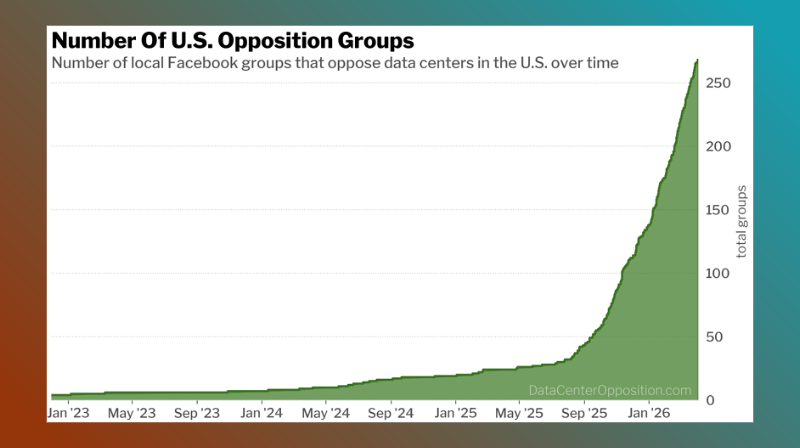 This follows another recent report tracking data center opposition that shows the explosion of local Facebook groups, and their membership, opposing data centers.
Hoosiers have earned national attention for leading the charge on this issue. Hoosiers are mobilizing their communities, attending public meetings, and advocating for elected officials to stand up for their constituents. This organizing has led to many data center proposals being canceled or denied, a growing list of communities enacting moratoriums, and more significant concessions and community benefits being proposed by developers.
But with the strong outpouring of opposition against Big Tech’s AI slop factories–er, data centers–has come a growing backlash to the backlash.
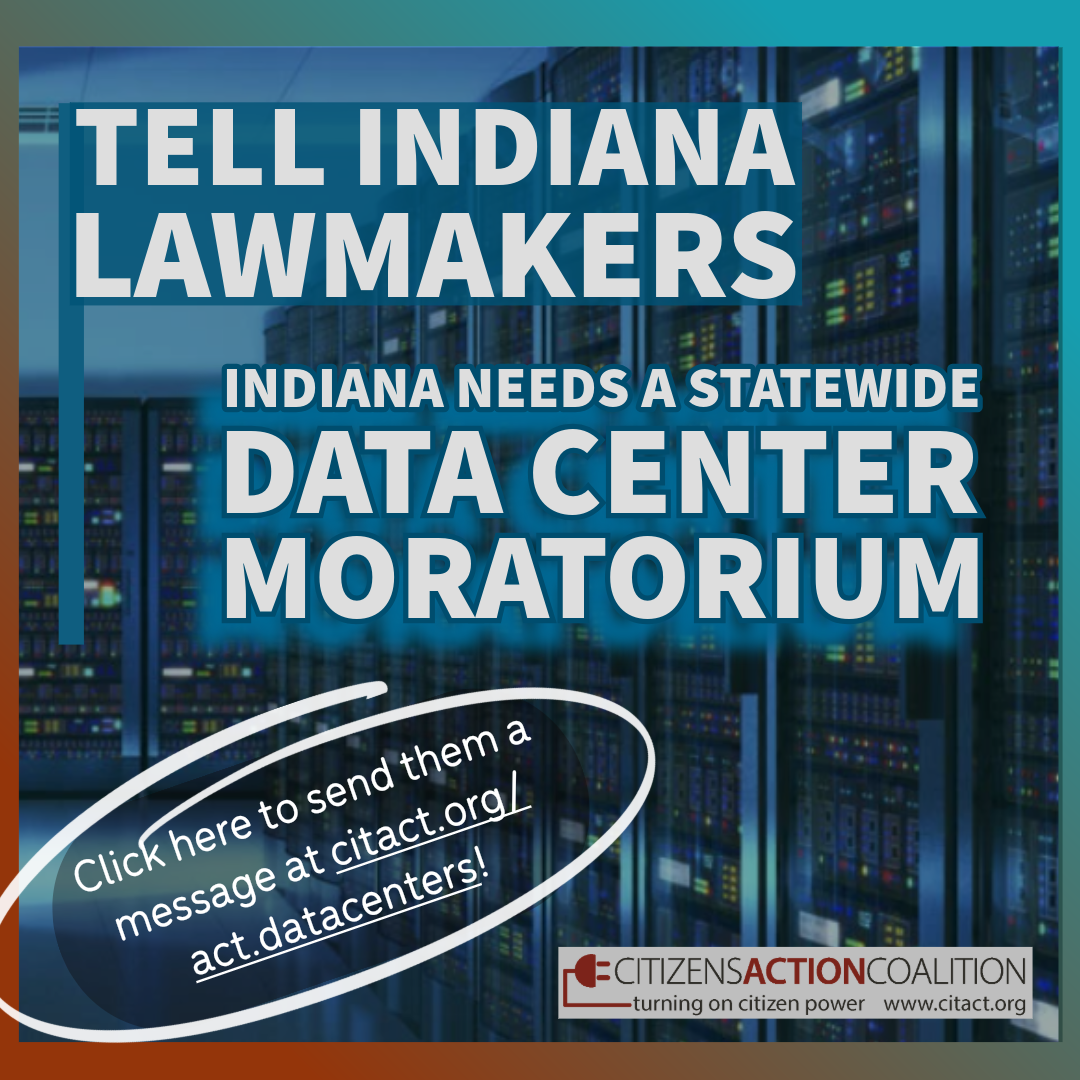 As the saying goes: First they ignore you. Then they laugh at you. Then they attack you. Then you win.
It’s safe to say we are now in the “Then they attack you” phase. A bevy of op-eds, think pieces, industry-funded reports, and social media posts from the pro-AI, pro-Big Tech establishment criticizing those of us opposing data centers have been published recently. They call us unhinged (or worse), claim data center opposition will exacerbate the concentration of wealth, and question the seriousness of data center impacts.
Big Tech is losing, and they know it.
These attacks - increasingly desperate, vitriolic, and in bad faith - against folks standing up for their local communities show how scared they are of the highly effective organizing taking place across Indiana and the rest of the country. Big Tech has lost their social license, and it may be too late for them to get it back. In other words, people are fed up with Big Tech and aren’t willing to tolerate their exploitation and greenwashing anymore.
So, as you continue to see more examples of this backlash to the data center backlash, don’t get discouraged. While they seek to divide us, we stand united and in solidarity with one another. While their supporters are dwindling, ours expand by the day from all walks of life and all corners of the state. And while they increasingly rely on personal attacks and misleading rhetoric, we are focused on the facts and increasing transparency.
 Keep up the good fight, Hoosiers.
Onwards together,
The CAC Team

News & Views
** 27 Public Interest Organizations Call on Indiana Local Governments to Enact Data Center Moratorium **
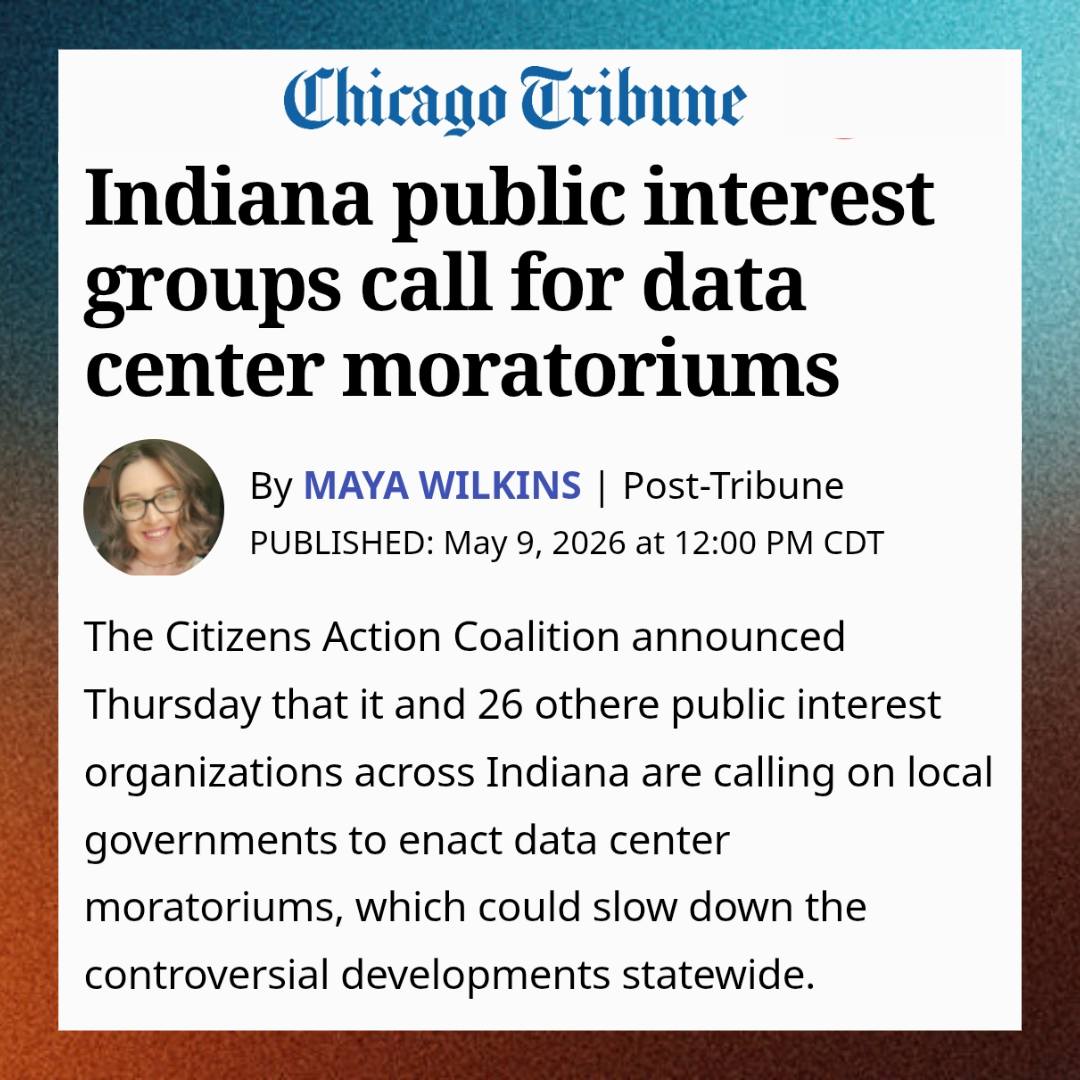 Twenty-seven public interest organizations including CAC issued a press release on May 6 urging local governments across Indiana to immediately enact a moratorium on new data center development, permitting, and construction. The call for a pause on new data centers aims to allow adequate time for reasonable policies and regulations to be enacted that protect Hoosiers from harmful impacts.
Indiana has faced an avalanche of data center proposals, with CAC tracking approximately 60 in the past 2 years. Indiana utilities now have approximately 9,000 megawatts (MW) of new data center load growth under executed contract, based on CAC estimates using public information.
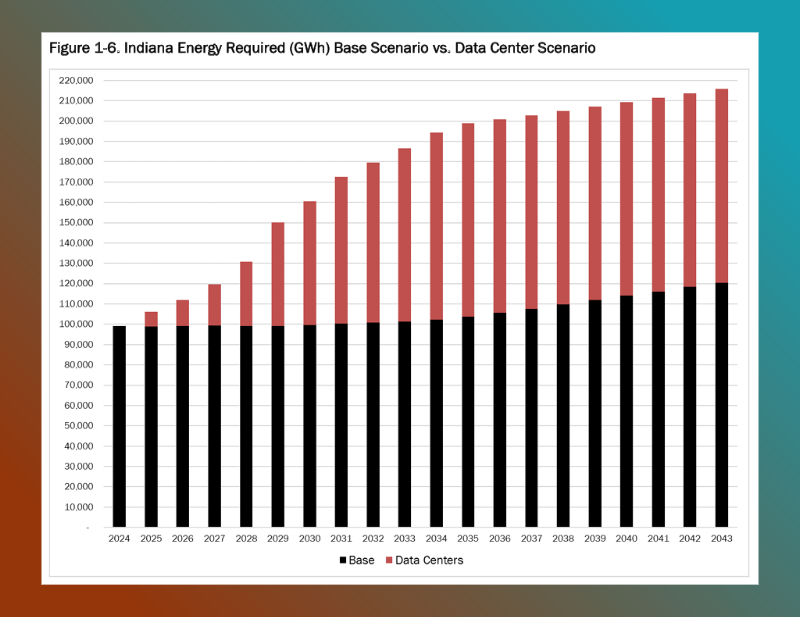 As shown in Figure 1-6, which comes from Purdue's State Utility Forecasting Group, Indiana’s electric utilities are expecting to nearly double statewide electricity consumption within the next decade as a result of new data centers. These new data centers could consume more than twice the electricity used by all Indiana households combined.
CAC’s Take: Since the federal and state governments continue to subsidize and promote data center expansion, it has fallen to local governments to protect Hoosiers from Big Tech and the growing impacts they will have on our communities and the environment. A moratorium is the first step to do so. It allows time for the local government to gather information, hold events to solicit public comment, and analyze impacts. It also allows time for a local government to draft an updated zoning ordinance addressing data centers.
Hoosiers should not be rushed into accepting projects without having adequate information about the project and its impacts in advance, and local governments should use their authority to protect residents.
** NIPSCO Loses $11.5 Million in the MISO Energy Market by Complying with Unlawful Federal Order to Keep Coal Plant Open **
NIPSCO disclosed in a recent U.S. Securities and Exchange Commission filing that it lost approximately $11.5 million through March 31, 2026, to comply with unlawful orders from the U.S. Department of Energy that are forcing it to keep open its Schahfer coal plant, which it had planned to retire at the end of 2025. Specifically, NIPSCO spent an incremental $65.9 million but only made $54.4 million in the energy market during that time, demonstrating the uneconomic coal plant operated at a significant loss despite relatively high market prices.
CAC’s Take: The final cost that will fall on ratepayers associated with the federal government orders is unclear, as NIPSCO has not provided a transparent and complete accounting of its costs to date. For example, it does not appear that NIPSCO has included a profit margin for its shareholders as part of the incremental costs it identified, so these and other costs could get added to the final tab at the time NIPSCO requests to recover the costs from ratepayers.
The Federal Energy Regulatory Commission has already approved NIPSCO’s proposal to spread the costs of continuing to operate the Schahfer coal plant across ratepayers in the Midwest, rather than concentrating it on NIPSCO ratepayers. While this will help lessen the cost burden for Hoosiers in Northwest Indiana, it also means that Hoosier ratepayers will be forced to chip in to pay for out-of-state coal plants, such as the Campbell coal plant in Michigan, for which the federal government has also ordered to stay open. And it means your bill will go up to pay for these unneeded Schahfer coal-fired power plant units even if you aren’t a NIPSCO customer, but rather a customer of Duke, AES, or CenterPoint.
** Utilities Implementing Levelized Billing for LIHEAP Customers in July **
A new law passed during the 2026 Indiana General Assembly, House Enrolled Act 1002, requires that utilities place all LIHEAP-enrolled customers on “levelized” billing for their electric bill by July 1, 2026. Under levelized billing , more commonly referred to as “budget billing,” the electric utility will estimate a customer’s average usage based on how much electricity they used in the past and charge them an electric bill that stays the same, or level, from month to month. Up to twice a year, the utility can update the customer’s monthly bill amount and check to see if past levelized bill payments have been enough to cover its costs. If a customer was paying too much, it will provide a bill credit, and if they were not charged enough, the utility can add a charge to cover that shortfall.
CAC’s Take: Some folks appreciate the predictability of paying the same amount every month, whereas others prefer standard billing based on actual electricity usage. If you are enrolled in levelized billing, it's important to know that (1) levelized billing will not reduce the total amount paid to the utility over time, but will help stabilize the amount paid each month; (2) your utility can add a true-up charge two times each year if you used more electricity than they expected in the prior months; and (3) you have the right to opt out of levelized billing and only pay each month based on your actual usage if you prefer.
Contact your electric utility if you have questions or would like to opt-out of levelized billing.
Hoosiers that are not LIHEAP-qualified will not be impacted by this change, but have the option of enrolling in levelized billing by contacting their electric utility.
Data Center Digest
-
Latitude Media profiled organizing in the Hoosier state in a recent profile, In Indiana, an Anatomy of Data Center Opposition.
-
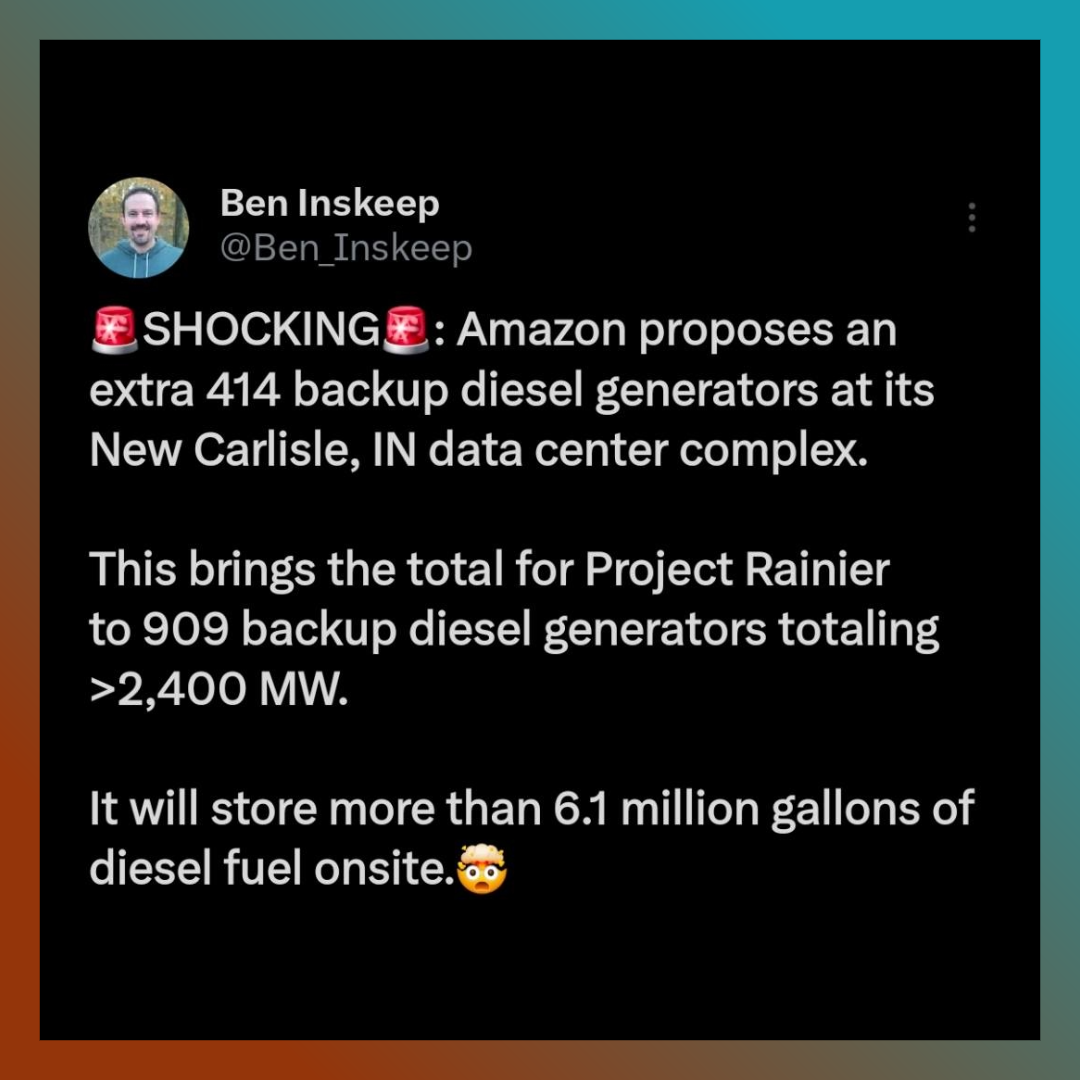 Amazon submitted an application to IDEM requesting to add an additional 414 backup diesel generators at its New Carlisle data center campus. If approved, the New Carlisle campus would have 909 backup diesel generators totaling more than 2,400 megawatts with more than 6.1 million gallons of diesel stored onsite. An opportunity for public comments will open after IDEM reviews the application and publishes a draft permit.
 -
Amazon is proposing to destroy about 5 acres of wetlands and nearly 1 mile of streams to build an additional 14 data center buildings on a third parcel at its sprawling New Carlisle campus, according to an IDEM Public Notice.
Public comments are due June 12.
-
The Washington City Council in Davies County unanimously voted to cancel all dealings with Outrigger Industrial, which had proposed a 500 megawatt data center, citing a lack of transparency by the developer, Indiana Public Media reported. The Washington City Council then unanimously approved a motion to consider a moratorium on any data center developments in the future.
-
The City of Valparaiso issued a draft data center ordinance that would establish 55 decibel sound limits, a 1,000-foot setback, and a vibration limit, while prohibiting data centers in all zoning districts except by special exception in heavy industrial zones.
-
A data center being developed in Sullivan County is facing criticism after promising to use local union labor, but then relying on out-of-state contractors, local media reported.
-
The LaPorte City Council unanimously approved annexation of nine parcels of land that will be used by Microsoft for a second data center, located adjacent to Microsoft’s other data center under construction in the city, local media reported.
-
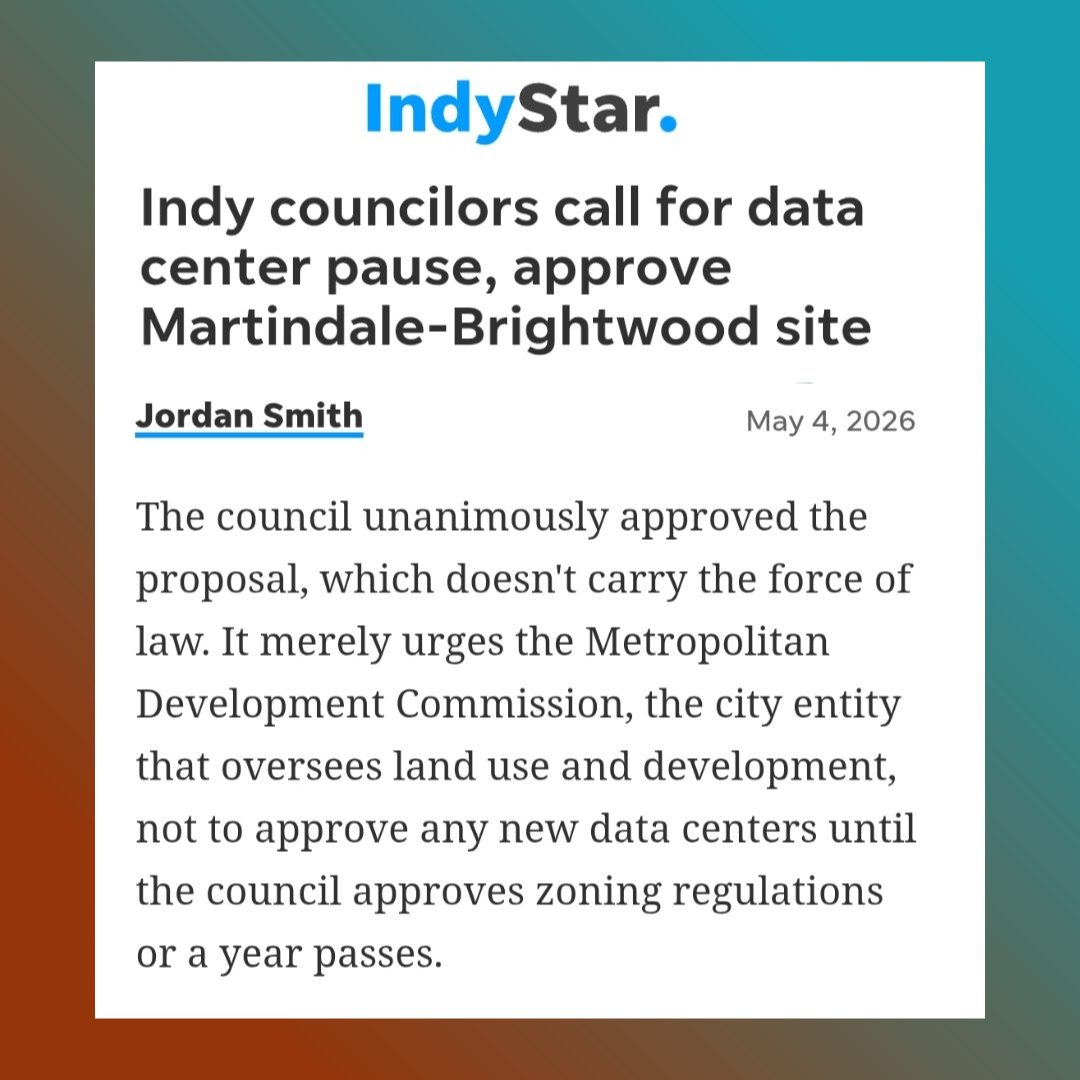 The Indianapolis City County Council unanimously passed a resolution calling on the City’s Metropolitan Development Commission (MDC) to issue a moratorium on approving new data centers, Mirror Indy reported.
However, the MDC does not have to follow the Council’s resolution, and is considering a data center ordinance with weak protections for Indianapolis residents, such as allowing 65-decibel noise and only requiring a 200-foot setback from residences. The MDC is expected to discuss the proposal at its July 1st meeting.
Visit citact.org/act.indy.dc.moratorium to send a message to Indy officials urging them to implement a data center moratorium instead of weak regulations!
CAC Shoutout
 CAC gives our June shoutout to our Hoosier colleagues at Just Transition Northwest Indiana (JTNWI). JTNWI is a grassroots environmental justice organization that serves Northwest Indiana. JTNWI has been raising the alarm about toxic coal ash, pushing for a clean energy transition, and helping communities stop dirty data centers. Check out Just Transition's Facebook page to stay informed about their great work!
Speaking of dirty data centers, next up on JTNWI’s calendar is the June 3 IDEM virtual public hearing on an air permit for NIPSCO’s massive 2,600 megawatt gas plant planned for Wheatfield. The entirety of the power plant has been tapped for new Amazon data centers planned for places like Hobart.
CAC in the News
-
 CAC was quoted in a Reuters article about the proliferation of Construction Work in Progress (CWIP), a policy that allows utilities to raise utility bills to pay for new power plants and equipment years before they are fully constructed. CAC Program Director Ben Inskeep explained that “CWIP incentives are adding insult to injury” for Hoosiers struggling with recent huge rate increases.
 -
 CAC was mentioned in a Canary Media profile about Wheatfield, IN, where NIPSCO’s coal-fired Schahfer plant continues to operate under an unlawful emergency order, NIPSCO is building a 400 megawatt (MW) gas-fired peaking power plant for ratepayers, NIPSCO's subsidiary, GenCo, is building a 2,600 MW gas-fired power plant for Amazon’s data centers, and a data center is being developed. The article notes that CAC Organizer Bryce Gustafson “had already helped Indiana residents fight dozens of data center proposals elsewhere in the state.”
 -
CAC’s analysis of AES Indiana’s profit margin was noted by the Associated Press. CAC Program Director Ben Inskeep characterized the pending AES Indiana rate case as the first big test for new IURC commissioners, noting slashing their profit margin could have substantial ratepayer affordability benefits.
-
 CAC was quoted in an IndyStar article about the dirty coal- and gas-fired power plants that will be relied upon to power the massive amounts of energy data centers need. Our Program Director Ben Inskeep highlighted the transparency challenges we face in filings at the indiana Utility Regulatory Commission. “'Some information is public, other is secretive,' said Ben Inskeep, the program director for Citizens Action Coalition, an Indiana-based utility watchdog group that has been organizing against hyperscale data center development."
 -
 CAC was quoted in an Indiana Public Media article about the utility affordability challenges data centers could make even worse. CAC Executive Director Kerwin Olson discussed seeing the tide shift in terms of utility control at the Statehouse. “Having spent over 20 years at the Indiana Statehouse, this was the first time that I've seen the utilities on their heels a little bit, not in total control,” he said. Although many utilities and state leaders are verbalizing the desire to prevent data centers from raising everyone else’s electric bills, Kerwin said “It's premature for anybody to sort of say, ‘We've got this figured out, data centers are paying their fair share,’ when there's a whole lot more work to be done.” He added, “There’s a lot of filings that are going to be made, and a lot of costs that are going to grow.”