Citizen Power | July 2026
Commission Upheaval Following AES Indiana Rate Hike Firestorm ~ News & Views ~ Data Center Digest ~ CAC Shoutout ~ CAC in the News
Commission Upheaval Following AES Indiana Rate Hike Firestorm
The Indiana Utility Regulatory Commission (IURC) was thrust into the spotlight in June following its decision in the AES Indiana rate case (details below) -- and not in a good way. The IURC approved another steep rate hike, at odds with the Indiana Office of Utility Consumer Counselor’s (OUCC) recommendation and CAC’s support for a rate decrease.
Consumer Counselor Abby Gray, who was tapped last year by Governor Braun to lead the OUCC after decades of public service, called the order “an outrage.” Governor Braun quickly chimed in to express deep disappointment and say the decision was unacceptable, calling for a rehearing of the decision.
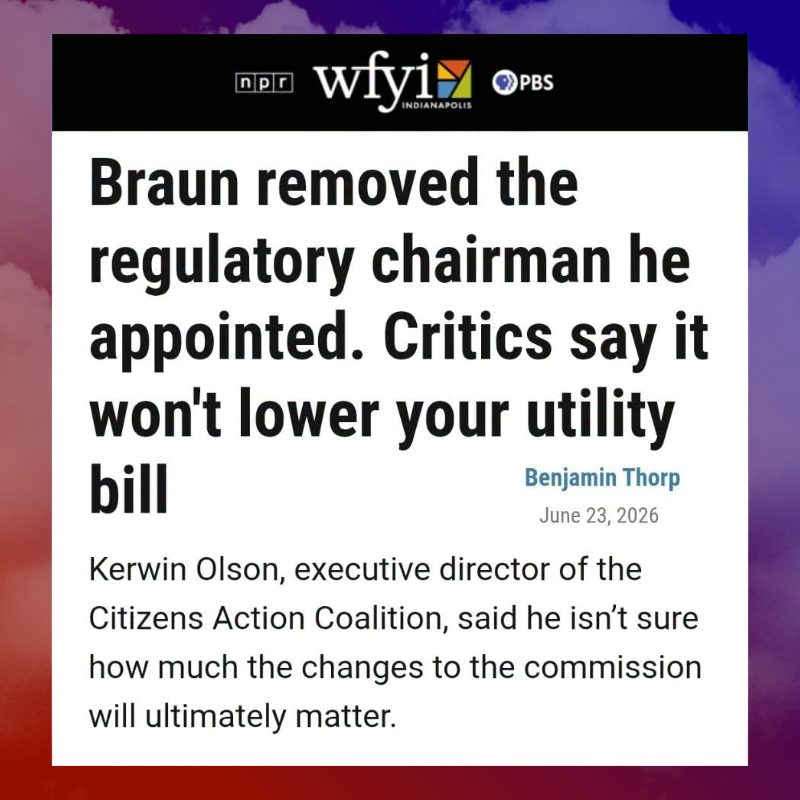 The direct, public rebuke of the IURC after its order was followed five days later with a tweet from Governor Braun stating that he was promoting current Commissioner and former long-time OUCC staff member Anthony Swinger to Chairman of the IURC effective immediately, resulting in the demotion of then-Chairman Andy Zay to Commissioner. Former Chairman Zay had supported the AES Indiana rate hike.
Soon after, Commissioner David Veleta, who also voted in favor of the AES Indiana rate hike, announced his resignation from the IURC effective August 31, 2026, or sooner should his replacement be ready to assume the role. Applications are due July 7, 2026.
On the one hand, it’s refreshing to have a governor emphasize residential affordability in the utility context and take swift action when his appointees fail to follow through on that objective. After all, Hoosiers have seen many gubernatorial administrations do little, if anything, to mitigate rising affordability concerns while their commissioners rubber stamp utility rate hike after rate hike. We certainly need action.
On the other hand, the increased politicization of IURC orders and political interference with the IURC’s ostensibly independent decision-making raises serious concerns. It could also distract from addressing some of the root causes of our affordability crisis and the need for major reform to our utility and energy laws. It’s hard to complain when the Governor wields his immense political power to do something you support. But that power can, and has, cut both ways.
 For example, prior to being elected to his current position, then-gubernatorial candidate Senator Braun urged the IURC to reject the conversion of AES Indiana’s Petersburg Units 3 and 4 from coal-fired to gas-fired. Fortunately, the IURC did not adopt his recommendation, which would have been costly for AES Indiana customers and disastrous for our environment.
We need regulators who are willing to issue orders that put the public interest first, above their own personal interests and the special interests of industry and political party. But we also desperately need our lawmakers to fix the underlying policies that have tied the IURC’s hands, have drastically tipped the scales in favor of the utilities, and have caused steep increases in Hoosier utility bills.
In solidarity,
The CAC Team

News & Views
 ** IURC Approves AES Indiana Rate Hike **
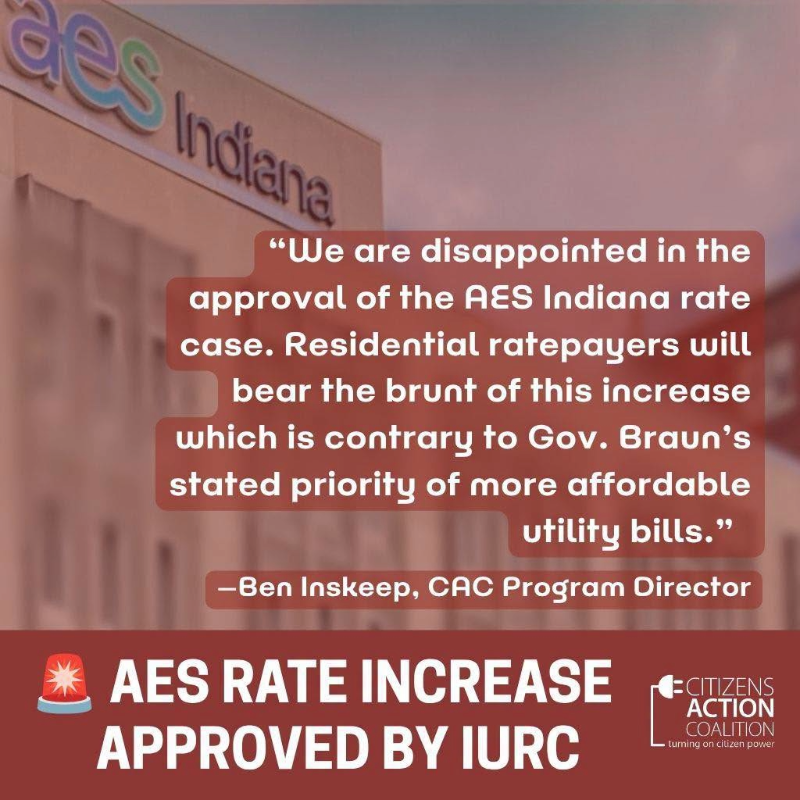
The IURC issued a final order in AES Indiana’s rate case, approving, with modifications, a sweetheart deal between the utility, the City of Indianapolis, and several of its largest customers.
According to an email sent by AES Indiana to customers, the order will result in residential monthly electric bills for 1,000 kWh of usage increasing by less than $1 per month beginning in July and then by a whopping $8.50 per month in January 2027.
The Commission made two changes to the settlement agreement between AES Indiana and its large power users. First, the IURC reduced the utility return on equity, or profit margin for shareholders, from 9.75% under the Settlement to 9.50%. Second, the IURC reduced AES Indiana’s budget for vegetation management, or tree trimming, from $36.6 million to $25.2 million. These changes reduced the total annual rate increase from $90.7 million under the settlement to $71.1 million.
Chairman Zay was the only Braun appointee to vote in favor of the AES Indiana rate hike, with Commissioner Dieg dissenting, and Commissioner Swinger recusing himself due to his past participation in the case when he worked at the OUCC. Commissioners Veleta (appointed by Gov. Holcomb in 2022) and Ziegner (appointed by Gov. Bayh in 1990) also approved the rate hike. The OUCC has stated that it is in the process of drafting a petition for reconsideration to challenge the Order.
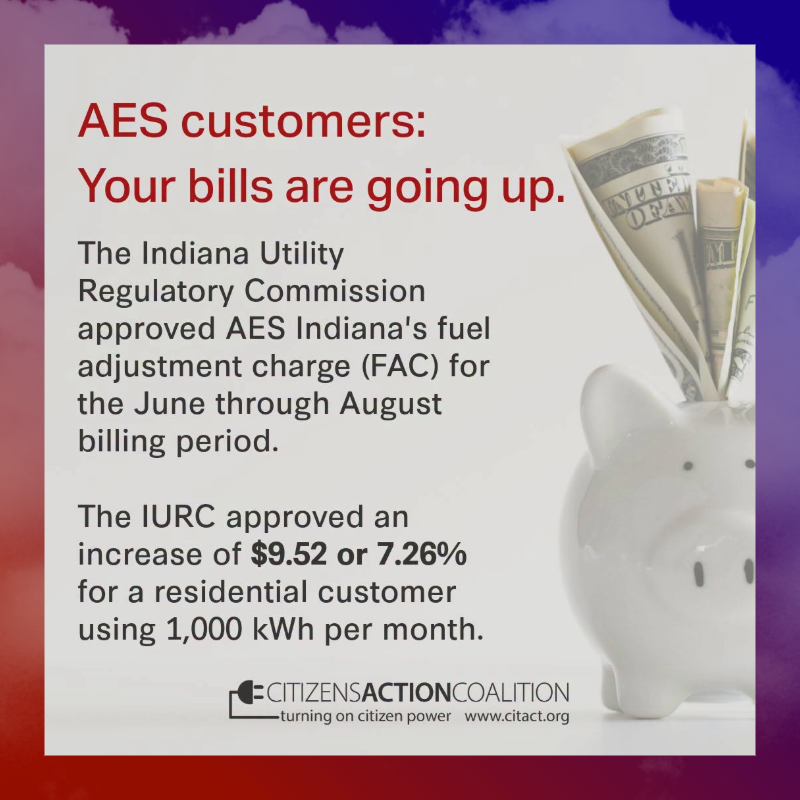 In separate fuel adjustment clause proceedings, which address a bill surcharge - also referred to as a tracker or rider - that applies on top of base rates, AES Indiana received IURC approval for a $9.52 per month increase on residential bills for June through August 2026, and AES Indiana has applied for an additional $8 per month increase that would apply to bills in September through November 2026. To be clear, these surcharge increases are above and beyond the increase approved in the rate case.
CAC’s Take: This AES rate case was a key test for the IURC and it failed the test. The Commission had received an unprecedented outpouring of opposition from AES customers to elected officials. There was a robust record demonstrating that AES Indiana has provided unacceptably poor service to ratepayers, including failing to send accurate and timely bills, auto-withdrawing unauthorized payments from customer bank accounts, and charging thousands of customers a security deposit that was higher than authorized by law.
Recent AES Indiana filings show it is not only financially healthy, but earning excessive profits above its authorized level. And the settlement cut by AES Indiana was only with its large power users, sticking households with the largest rate increase of any type of customer. If there ever was a time for the Commission to reject a rate increase, this was it. While the IURC's order was outrageous, the fallout has been unprecedented and suggests the tide could be turning against more utility rate hikes.
** IURC Approves NIPSCO-Amazon Sweetheart Deal **
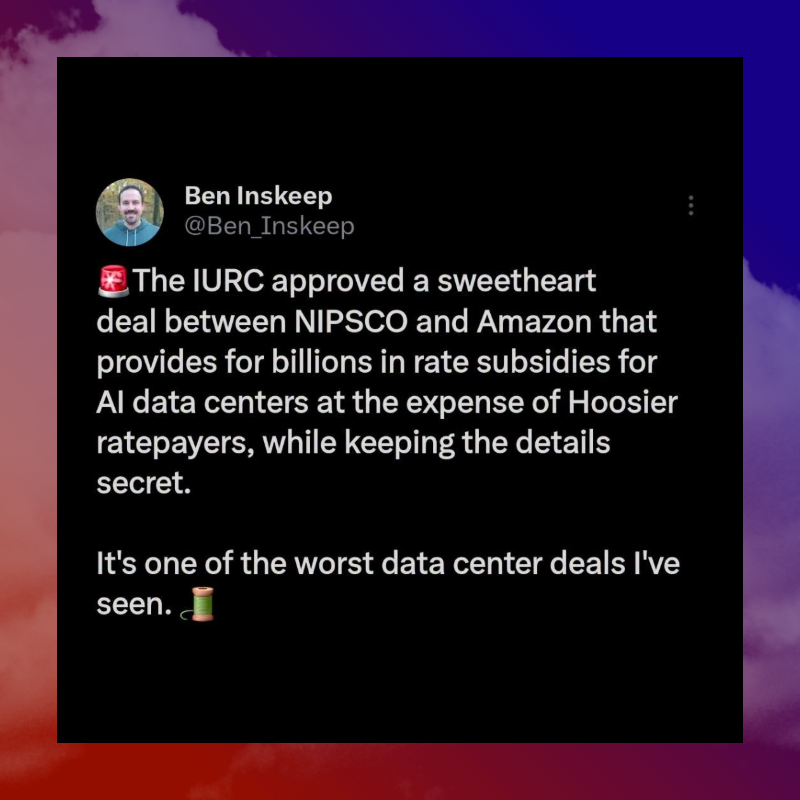 While media attention was focused on the AES Indiana rate case decision, the Commission issued two separate orders that same day approving a special contract between NIPSCO and Amazon for 2,400 megawatts (MW) of data centers – one of the largest agreements between a utility and Big Tech company in the nation – as well as a massive 2,600 MW gas-fired power plant at Schahfer and a 400 MW battery to be owned by GenCo to serve Amazon’s facilities.
CAC’s Take: CAC opposed the backroom deal cloaked in secrecy between Amazon, NIPSCO, and GenCo (the NiSource subsidiary that is building power plants for data centers). The deal keeps the rates, terms, and contracts between NIPSCO-Amazon and NIPSCO-GenCo secret indefinitely. CAC entered into an NDA with NIPSCO in this case in order to be able to review the confidential information and present detailed analysis and evidence opposing the deal. CAC calculated NIPSCO’s deal would result in Amazon shortchanging NIPSCO ratepayers by approximately $2 billion over the contract relative to the transmission rates paid by very large industrial customers like steel mills. Furthermore, the massive gas-fired power plant being built to power Amazon will result in large amounts of new pollution, use approximately 16 million gallons of water per day, and could drive gas and electric prices higher for other consumers.
Data Center Digest
 Moratorium Update
-
Cities and towns are increasingly adopting moratoria on data centers as well:
A proposal for a 1-year moratorium has advanced in New Albany.
The Town of Merrillville and the Town of Ingalls enacted a 1-year moratorium.
Previously, the Indianapolis City-County Council passed a non-binding resolution recommending a data center moratorium.
-
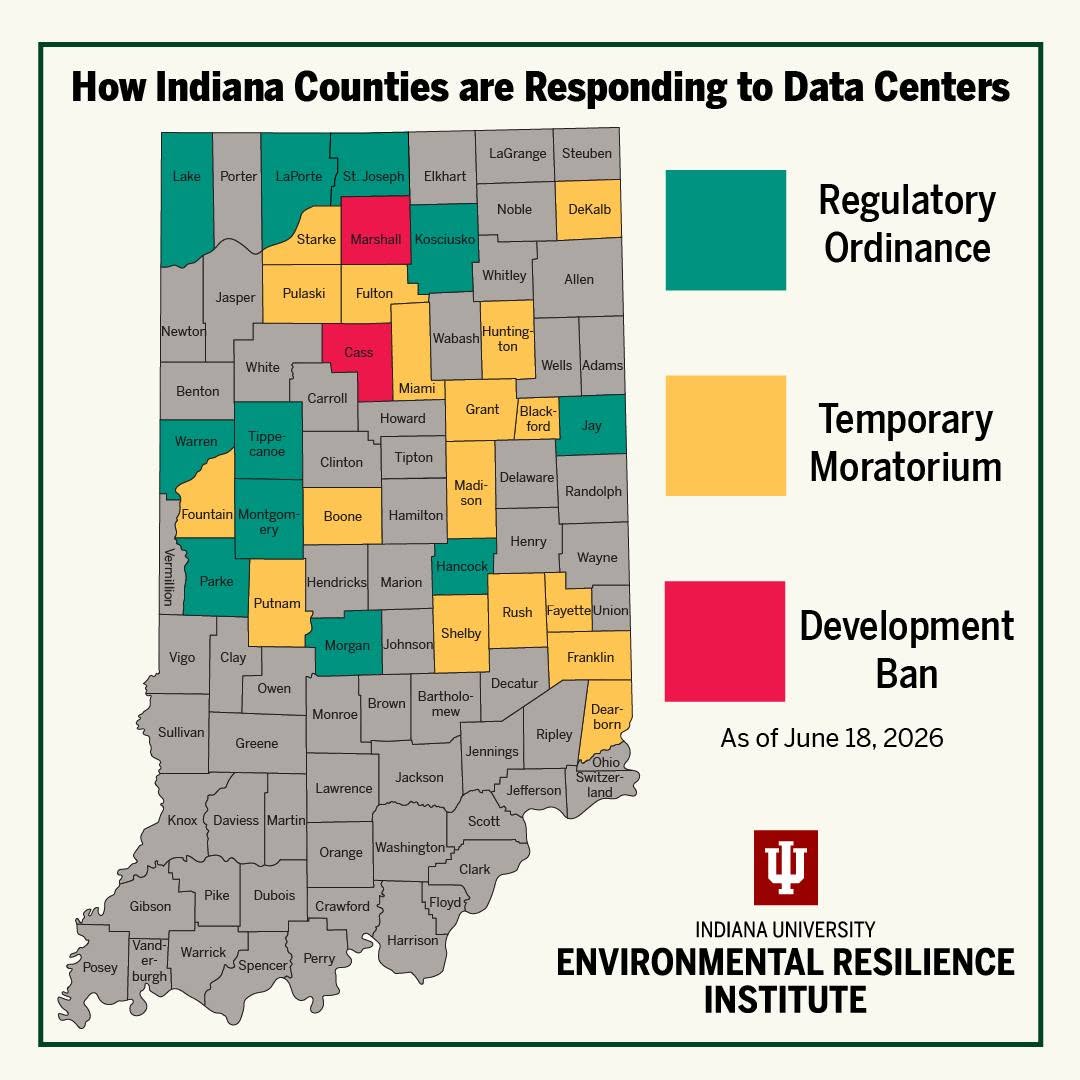
19 counties in Indiana have now passed a moratorium or ban on data centers.
In June, Boone County Commissioners enacted a 1-year data center moratorium. However, it will not apply to the 1,000 MW Meta data center under construction in Lebanon.
Madison County Commissioners also unanimously passed a six-month data center moratorium.
-
The IU Environmental Resilience Institute published a map showing counties in Indiana that have enacted ordinances, temporary moratoriums, and development bans on data centers.
Data Center Project Updates
-
In Clay County, a ~400 MW gas-fired power plant that will serve a mysterious, unidentified data center started construction after receiving an air pollution permit from IDEM, yet county commissioners say they were not informed of the project in advance and oppose data centers.
-
In Jasper County, local officials announced Amazon is moving forward with a data center called Project Rise on 304 acres owned by NIPSCO near the Schahfer Generating Station, the site of several NIPSCO coal- and gas-fired power plants, and where GenCo is building a 2,600 MW gas-fired power plant to serve Amazon’s data centers in northwest Indiana.
Amazon will provide $98 million in upfront funds, as well as more than $23 million in new annual revenue for 10 years of full operation. CAC research uncovered that the data center could use 800 MW of power, and that it is planning to have 14 buildings, rather than 9 buildings as initially announced.
Amazon has applied for an air pollution permit for 391 backup diesel generators (1,061 MW) with 2.7 million gallons of diesel storage capacity.
-
In Indianapolis, the Metropolitan Development Commission’s (MDC) hearing examiner recommended approval of the DC Blox data center, which would be located near Irvington across Pennsy Trail from an elementary school.
The project now heads to the full MDC for a vote on the proposed variance. DC Blox has come under national scrutiny after country music star Brad Paisley spoke out against its proposed data center in Tennessee that is next door to the Nashville Zoo, which also strongly opposes it.
-
In Indianapolis, a small data center has operated for approximately 16 years without a required air pollution permit from IDEM, IndyStar confirmed after first being reported by CAC. IndyStar also confirmed that the data center is not receiving any fines or penalties, and that the owner failed to get a required air pollution permit for a separate small data center in Fort Wayne.
Other News
-
 Shelbyville Mayor Scott Furgeson was caught on camera in early June insulting his constituents opposed to data centers, saying “I’ve seen a lot of these [anti-data center signs] all over the town, but I only see them in shitty houses.” Mayor Furgeson did not apologize in his initial statement released on June 3, but after growing backlash, he apologized in a June 17 video.
 -
In Michigan, Governor Gretchen Whitmer was caught on a hot mic dismissing resident concerns about a highly controversial data center in Saline Township in a conversation with an Oracle executive at a data center ribbon cutting, saying “We’re used to people saying ‘f*** no,’ and then doing it anyway.”
-
States across the country are considering pausing or repealing lucrative data center subsidies.
-
The U.S. Department of Justice argued that xAI is “vital” for national security in a legal filing looking to dismiss a lawsuit filed by the NAACP against Elon Musk’s company for failing to get required air pollution permits for the gas-fired power plants powering the trillionaire’s AI chatbot.
-
The federal government invoked the Defense Production Act to approve $27 million in subsidies for the Merom coal-fired power plant. NIPSCO GenCo has signed a capacity agreement to use the coal plant to serve Google and Amazon data centers in Indiana.
-
New research finds that working class neighborhoods are resisting data centers at five times the rate of wealthy neighborhoods, and data centers that faced community pushback were canceled or suspended at more than five times the rate of data centers that did not face community push back.
CAC Shoutout
 CAC gives a shoutout to our friends at Solar United Neighbors (SUN). In Indiana, SUN helps Hoosiers go solar, join together, and fight for their energy rights.
Right now, SUN is working to help Hoosiers save money on their utility bills through solar co-ops. A solar co-op helps homeowners learn about solar and purchase panels at a group rate from a single installer. A group of volunteers from the co-op will select a solar company to complete the co-op's installations.
Learn about solar energy and its benefits for your home, or small business at one of SUN's Solar 101 workshops! They’ll take you through the technology, economics, financing and more. You’ll also learn about the Solar Co-op in your area. These educational workshops are free to join, and participants are not obligated to purchase anything.
|
Zionsville Solar 101 |
Carmel Solar 101 |
CAC in the News
-
 CAC was quoted in a Fox 32 Chicago article about Hoosiers calling on Governor Braun to implement a data center moratorium during a private event in Merrillville. "What we've seen is big industry getting the red carpet rolled out for them year after year. We put big corporations on a pedestal and throw Hoosiers to the wolves. So I don't think they're looking out for the everyday Hoosier," said our organizer Bryce Gustafson, when asked if public officials are working for the people of Northwest Indiana.
 -
CAC was mentioned in an Indiana Capital Chronicle article about Duke Energy’s egregious plot to overcharge ratepayers by tens of millions of dollars.
-
CAC was mentioned in an American Prospect article about AES Indiana’s upcoming acquisition by BlackRock.
-
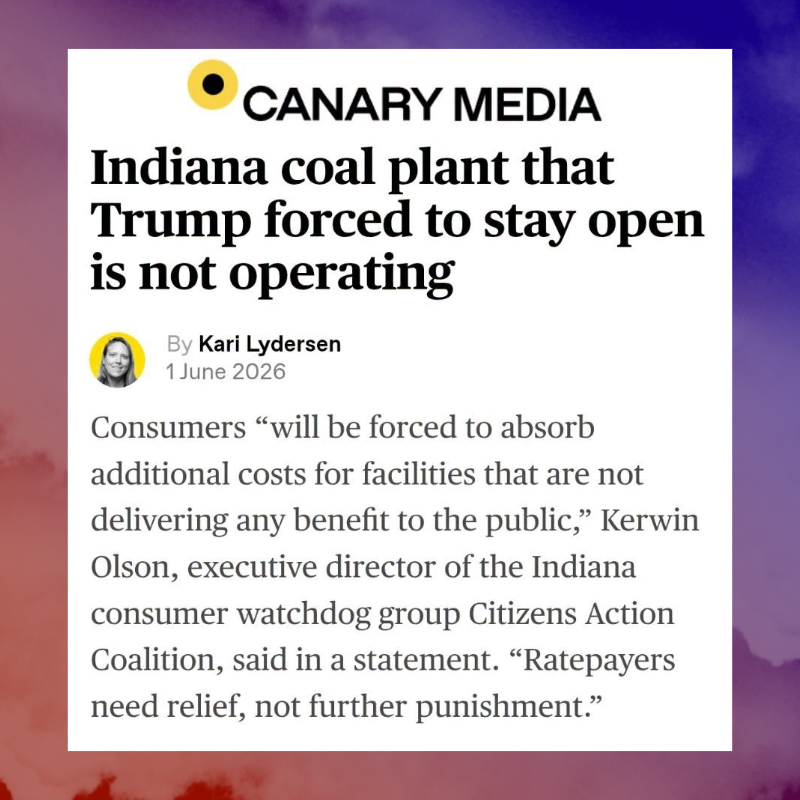 CAC was quoted in a Canary Media article about the uneconomic Schahfer coal plant that the Trump administration is forcing to stay open. Consumers “will be forced to absorb additional costs for facilities that are not delivering any benefit to the public,” said CAC Executive Director Kerwin Olson. “Ratepayers need relief, not further punishment.”
 -
CAC was quoted in a Tri-State Home Page article about local opposition to data centers in Posey County. When asked why data centers are coming to Indiana, our organizer Bryce Gustafson explained that in 2019, our Statehouse passed a law that gives data center developers up to 50 years of sales tax exemptions.
We were quoted in quite a few articles about the IURC mess:
-
Braun Removes IURC Chair after Commission’s AES Indiana Rate Hike
-
Braun Removed the Regulatory Chairman He Appointed. Critics Say It Won't Lower Your Utility Bill
-
Braun Removes Indiana URC Chair After $71M AES Rate Increase Approval