Citizen Power | August 2026
Hoosier Resilience ~ News & Views ~ Data Center Digest ~ CAC Shoutout ~ CAC in the News
Hoosier Resilience
 Many Hoosier communities are increasingly overwhelmed, facing difficult choices due to a lack of resources and familiar patterns of corporate exploitation:
-
Hoosier communities are facing an imminent budget crisis as a result of the massive business property tax reductions the General Assembly handed out in Senate Enrolled Act 1 (2025).
-
The General Assembly has increasingly asserted its power to remove local government authority while allowing environmental degradation and utility greed to fester.
-
Carbon capture and sequestration projects are being planned without adequate consideration of long-term impacts and nearby landowners and residents.
-
And now hyperscale AI data center proposals are proliferating across the state, keeping polluting coal open, spurring construction of large new natural gas power plants, and leading to talk of Indiana’s first nuclear power plant.
We are now at a critical juncture. As exploitation of Hoosier communities is being turbo-charged, affordability has become a top political issue, and data center opposition has swelled. We have an opportunity to reverse course and prioritize Hoosiers. The next year will solidify our state’s trajectory in many key areas.
 Thank you for supporting CAC’s consumer and environmental advocacy at such an important time.
In Solidarity,
The CAC Team

News & Views
**Governor Braun, Indiana Utilities Sign Unenforceable “Ratepayer Protection Pledge”**
Governor Braun joined 22 other state governors in signing the White House’s non-binding “Ratepayer Protection Pledge” that claims to include provisions to protect utility ratepayers from rate hikes caused by data centers. Indiana Michigan Power, Duke Energy, CenterPoint, NiSource (parent company of Indiana utility NIPSCO), and AES Corp. also signed the pledge. Previously, large Big Tech companies signed the pledge.
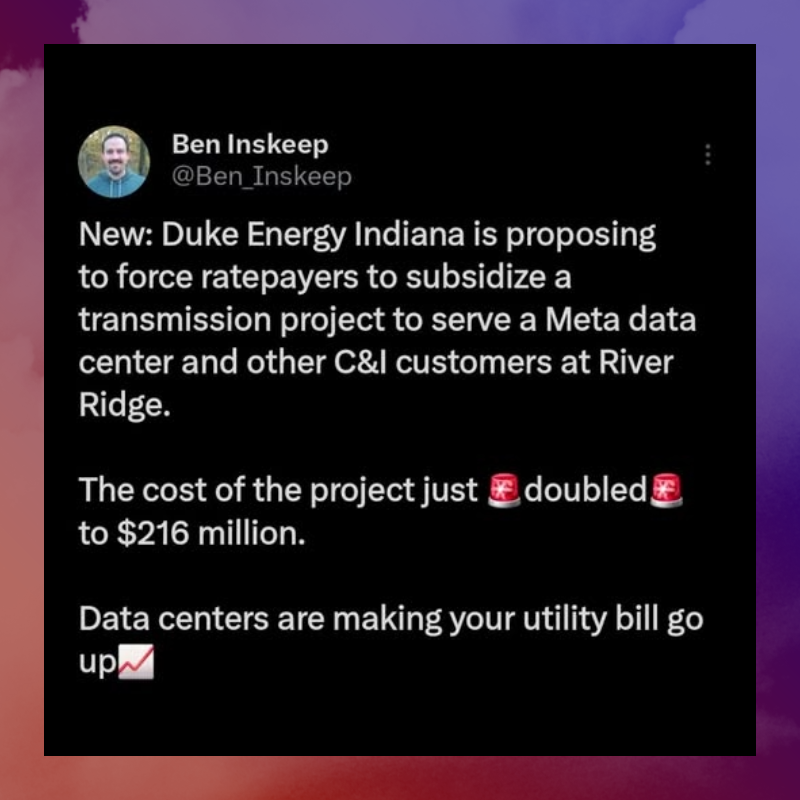 CAC’s Take: The toothlessness of these voluntary promises is on full display in Indiana, where none of Indiana’s electric utilities, Big Tech companies, or the Governor’s appointees to the Indiana Utility Regulatory Commission (IURC) are adequately implementing the pledge, leading to Hoosier households being forced to subsidize new data centers through our electric bills.
The egregious cost-shifting is rampant across the state.
Examples include:
-
$2 billion in rate subsidies provided by NIPSCO to Amazon in IURC Cause Number 46322
-
More than $400 million in data center interconnection upgrades for Google and Amazon socialized onto I&M customers in IURC Cause Number 46301
-
More than $215 million in data center interconnection upgrades for Meta socialized onto Duke ratepayers in IURC Cause Number 45647 TDSIC 5
Meanwhile, the data center demand shock is causing the prices paid by all consumers to rise for grid equipment, new power plants, and wholesale electricity and capacity.
**Commission Releases Affordability Report; Opens Rulemakings**
 The Indiana Utility Regulatory Commission (IURC) published its Energy Affordability Report as part of its informal affordability investigation that previously included a 10-city listening tour and an all-day technical conference featuring presentations by utility executives.
The report includes:
-
A request to utilities to double their customer assistance program funding.
-
Mention of the opening of a formal IURC investigation to examine utility return on equity (i.e., profit) under multi-year rate plans in Cause Number 46428.
-
Mention of the opening of a formal IURC investigation to examine the use of trackers in Cause Number 46429.
-
Recommendation to the State to secure additional federal funding - but did not mention how the federal government awarded but then rescinded a $117 million in Solar for All grant that would have helped Hoosier households get access to affordable, clean energy.
Finally, the report made several recommendations for the General Assembly that CAC supports:
-
To evaluate repealing the 7% sales tax on utility bills.
-
To change the law to give IURC oversight of utility mergers and acquisitions at the holding company level (as Indiana is one of the few states without this oversight authority).
-
To require utilities to be members of regional transmission organizations, which would reduce their transmission rates by removing a profit adder given to utilities who are not required to be members. All of Indiana’s investor-owned utilities are already members of an RTO (either PJM or MISO).
CAC’s Take: The report makes some good recommendations, particularly for legislation the General Assembly should consider. CAC also appreciates the two investigations opened by the IURC and has filed to intervene in those cases. The brief report, however, did not provide many details. It did not define or even characterize trends in energy affordability in Indiana, for example. We appreciate the IURC’s renewed focus on affordability and we will continue to advocate for meaningful changes to improve outcomes for Hoosiers.
**New IURC Commissioner Appointed**
Gov. Braun appointed Joby Jerrells as a Commissioner to the Indiana Utility Regulatory Commission to replace outgoing Commissioner David Veleta. Commissioner Jerrells previously worked as chief counsel of the Indiana Attorney General Advisory Division.
CAC’s Take: With the selection of Commissioner Jerrells, Gov. Braun has now replaced four out of five members of the IURC. Gov. Braun has made affordability a clear priority for his administration. Although the General Assembly has passed a slew of legislative rate hikes over the past two decades at the behest of Indiana’s monopoly utilities, the IURC still retains significant discretion in numerous areas where it can choose to prioritize affordability over utility greed.
**CAC and OUCC Ask IURC to Reconsider Disastrous AES Rate Case Order**
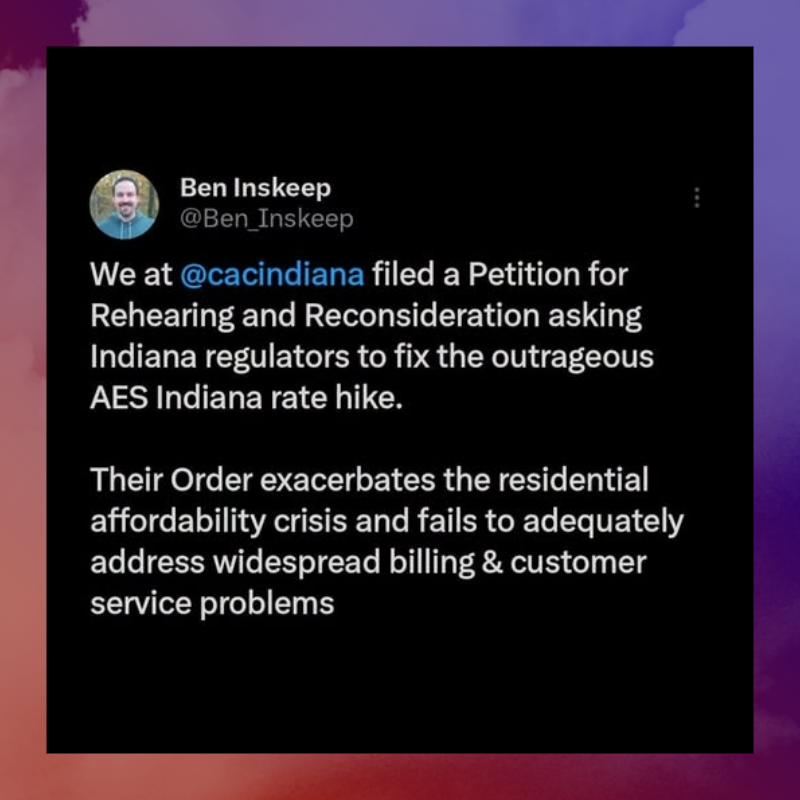 CAC filed a petition for rehearing and reconsideration of the IURC’s Final Order in the AES Indiana rate case. CAC argued that the Final Order does not adequately address several key issues, including:
-
Ongoing customer service deficiencies
-
Cost allocation - the Final Order sticks households with the largest rate increase of any type of customer, forcing Hoosier households to subsidize the electric bills for large industry and commercial businesses.
-
Regressive declining block rates, an absurd and regressive rate structure that forces those who use the least energy to pay the highest rates per kilowatt hour.
Second, CAC requested the IURC reopen the case to consider the impact of the BlackRock-led acquisition of AES Corp. and the Google data center under construction in Monrovia, as both issues only arose after the record in the case was closed.
The Office of Utility Consumer Counselor (OUCC) also requested the IURC reconsider its decision, as well as filing an appeal in court. Subsequently, CAC and OUCC joined forces to file a reply to the response to the petitions for reconsideration by AES Indiana and Walmart.
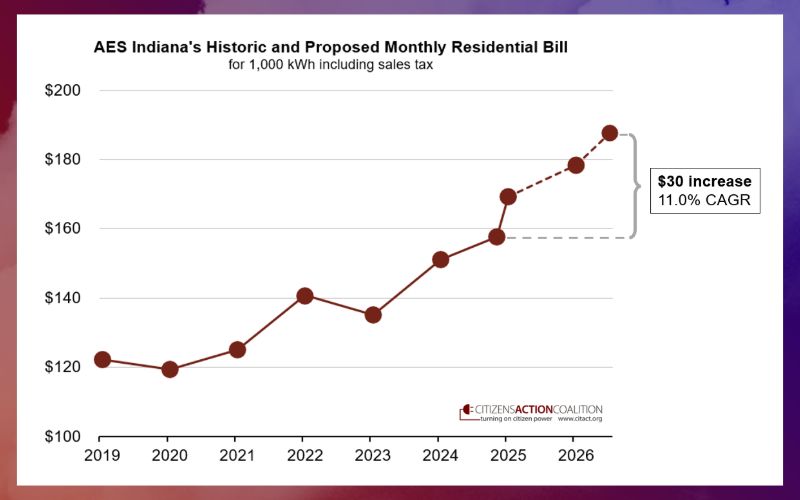 CAC’s Take: AES Indiana residential bills for 1,000 kWh have increased from $135 per month as of July 2023 to $178 per month as of July 2026, inclusive of sales tax, according to the IURC Electric Residential Bill Survey – a $43 per month increase in 3 years. Bills will increase to $188 per month by early 2027 as a result of the Final Order (see graph), based on AES Indiana projections. The Commission has until September 8 to respond to the CAC and OUCC petitions for rehearing.
Data Center Digest
Project Updates
-
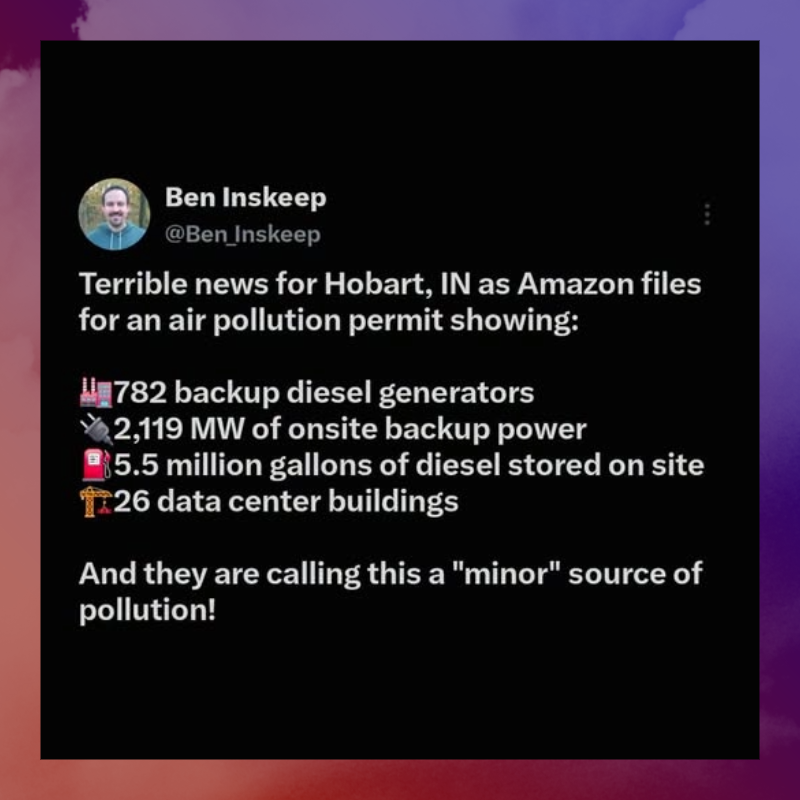 The Amazon data center campus in Hobart filed an IDEM permit application for 782 backup diesel generators totaling 2,119 megawatts of power for 26 planned data center buildings. The site will house approximately 5.5 million gallons of diesel storage capacity.
 -
Microsoft filed separate applications with IDEM for 50 backup diesel generators (142.5 MW) at its Granger and La Porte data center campus sites that are under construction.
-
Hoosiers living near Meta’s data center under construction in Lebanon call it a “nightmare,” detailing 24/7 lights, noise, dust, vibration, and traffic. IDEM even sent a Violation Letter identifying fugitive dust generated from the ongoing excavation and construction associated with the data center.
Things are about to get worse for the project’s neighbors, as IDEM issued a draft permit for 134 megawatts (MW) of methane gas-fired power comprised of 65 methane gas-fired Caterpillar engines, half of which would be installed immediately, and the remainder potentially in May 2027. The facility will serve as bridge power until transmission projects can be completed to connect it to the grid and maintain reliability as it scales up to 1,000 MW.
IDEM is holding a virtual hearing on August 6, and public comment is due August 8.
-
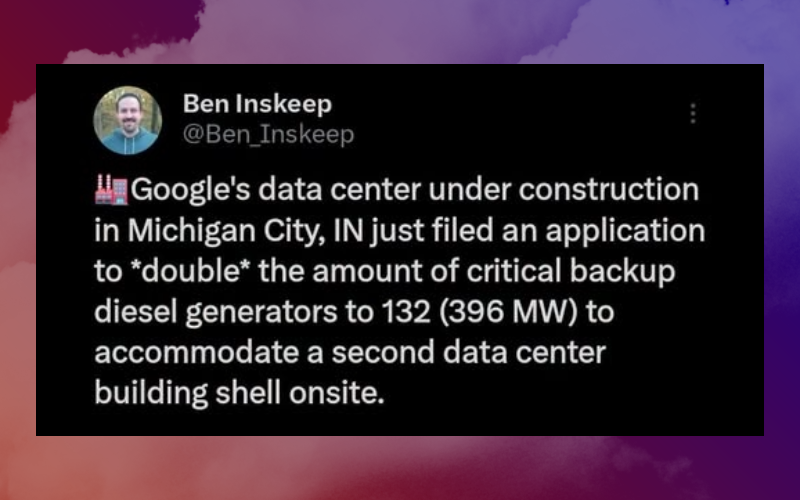 The Google data center in Michigan City filed an air permit application at IDEM to double the amount of critical backup diesel generators to 132 (396 megawatts) to accommodate a second data center building onsite.
 -
The Google data center in Monrovia is raising concerns about AES Indiana’s potential use of eminent domain to site new transmission lines to connect the facility to the grid and maintain grid reliability.
Local Updates
-
The Indianapolis Star reported that the Indianapolis Metropolitan Development Commission (MDC) staff initially told Metrobloks that it planned to recommend denial of its data center project in Martindale Brightwood. However, 12 days later MDC staff flipped and recommended that the MDC approve the data center. MDC staff are now supporting a $395 million property tax subsidy for the Metrobloks data center. At a projected 35 permanent jobs, the subsidy is equivalent to $11.3 million permanent jobs created. The MDC will consider the property tax subsidy proposal at its August 19th meeting.
-
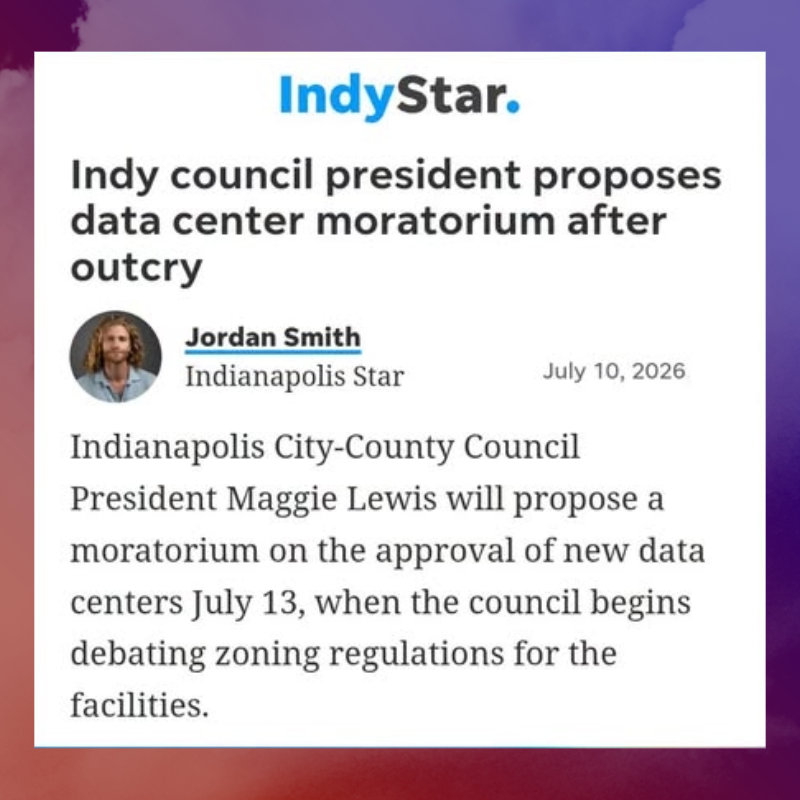 The Indianapolis City-County Council Metropolitan and Economic Development Committee advanced a data center moratorium, with the backing of Council President Maggie Lewis and Mayor Joe Hogsett. The full City-County Council is anticipated to vote on the moratorium as early as August 10. If approved, the proposal will go back to the Metropolitan Development Commission (MDC) for consideration. The MDC is anticipated to consider the amendment as early as August 19.
Unfortunately, the proposed Indianapolis data center moratorium does not apply to projects that have already been approved or requested approval. In fact, the Metropolitan Development Commission approved a variance for DC Blox, allowing the Indianapolis data center to move forward despite widespread and vocal community opposition and pending moratorium proposal.
-
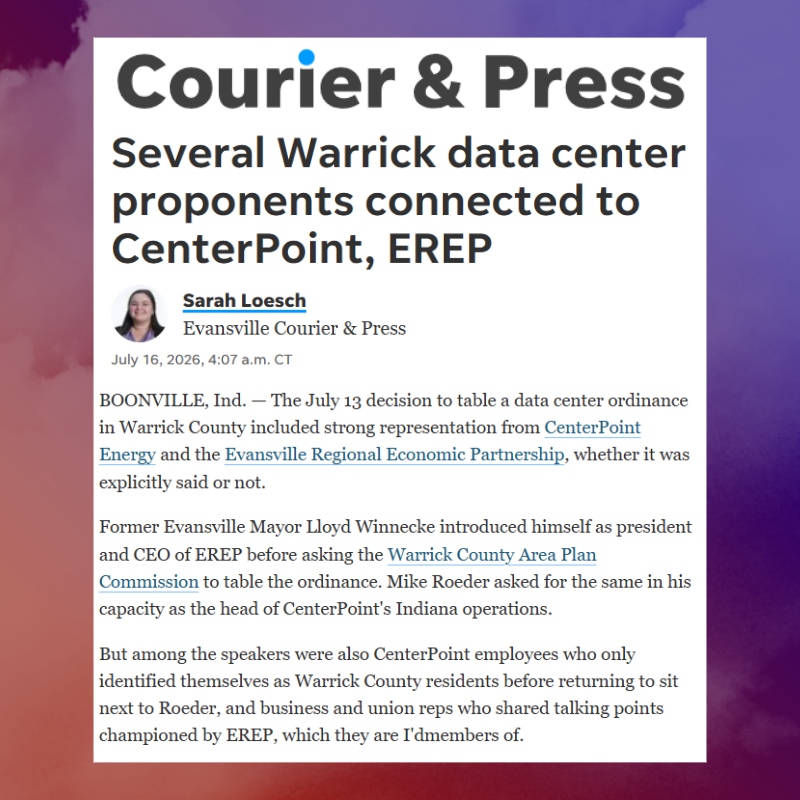 Numerous CenterPoint Energy employees – who could financially benefit from data centers coming to Southwest Indiana – spoke out against a proposed ordinance in Warrick County that would have restricted large data center development, resulting in it getting tabled. However, none disclosed that they were employees of CenterPoint, the Courier & Press reported.
 -
Posey County commissioners admitted they have executed a non-disclosure agreement with a data center developer and farmers in several communities have been approached about selling to a data center developer, local media reported.
National Updates
-
 A Wall Street Journal investigation found Big Tech companies like Google, Amazon, and Microsoft are severely underreporting water consumption by not including water use by power plants fueling their energy intensive operations.
 -
A new Reuters investigation finds that "Skyrocketing demand from [AI] data centers is exacerbating shortages of critical grid equipment like transformers... driving up costs, stretching out wait times and spurring utilities and developers to lock in orders far in advance."
-
The U.S. Environmental Protection Agency is proposing a new rule that would eliminate public participation as a requirement of New Source Review for “minor” sources of air pollution. If approved as proposed, it would allow IDEM and other state environmental regulators to decide whether, when, and for long to provide opportunities – if any – for public participation in air permits commonly sought by data centers for backup diesel generators, among other types of pollution. Public comments are due August 21, 2026.
-
Meta’s closed-loop cooling system at a new data center in Wyoming released a rare bacterium into a city’s wastewater system, leading to the contamination of the water reuse system, months of cleanup, and the revocation of the data center’s wastewater permit.
CAC Shoutout
 We’re renewing our April shout-out to once again acknowledge our incredible partners at Earthjustice, the premier nonprofit public interest environmental law organization.
Earthjustice is representing CAC and Vote Solar in a pivotal lawsuit before the Indiana Supreme Court that could impact the ability of associations across Indiana to represent their members in court. Oral argument is scheduled for September 17 at 10am and can be watched online.
A huge thank you to Earthjustice for their counsel, insight, and advocacy on behalf of CAC over the years, and especially now in this critical case.
CAC in the News
-
CAC was featured in a Posey County News article about the Data Center Community Forum CAC helped organize in Mount Vernon. CAC organizer Ryan Stratman emphasized that a data center moratorium would give local officials time to gather information on data center impacts and consider rules before any formal proposal comes forward.
-
CAC Executive Director Kerwin Olson discussed House Enrolled Act 1002 (2026) with Fox 59. While the new law will provide meaningful relief to low-income customers, “it misses the mark with respect to short-term impact to customers,” OIson said. “We’re hopeful that the conversation continues at the Statehouse because what we really need to do is address state policy, and put consumers on a level playing field, with respect to the laws on the books — because right now, what we have are laws written primarily by and for the investor-owned electric utilities.”
-
 CAC intern Anna Kavanaugh was featured in a Press Dispatch article about community members in Pike County organizing in opposition to data centers.
 -
CAC Regulatory Director Jennifer Washburn discussed CAC’s efforts to petition Indiana utility regulators to reconsider the $71 million AES rate increase. When reconsidering the rate case decision, Washburn told WFYI that she wants the IURC to consider factors like the deal announced for BlackRock to acquire AES Indiana’s parent company, Google’s proposed data center in Monrovia, and a record number of consumer complaints.
-
CAC was featured in a Guardian article about the false climate solution that is Carbon Capture and Sequestration (CCS). Our Executive Director Kerwin Olson discussed the massive tax subsidies companies receive to shove carbon dioxide underground, hoping it stays there for eternity. He explained that a small project that sequesters 200,000 metric tons of carbon per year can earn $17 million annually through the Section 45Q tax credit. “You can do the math. That is a lot of cash – an enormous amount of cash. You’re talking billions of dollars.”
-
CAC organizer Bryce Gustafson spoke with Fox 59 about the Indianapolis City-County Council’s efforts to advance a data center moratorium instead of weak regulations. “We’re reaching a boiling point with this issue. There are a lot of communities who are questioning why these data centers are coming,” he said.
-
CAC Program Director Ben Inskeep talked with Indiana Public Media about the harrowing reality that AES Indiana could use eminent domain to force folks to give up their land for transmission lines to serve the Google data center in Monrovia. “Eminent domain is supposed to be for projects that benefit the public interest. They're not supposed to be for projects that are benefiting the private interest of a $1 trillion company at the expense of the general public” Inskeep said.
-
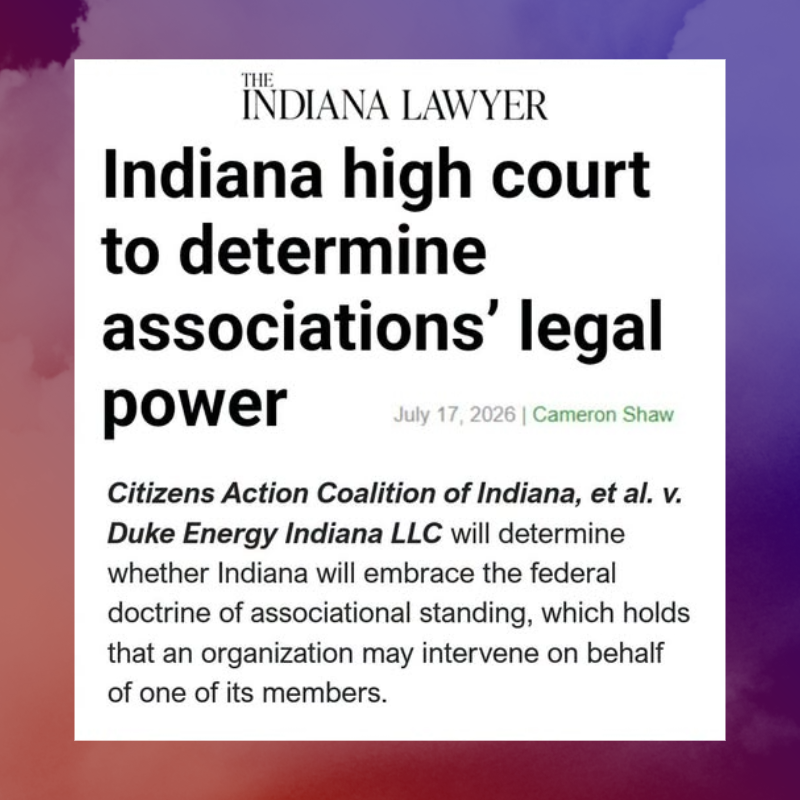 CAC was featured in an Indiana Lawyer article detailing Duke Energy’s egregious attack on associational standing, the legal standard that allows organizations like CAC to sue on behalf of our members.
The Supreme Court’s decision in Citizens Action Coalition et al. v. Duke Energy Indiana LLC could have far-reaching consequences for many other associations that engage in legal proceedings on behalf of their members in Indiana.
-
CAC was featured in a Chicago Tribune article about our presentation at a community forum organized by the Gary Common Council. We discussed high NIPSCO bills and the impacts of data centers.
-
CAC was featured in a Capital Chronicle article about our efforts at the Federal Energy Regulatory Commission (FERC) to break up Blackrock as the private equity giant moves to buy AES Indiana’s parent company, the AES Corporation. Firms like BlackRock “are the last people we should want to be running our public utilities,” said our executive director Kerwin Olson.