AI Data Center Build-Out Creates Unprecedented Risk to Hoosiers
CAC calls on federal lawmakers, Indiana state lawmakers and local public officials to pass an AI data center moratorium to allow adequate time for reasonable policies and regulations to be enacted that protect Hoosiers and our environment from the harmful impacts of these massive, resource-guzzling facilities.
Jump to: Data Center Map ~ Moratorium Map ~ Electric Bills ~ Rate Hikes ~ Pollution ~ Water ~ Subsidies
Updated: July 2026
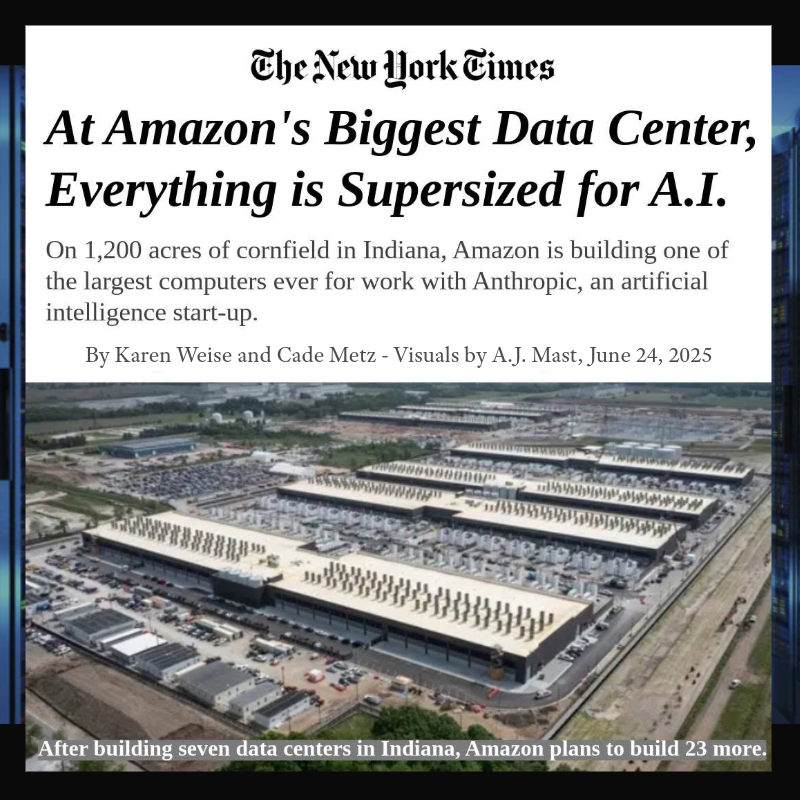 Communities across Indiana are being overwhelmed by AI data centers. Approximately 60 large AI hyperscale data centers have been proposed in Indiana over the past two years. Several are already operating and more are under construction.
Data centers are essentially warehouses for computers and servers. They are the physical location of the "cloud" and have been around for decades without causing concern. Up until recently, the types of applications that have relied on data centers have been things like streaming movies and TV shows, scrolling social media, electronic document storage, etc.
However, the AI data centers now coming to communities in Indiana are a different beast. These are typically massive, specialized hyperscale data centers being built by companies like Amazon, Google, Meta, and Microsoft, for generative artificial intelligence (AI).

Where Are AI Data Centers Being Proposed?
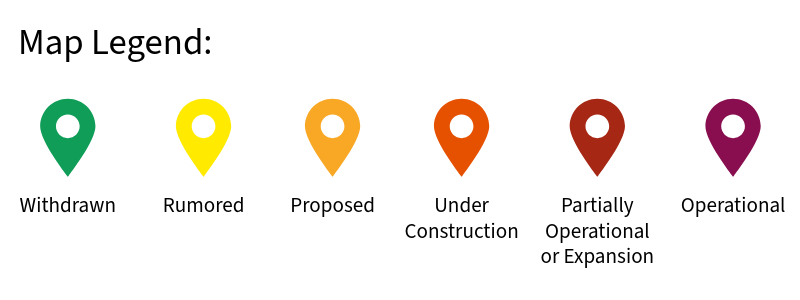
Click here for the spreadsheet with the data behind this map.
AI data centers are the number one threat to utility affordability, reliability, environmental sustainability, and democracy in Indiana.
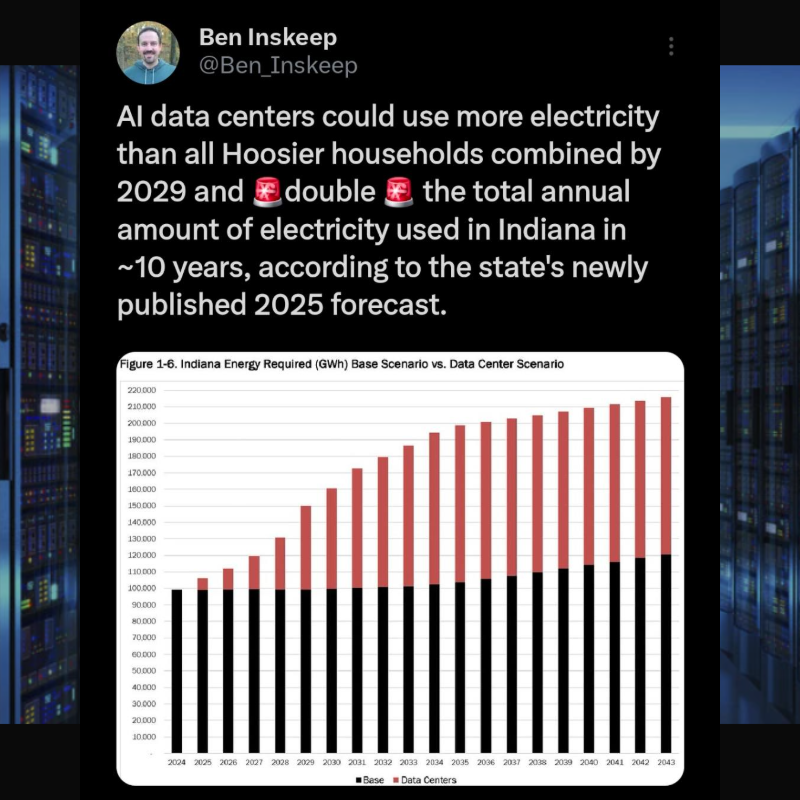
 The AI data centers pushed by tech giants need unprecedented amounts of energy. Just one large AI data center can use as much energy as 730,000 Hoosier households. That’s up to 10 times more power than Indiana’s other large energy users like steel mills and manufacturing plants.
The staggering amounts of energy AI data centers require creates numerous economic and environmental risks for Indiana, especially because they’re being rolled out rapidly and without adequate transparency.
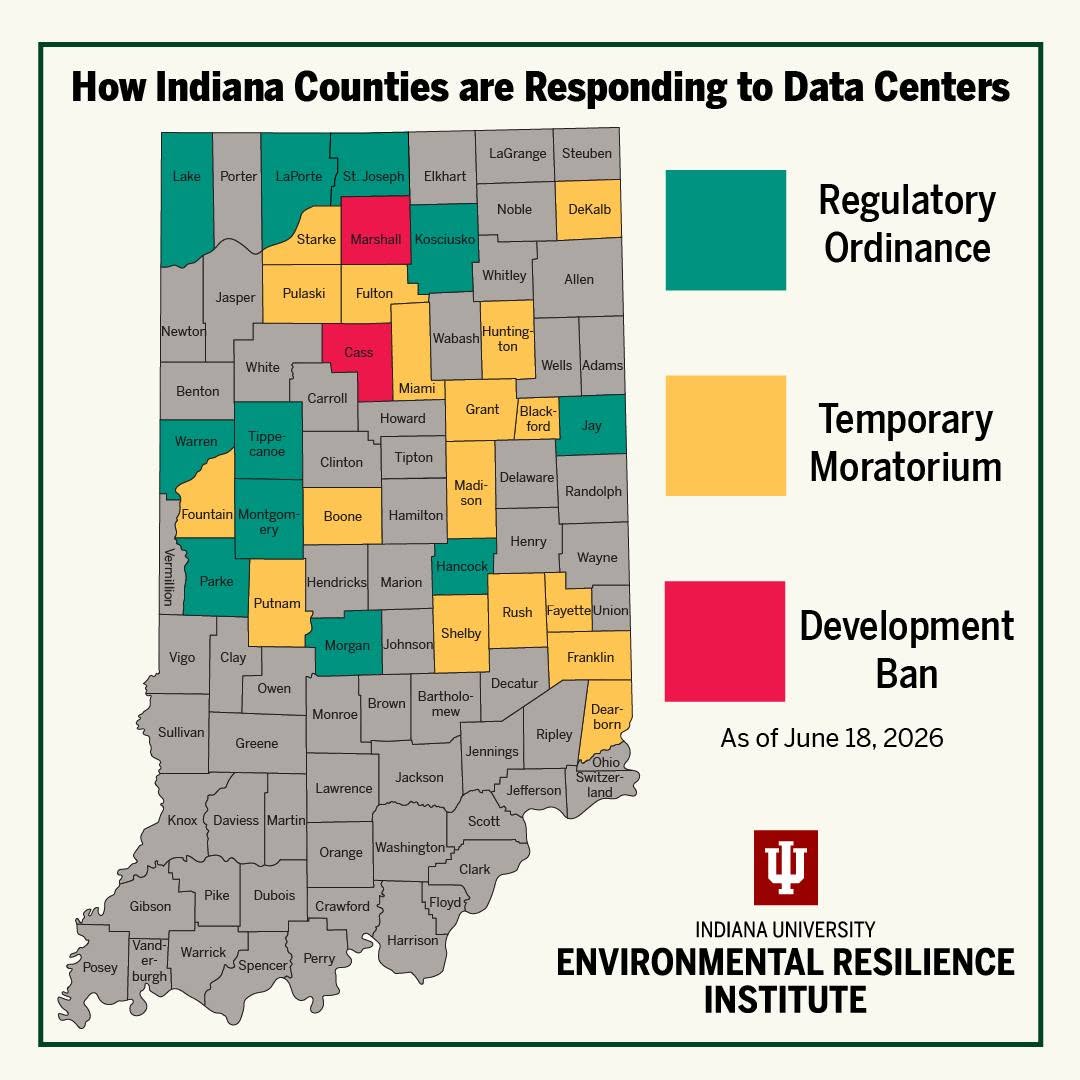
In response, many cities and counties around Indiana have passed data center moratoriums.
AI hyperscale data centers are raising electric bills in Indiana.
 It will cost billions of dollars in new infrastructure to serve data centers. Indiana’s profit-hungry monopoly utilities earn a rate of return on every dollar they spend, so the more money they spend, the more money they make.
As a result, data centers will boost monopoly utility profits - and utilities are looking for every available opportunity to maximize their return. This could lead utilities to overbuild power plants and transmission lines, leading to stranded assets in the long-term, especially if AI becomes more energy efficient.
Although very few AI data centers are operating in Indiana right now, Indiana’s electric utilities are already in the process shifting some data center costs onto everybody else’s bills.
-
Duke Energy is shifting $216 million in network upgrades for the Meta data center in Jeffersonville onto all Duke Indiana customers in Cause No. 45647 TDSIC-5.
-
I&M is shifting more than $400 million in costs to connect Google (Fort Wayne) and Amazon (New Carlisle) data centers to the grid onto their customers in Cause No. 46301.
-
$896 million in transmission upgrades for the Meta data center at LEAP:
-> $9 million to be paid by AES Indiana customers
-> $210 million to be paid by Duke customers
-> $627 million will be paidy by Wabash Valley Power Alliance, but there is no transparency on who will pay these costs, leading to concerns that they will be passed on to all electric customers instead of paid by Meta.
Advocates like CAC are not privy to the deal between Meta and Wabash Valley Power Alliance, meaning we can’t access information detailing whether protections are in place or who will pay for the upgrades, underscoring concerns about transparency.
-
I&M shifted uneconomic coal contract costs through 2040 allocated to Michigan customers onto Indiana customers to serve Indiana data centers in Cause No. 45164 RA-5.
-
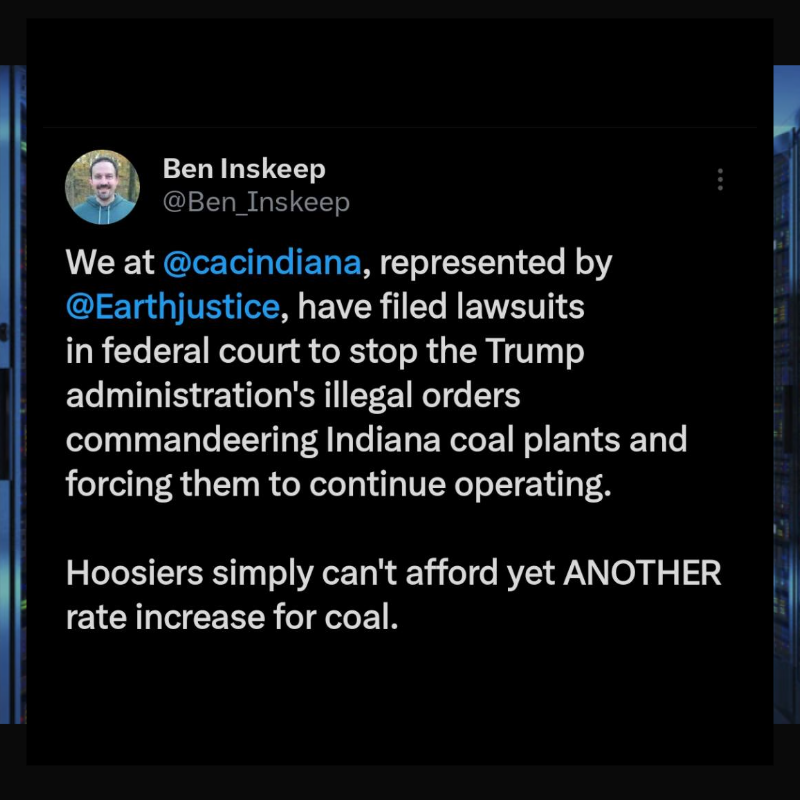 Due to unlawful “emergency” orders from the U.S. Department of Energy (DOE), which pointed to the growing energy needs of AI data centers, CenterPoint & NIPSCO are still running coal plants they planned to retire in 2025. The Federal Energy Regulatory Commission approved proposals by the utilities to pass on the costs of the orders to electric ratepaying customers across the Midwest.
Making matters even worse, the Schahfer coal plant NIPSCO is being forced to continue to operate is in such bad shape that it will be down for repairs for most of 2026. But because of the DOE's order, electric customers across the Midwest will have to pay for it regardless.
It is unjust and outrageous that Hoosiers struggling to keep up with rising energy costs - on top of inflation, rising gas and grocery prices, and high healthcare and housing costs - are being forced to subsidize some of the wealthiest corporations in human history.
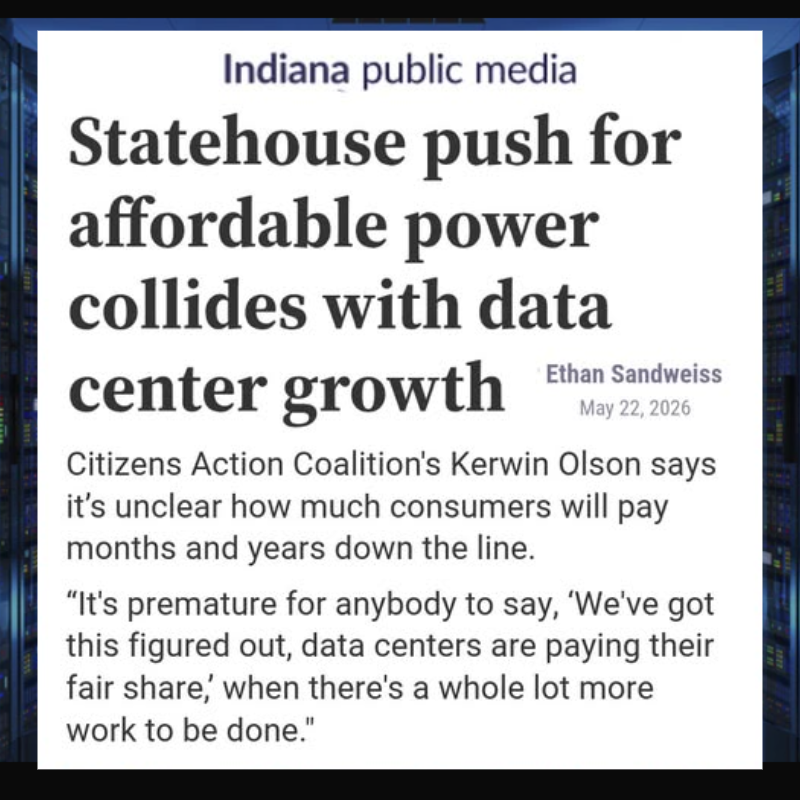
Future rate hikes are likely as electric utilities devise new schemes to serve data centers.
The deluge of data centers being constructed across the country has resulted in soaring costs to build new power plants, for essential grid equipment like transformers, and for some consumer electronics. Furthermore, Big Tech companies building data centers are some of the richest and most powerful entities in history, leading to concerns about their ability to influence policymakers at the expense of Hoosiers. Against the backdrop of record rate increases, Hoosiers are rightly worried that data centers could lead to more bill increases.
 Instead of protecting Hoosiers, the Indiana General Assembly passed HEA1007 in 2025, accelerating the data center build out while jeopardizing ratepayer affordability. Although the law has been touted by some elected officials as “the solution” that will protect consumers, in reality it reduces regulatory oversight and speeds up approval of expensive power plant expansions to serve data centers.
Some have falsely claimed that HEA1007 (2025) requires AI data centers to pay at least 80% of the costs of new power plants to serve them. This isn’t true. And even if it was, it’s not something to brag about. Data centers should, of course, pay for 100% of their full costs. If a data center is only paying 80% of its costs, it means other customers will be on the hook for the remaining 20%. However, utilities aren’t required to use this law to serve data centers, meaning there are few protections in place for consumers from rising data center costs driving bills higher.
HEA1007 (2025) also prescribes very short timelines for the IURC to make decisions about cases involving billions of dollars in energy infrastructure necessary to serve large data centers. This means that groups like CAC that intervene in these cases have very little time to review the ins and outs of an unprecedented and costly expansion of energy infrastructure, which is made even more difficult because utilities frequently redact critical information (NIPSCO example, AES example).
Citizens Action Coalition is working hard to monitor the deluge of filings at the Indiana Utility Regulatory Commission involving data centers, and intervening in as many cases as we can.
Indiana’s monopoly utilities are responding to the massive power and infrastructure needs of data centers in different ways.
-
Indiana Michigan Power is proposing a range of tariffs and special contracts to serve data centers in their service territory. Some arrangements appear to protect customers from paying for data centers’ energy needs, while others do not.
-
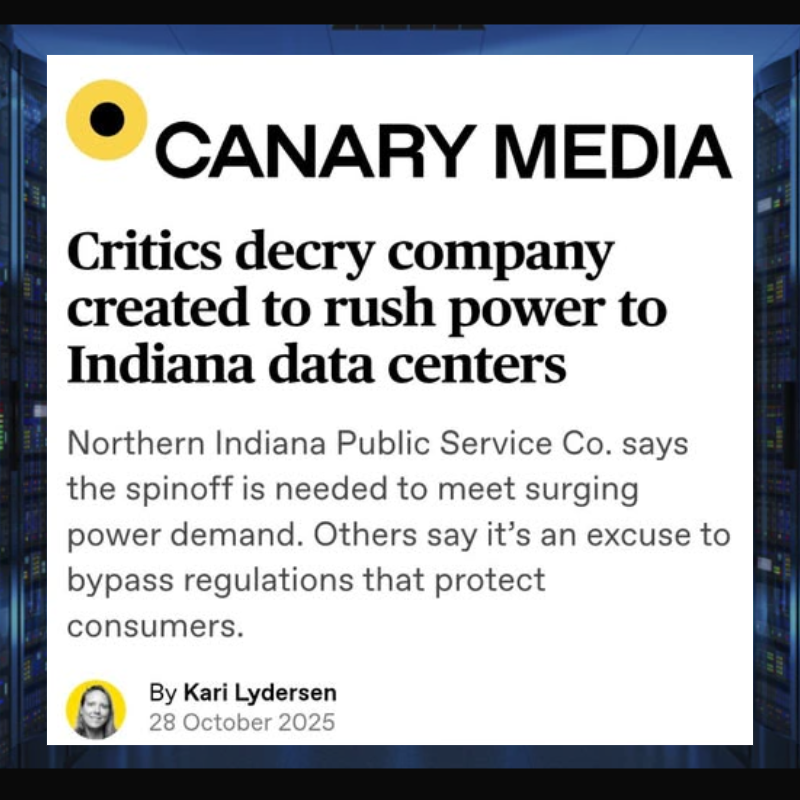 NIPSCO ignored HEA1007 (2025) and created a NiSource subsidiary company called GenCo to serve data centers. This arrangement makes it harder for CAC and the public to access critical information about GenCo’s arrangements with data centers and fast-tracks the approval of new, polluting natural gas power plants.
 -
Duke Energy only has one large data center in their service territory at the moment, the Meta data center in Jeffersonville. Duke cut a deal with Meta to allow it to purchase power from other providers and the wholesale market, giving it access to lower-cost and cleaner sources of generation that other Duke customers don’t get.
-
AES Indiana filed a case involving transmission upgrades and battery and solar-plus-battery projects to serve the Google data center in Monrovia. However, it did not propose enough renewable energy to offset Google’s energy needs, meaning a substantial portion will likely come from fossil fuel power plants operating at higher output in the wholesale energy market.
-
A data center has not yet located in CenterPoint’s service territory - but their CEO says they are making "considerable progress" in attracting a large load customer (i.e. a hyperscale AI data center) on a recent earnings call.
In addition to the specific IURC cases in which monopoly utilities seek to shift costs from data centers onto residential customers, data centers can also raise your electric bill in less direct ways.
-
Since many utilities across the United States plan to build gas-fired power plants to serve data centers, the cost to build a gas-fired power plant has surged 66%.
-
Capacity / Wholesale Market Auctions: Soaring power demand from data centers directly increased the capacity auction prices in PJM (the grid operator for the eastern portion of the country, including a section of Northeast Indiana) by a shocking $9.3 billion in 2025-26, $7.3 billion in 2026-27, and $6.5 billion for 2027-28, according to the Independent Market Monitor.
I&M is the only Indiana electric utility in the PJM service territory. Although I&M doesn't directly pay PJM auction capacity prices, the signals to the entire market are that power is constrained, so it means that contracts that I&M reaches with power plant owners to buy capacity, or that existing power plants that I&M wants to buy from a seller in PJM, will be much more expensive going forward than if there were no data centers.
AI data centers are increasing air, climate, and noise pollution.
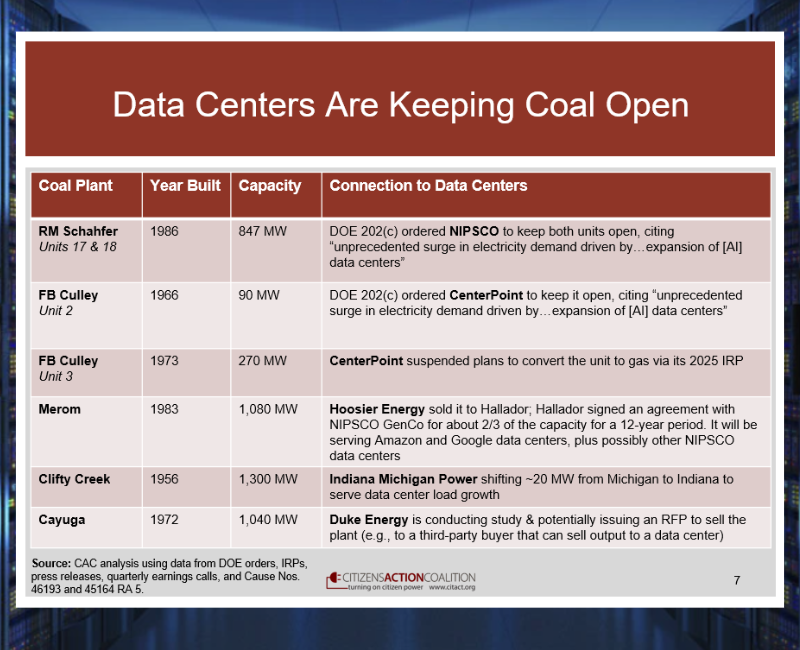 Indiana is already heavily reliant on fossil fuels to produce electricity, and energy-guzzling AI data centers are making matters even worse. Indiana coal plants are seeing their retirement dates delayed due to data centers. This is jeopardizing Indiana’s progress towards better air quality while creating even more coal ash that is already sitting next to our major rivers, leaching into our ground water, and costing millions to clean up, even when utilities clean it up poorly.
Indiana utilities are also planning a massive expansion of new gas-fired power plants to meet the needs of AI data centers. Two utilities, I&M and NIPSCO, have announced plans to build a whopping 5.6 gigawatts (GW, one gigawatt = 1,000 megawatts) of gas-fired power plants by 2030 and 7.8 GW by 2035.
That’s as much power as serving ALL of NIPSCO’s customers, plus ALL of I&M’s customers, combined.
"Natural” gas and the pipelines necessary to serve them produce climate pollution like methane and significant amounts of other types of harmful air pollution, including carbon monoxide, particulate matter, and volatile organic compound (VOC) emissions.
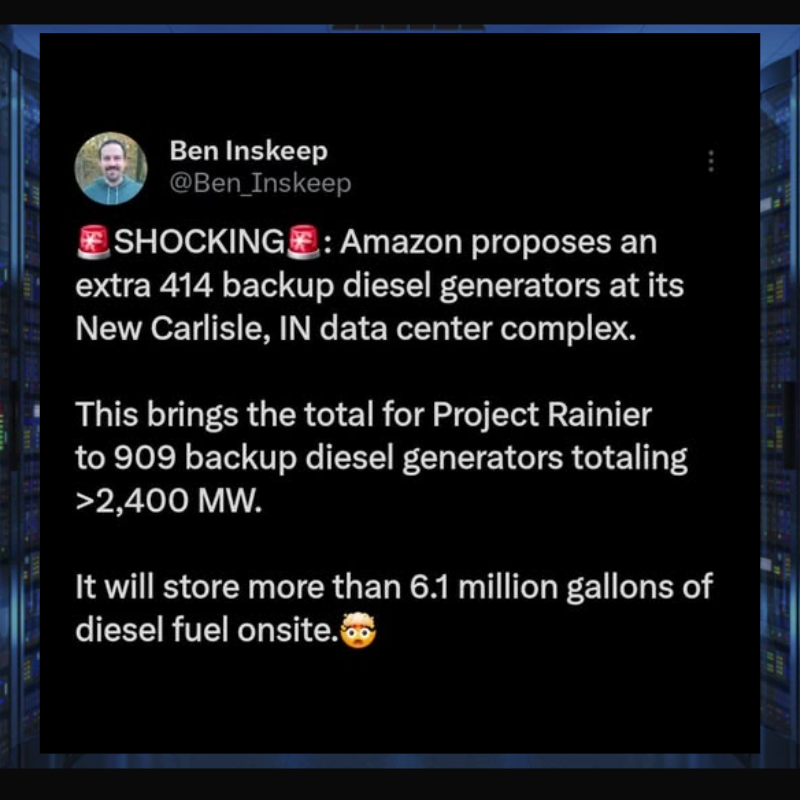 Making matters worse, data centers also usually have on-site backup generators, typically powered by diesel. The Amazon data center in New Carlisle has repeatedly asked to increase the number of backup diesel generators they maintain on-site. If its latest request is approved by the Indiana Department of Environmental Management (IDEM), Amazon will have an astonishing 909 backup diesel generators totaling 2,400 MW, with over 6.1 million gallons of diesel fuel stored on site at its New Carlisle facility.
Diesel generators generate large quantities of air pollution including particulate matter, nitrogen oxides, benzene, and formaldehyde. This pollution increases the risk of respiratory disease, cardiovascular disease, cancer, and neurological disorders.
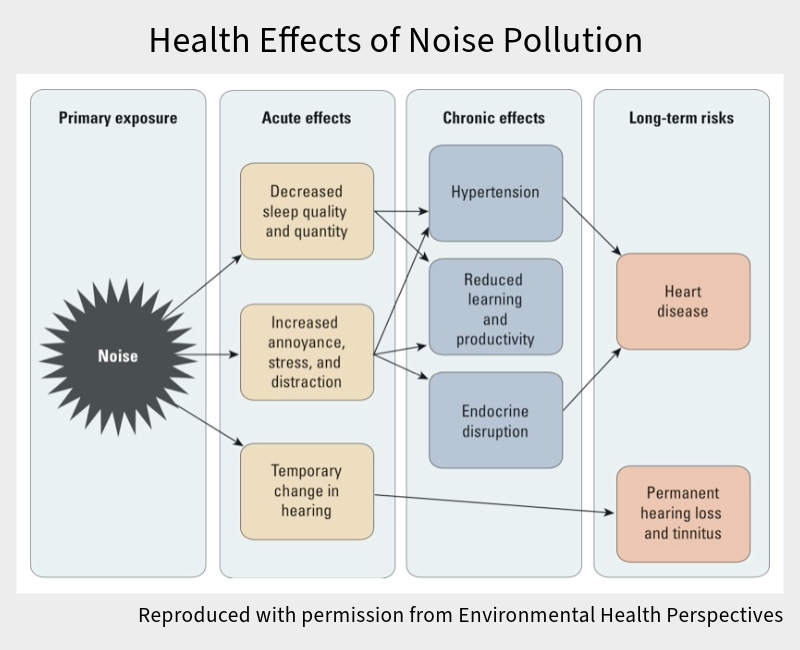 Equipment located at AI data centers, such as servers, HVAC systems, backup generators, fans, and exhaust tubes, can also cause noise pollution 24/7, with some data center neighbors measuring noise pollution at 65 decibels into the night.
According to the Boston University School of Public Health, "At only 65 decibels—about as loud as a car going by for someone standing on the side of the road - research has shown that people begin experiencing increased risk of hypertension and heart attack."
Waste heat from AI data centers can also "boost air temperatures in downwind neighborhoods by as much as 4 degrees Fahrenheit," according to a May 2026 study conducted by Arizona State University in the Phoenix metro area, the hottest in the U.S.
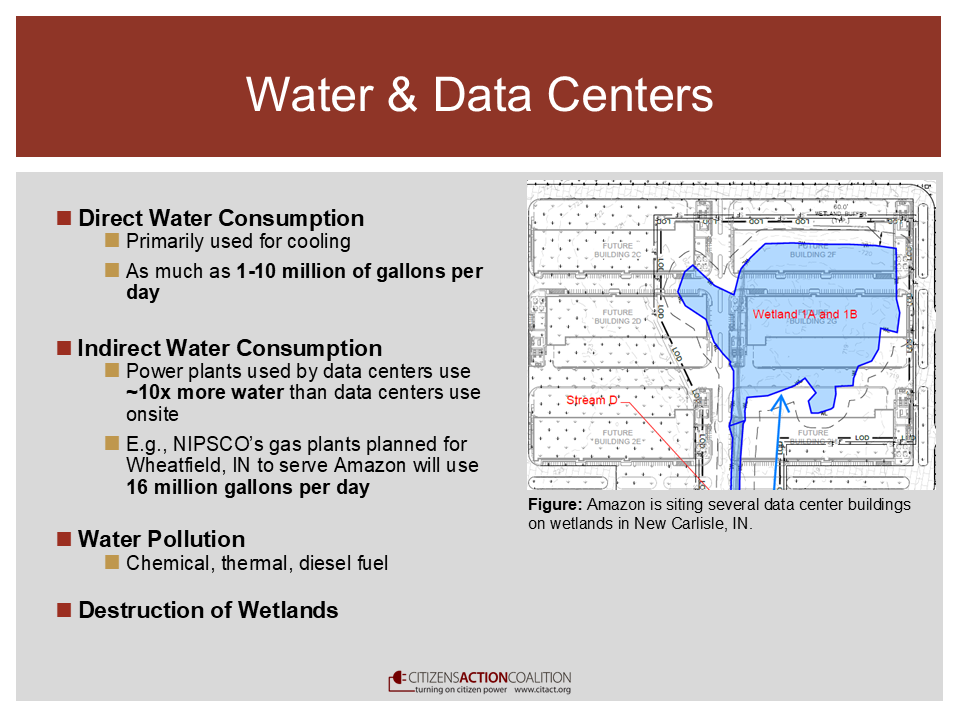
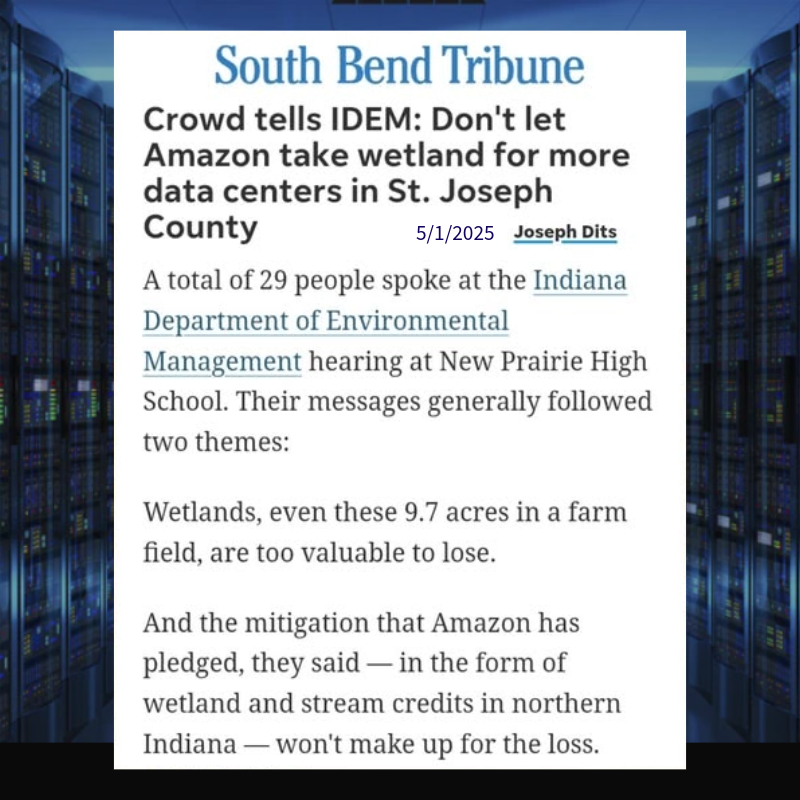
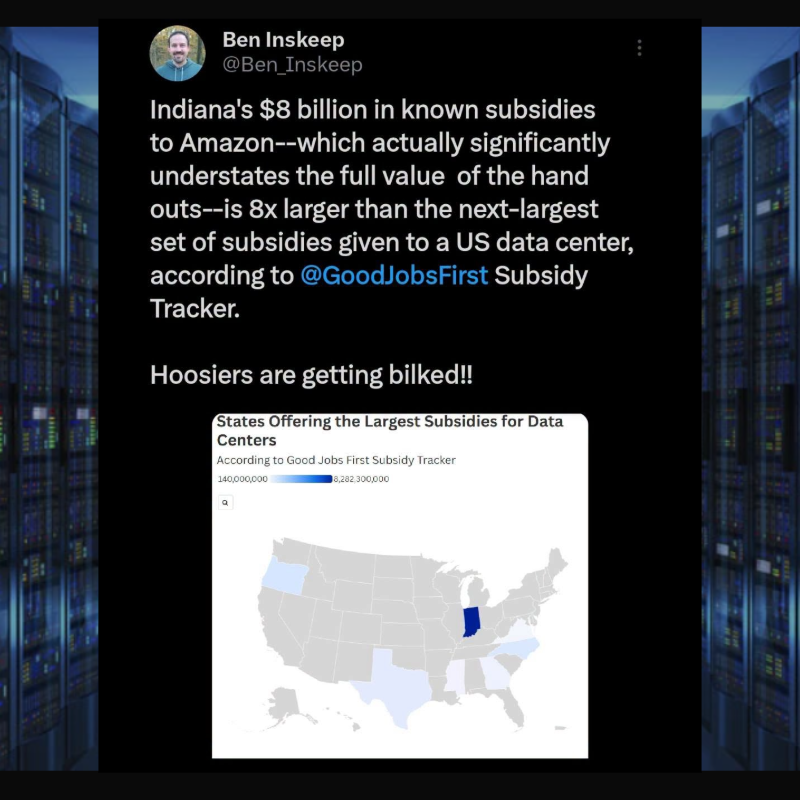
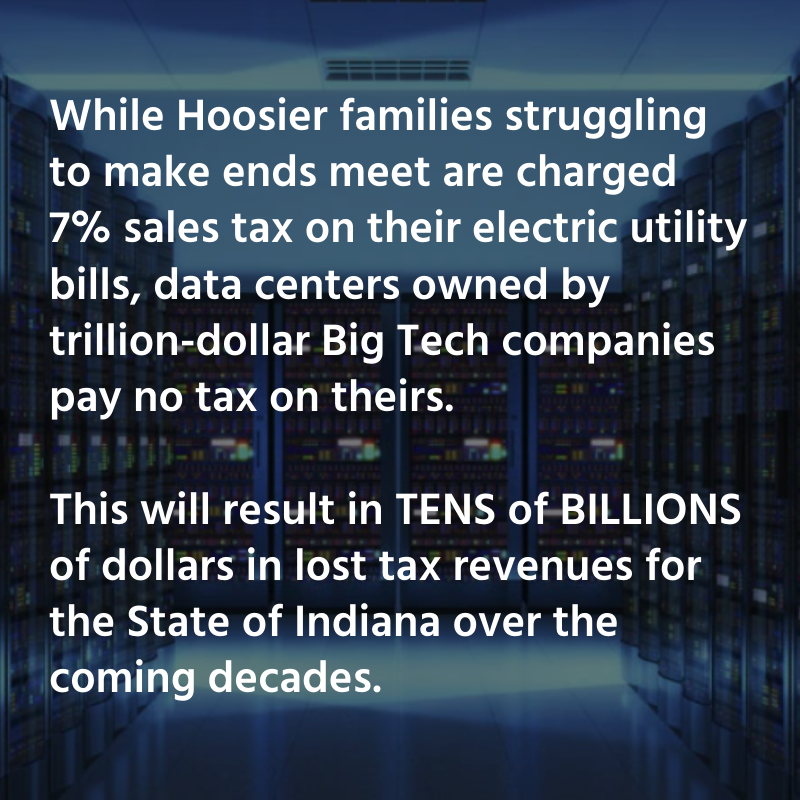
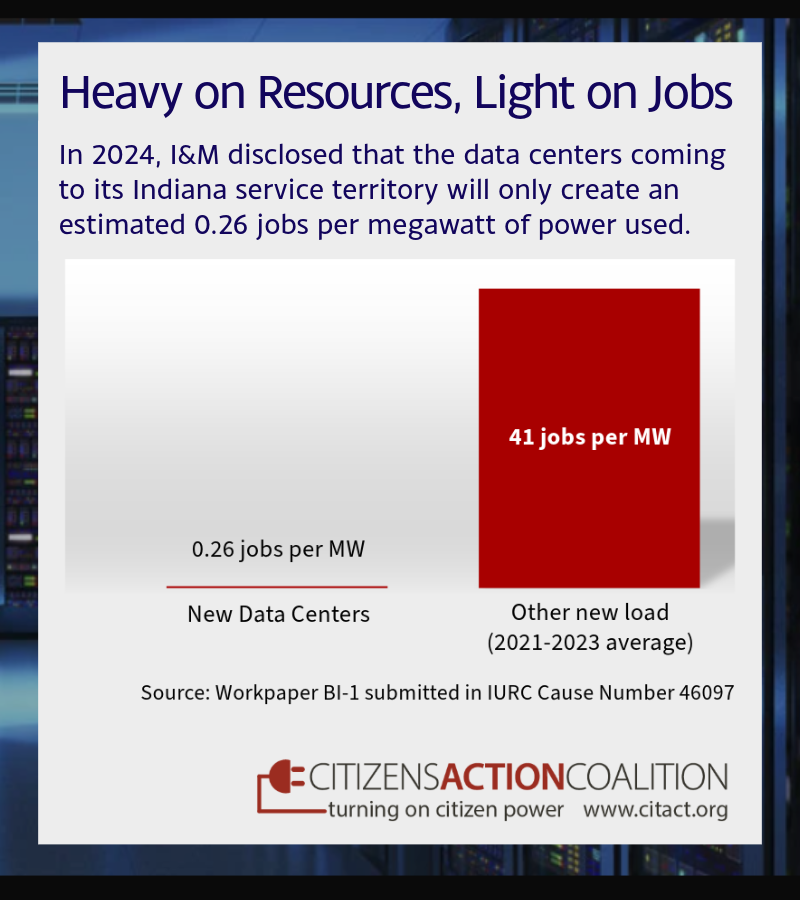
Campaign Tools
Take Action Please use this form to email your Indiana state legislators, Gov. Braun, and Lt. Gov. Beckwith, and tell them to protect Hoosiers from the impacts of AI data centers! Indianapolis folks: Please visit citact.org/act.indy.dc.moratorium to tell Indianapolis public officials to implement a data center moratorium instead of the weak regulations being considered! Southwest Indiana folks: Please visit citact.org/act.nodc.swin to urge Southwest Indiana county public officials to implement an AI data center moratorium! Help us fight for Hoosiers! AI data centers, and the coal- and gas-fired plants that power them, need substantial amounts of water. AI data centers can use enormous amounts of water, primarily for the evaporative cooling of computers, which generate intense waste heat when they operate (just like your computer might feel hot to the touch when it is running too many applications). AI requires intense amounts of processing, and the more processing done at the data centers, the more heat they generate, the more water they need to cool everything down. Although data center developers are not required to disclose which type of cooling system they will use, many are now touting closed-loop cooling systems as a water-efficient alternative to evaporative cooling measures. It is important to note that this type of cooling uses more energy than evaporative cooling, and producing electricity also requires water. For example, the 2,600 MW gas-fired power plant that NIPSCO GenCo is building for Amazon data centers is estimated to withdraw up to 33 million gallons of water per day, of which 16 million gallons of water per day on average would be consumed (converted into steam rather than discharged back into the river). Excluding power generation, a single AI data center can use approximately 1 to 5 million gallons of water per day on site, as much water as a town of 10,000 to 50,000 people. For example, the Meta data center under construction in Lebanon, IN, will be able to use up to 8 million gallons per day by 2031, despite having a closed loop cooling system. This water will be piped to Lebanon from the City of Indianapolis’s drinking water sources, including Eagle Creek Reservoir. While some water that is withdrawn by a data center is converted into steam or evaporates, the remainder ultimately becomes wastewater and is returned to the water source or to a wastewater utility. Data centers have been highly secretive about what is in their wastewater. There are concerns that PFAS (“forever chemicals”) or other pollutants could be part of this waste stream and be subject to inadequate regulation. Furthermore, even if the water is still clean, it can carry a lot of heat if it was used for cooling purposes, leading to what is called “thermal pollution,” where hot water harms the aquatic life and health of a body of water. Data center developers often seek to destroy wetlands, with the Amazon data center destroying 10 acres in New Carlisle, and the Google data center destroying 2 acres in Fort Wayne. Especially with the passage of HEA1383 in 2024, Indiana has very weak protections for wetlands, which are critical to protecting water resources and quality. Indiana lacks an integrated approach to managing our water resources - especially for large scale development, as shown by the controversial LEAP boondoggle. Since no entity is evaluating the cumulative impact of data center water withdrawals, power water withdrawals, wastewater discharges, and wetland destruction, it creates concerns about how water quantity and quality will be protected and managed across Indiana. Short-term boom, long-term bust? From AI bubble to increased efficiency, the future of AI’s energy use is uncertain. In 2019 - before the rise of generative AI and the massive increase in the size of data centers - the Indiana General Assembly enacted House Enrolled Act 1405, which provides large AI data centers with a full sales tax exemption for up to 50 years, while allowing local governments to also enact property tax exemptions, including real property tax abatements for up to 10 years and personal property tax abatements for up to 20 years. These subsidies are expected to total in the tens of billions of dollars in lost tax revenue for the State of Indiana over the coming decades. In 2025 alone, the State of Indiana doled out $655 million in data center sales tax exemption subsidies, but only disclosed this after Good Jobs First published a report highlighting that our state wasn’t reporting lost revenue from data center tax abatements. This $655 million is only the tip of the iceberg when you look at the lifetime lost revenues from data centers. The State of Indiana has already granted $8 billion in known subsidies to Amazon alone, according to the Good Jobs First Subsidy Tracker. And then there’s the lost sales tax revenue from data centers not having to pay sales tax on their electric bills. For example, just one 1,000 MW data center served by I&M will have an annual power bill of approximately $492.6 million, leading to foregone sales tax revenues on their electric bill of $34.5 million per year, and more than $1.7 billion in foregone sales tax revenues after 50 years, assuming no increase in electric rates. Source: I&M Attachment to Williamson Direct Testimony in Cause No. 46097 These massive subsidies for some of the wealthiest corporations in human history are deeply concerning, especially as state government agencies are forced to reduce spending and layoff personnel in response to budget shortfalls. Many local governments in Indiana are also starved for resources due in part to state policies that have made it challenging for them to collect enough revenues to provide adequate services. The challenges facing local governments are only expected to grow due to SEA1 passed in 2025 which will further erode local government revenues. The ongoing funding problems facing local governments can make data centers seem like an attractive option for increasing revenue, even if local governments choose to provide generous tax abatements. However, when local governments are evaluating whether to welcome AI data centers in their communities, they aren’t equipped with information detailing the breadth of costs the data centers will impose on their residents and other Hoosiers. This ranges from energy, water, wastewater, and road infrastructure costs to air and water pollution to energy and water availability. Despite many promises from developers to pay their fair share and be good stewards, the reality is that AI data centers are unprecedented, and only time will tell whether those promises are kept. From CAC’s perspective as we evaluate cases at the IURC regarding energy infrastructure, things are not off to a good start, especially with the Indiana General Assembly prioritizing subsidies and favorable regulation incenting data centers over protections for residents. It’s also important to note that data centers use so much energy that they could prevent other economic development opportunities that create more long-term jobs from setting up shop in Indiana. For example, Meta’s new AI data center in Clark County plans to use so much power that any significant new economic development would have to locate elsewhere or wait 5 years or more for the necessary electric infrastructure investments to be completed. And the track record isn’t good for the number of permanent jobs data centers create in Indiana: in 2024, I&M disclosed that AI data centers coming to its Indiana service territory will only create an estimated 0.26 jobs per megawatt of power used, compared to 41 jobs per megawatt of power used for other industries that have located or expanded operations in Indiana recently. The uncertainty surrounding the future of AI is also important to consider as Indiana evaluates whether these large, energy guzzling data centers and the risks that come along with them are the right economic development choice for our state. Many around the country - even Tech CEOs - are concerned about the AI bubble. There is also the potential that Apple’s approach to AI - powering AI processes on individual devices rather than relying on data centers - could render huge data centers obsolete in the future. Furthermore, there is some evidence that AI that depends on energy-intensive Large Language Models (LLMs) could become less relied upon than smaller, more efficient models that are narrower in scope and require less energy to operate. In Cause No. 46322, Amazon devised contract stipulations that allow them to dramatically drop the amount of energy they request - from 2,400 MW down to 1,200 MW - if they inform their electric utility, NIPSCO, by early 2029. In this case, NIPSCO's latest quarterly earnings call presentation shows that they actually ended up increasing the size of the Amazon contract from 2,400 to 2,800 MW. It certainly gives CAC pause to continue building out expensive infrastructure to serve these large companies with an uncertain future who are building escape hatches into their contracts. In Indiana, we have a poor track record of shifting costs from industrial customers leaving the grid to residential customers, and Hoosiers can’t afford to be stuck holding the bag for huge corporations any longer.