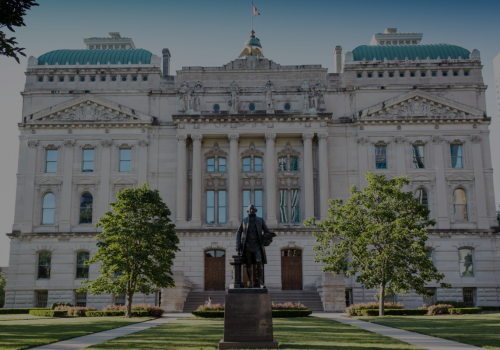
2026 Week 10 Final Statehouse Report
After an early start in December, the three months of a national politics-fueled legislative session ended this past Friday, with the Senate adjourning in the late afternoon, and the House following, around dinner time. Legislators worked throughout the day to bring the session to a close.
Waiting until the final moment and bending all the rules to ensure passage was House Bill 1368, which requires the Indiana Department of Natural Resources to seek approval at the Environmental Protection Agency (EPA) for the issuance of Class VI permits for Carbon Capture and Sequestration (CCS) projects. Currently, the EPA has exclusive authority to issue Class VI permits, unless a state seeks and is granted primacy over the permitting process, which is what HB1386 requires.
We oppose HB1368, primarily because it inexplicably continues to exempt the Wabash Valley Resources project in West Terre Haute from the statewide rules governing CCS in Indiana. In our Week 6 report, we noted that the bill split the House GOP from its normally monolithic voting bloc, and the vote this past Thursday was more of the same: the bill failed for lack of a constitutional majority, 48-42 with 2 representatives not voting. After some strong-arming and disagreement over the House Rules' implementation, the bill was brought back before the House for another vote on Friday, where it passed with bipartisan opposition, 57-40.
After the Senate Elections Committee amended House Bill 1359 to halve the number of days in Indiana's early voting period, the bill was not called and died on the Senate Calendar. The failed move to change Indiana Election law is a victory for democracy advocates, many of whom authored a letter calling for its demise. We flew into action, together with All In For Democracy colleagues, to immediately call for an end to putting the right to vote on the legislative menu.
Language regarding data centers that was originally in a dead bill, House Bill 1333, was resurrected in House Bill 1210. This was a huge omnibus bill containing many provisions, including land-use preemption and a ban on rental caps. The data center language inserted into the bill requires that data centers pay the local community where the data center is permitted 1% tax on all electricity consumed by the data center, presumably to sweeten the pot for local communities facing significant public opposition at the local level. More from the IndyStar on HB1210 here.
CAC’s priority bill House Enrolled Act 1002 was signed by the Governor this week after a unanimous Senate vote. While the bill is a significant step forward, it is unlikely to present an immediate fix to high utility bills, as the NWI Times’ Dan Carden notes.
We delve into the how and why of the history behind increasing utility bills here.
As a reminder, HEA1002 includes significant priority issues of CAC, which were also components of our Ratepayer Relief Plan, released with our partners at Indiana Conservation Voters. As previously discussed, these include assistance programs for low-income electric ratepayers, mandatory reporting of customer payment data to the Office of the Utility Consumer Counselor (OUCC), and a disconnection moratorium during the hottest times of the year.
On the heels of Gov. Braun’s signature of HEA1002, the Indiana Utility Regulatory Commission held a press conference - which hasn’t happened in decades, as Statehouse veteran Niki Kelly noted - to investigate rising utility rates. The press conference was handled solely by the new IURC Chairman, Andy Zay. We delve into the how and why of the history behind increasing utility bills here. Our Kerwin Olson’s take on the inquiry was featured in the IBJ’s coverage: “The state of Indiana has been placing monopoly profits over the financial well-being of consumers for far too long,” Olson said. “It’s time to balance the scales and bring fairness into the regulatory process.”
Senate Bill 240, which would allow for surplus interconnection service (SIS) to be included in utility Integrated Resource Plans, passed the Senate unanimously in the final days, and is headed to the Governor for his signature. CAC supported the bill as it may lead to lower costs for consumers and the more efficient interconnection of new clean energy resources. You can visit the Governor’s Bill Watch page to keep up with the bills that have landed on his desk.
Indiana’s environmental deregulation bill, SB277, was amended last week to remove harmful PFAS language. That language had come from SB237, a dead bill that would have reclassified PFAS chemicals and could have allowed polluters to escape penalties for emitting “forever chemicals” into our air and water. While that language was removed, the bill remains injurious to our environment and faced significant bipartisan opposition in both the House and the Senate. Thanks to the work of our colleagues from the Hoosier Environmental Council, Conservation Law Center, and Indiana Conservation Voters, we almost had the bill beat in the Senate. Take action to ask the Governor to veto SEA277.
Thank you!
We appreciate your continued support and your attention to our weekly Statehouse reports. Please keep up to date with our work by signing up for our email action alerts, and be sure to follow us on Facebook, X and Instagram!
Respectfully Submitted,
The CAC Team