Citizen Power | May 2026
The Duke Empire Strikes Back ~ News & Views ~ Data Center Digest ~ CAC Shoutout ~ CAC in the News
The Duke Empire Strikes Back
 We didn’t exactly expect Duke Energy to go quietly into the night after CAC, with legal assistance from Earthjustice, won a $65 million victory for Duke customers last summer in a case addressing the cleanup costs of coal ash messes that the utility created. But the Duke Energy empire’s latest attacks against Hoosier ratepayers go beyond its typical dirty tactics and into unprecedented territory. Namely, Duke is now pushing to change a critical legal standard called “associational standing” in an egregious attempt to prevent CAC from being able to challenge another IURC order ever again.
 Here’s what happened. The latest legal attack comes from a case where the Indiana Utility Regulatory Commission (IURC) approved Duke Energy Indiana’s plan to build a new fossil gas-fired power plant at the site of its Cayuga coal plant. In that case, Duke got a special financial incentive that allows it to start raising Duke ratepayer bills now to pay for the financing costs of the new gas-fired power plant even though it won't provide any power until late 2029 at the earliest.
Indiana law only allows for a gas plant to get this financial incentive when it displaces coal-fired generation. The catch? Duke isn’t displacing any coal fired generation here, as it is planning to offer the coal plant for sale to another company to keep it operating. Since the IURC ignored the law’s requirements and awarded the financial incentive anyway, CAC and Vote Solar, with legal assistance from Earthjustice, filed a legal challenge of the IURC order asking a court to step in and require the IURC and Duke Energy Indiana to follow the law.
This past month, the Indiana Supreme Court decided to step in before the appeals court could hear the case based on an emergency motion filed by Duke Energy Indiana. Specifically, Duke Energy Indiana, represented by law firm Barnes & Thornburg, is challenging the use of associational standing, which is the basic legal foundation that has been repeatedly upheld by Indiana courts allowing CAC to appeal IURC decisions on behalf of our thousands of members from across the state, rather than each individual Duke Energy customer member having to file an appeal.
It’s troubling to think that CAC has appealed on behalf of its membership for decades, but now our ability to continue to do so will be closely scrutinized by the Indiana Supreme Court. If the Supreme Court agrees with Duke Energy Indiana, it will mean that every other party that regularly participates in an IURC docket – the Office of Utility Consumer Counselor, big industrial customers, and even the utility companies – would have the legal authority to challenge an IURC order. But not CAC, Vote Solar, or other associations, like unions.
This decision could have far-reaching consequences for many other associations that engage in legal proceedings on behalf of their members in Indiana. Therefore, we are taking this case very seriously and will be mounting a robust legal effort in response.
It seems unlikely to be a coincidence that Duke’s legal escalation against CAC is coming fresh on the heels of a critical CAC legal victory against Duke Energy Indiana that overturned an IURC decision that would have allowed Duke Energy Indiana to charge ratepayers for $65 million in unauthorized coal ash clean up costs.
In the IURC case that is now addressing how ratepayers will get their money back – Cause Number 42061 ECR 45 – Duke Energy Indiana is arguing that its shareholders should actually get to keep approximately $20 million out of the $65 million benefit secured for Duke customers by CAC’s legal advocacy. This is another blatant attempt by Duke to enrich its shareholders while punishing CAC for standing up for the law and protecting consumers.
 Thank you for standing with us as we go toe-to-toe against the largest and most powerful electric utility in Indiana. We refuse to be intimidated by their tactics or daunted by their relentless and blatant attempts to raise Hoosier bills to enrich their shareholders.
Your continued support has never been so important or more appreciated.
Onwards together,
The CAC Team

News & Views
~ CAC Sues IURC for Unlawful Orders on Demand Response ~
At the end of March, CAC and Midwest Renewable Energy Association, with legal representation from Earthjustice, filed a complaint against Indiana Utility Regulatory Commissioners before the U.S. District Court for the Southern District of Indiana alleging that, despite Indiana’s historic support of free market competition, the State, through its utility regulatory agency, created and is operating a protectionist racket for the benefit of five incumbent Indiana utility companies.
Specifically, under a series of past IURC orders, Indiana businesses and families can only provide what is called “demand response” through Indiana’s monopoly utilities and not through competitive service providers. Demand response is when a business or family voluntarily participates in a program where they can get paid in exchange for reducing their energy use during specific, limited times of major grid congestion. CAC generally supports demand response because it helps lower costs for all consumers and reduces pollution by reducing the amount of power plants that our utilities have to build to provide reliable service and minimizing how often dirty power plants need to operate.
Unfortunately, the IURC orders also required those Indiana businesses and families to pay the utilities a kickback from the money they make in the wholesale power market by participating in a demand response program as well as other unreasonable fees and charges. Our complaint argued that the IURC’s orders are rank protectionism that violate both the United States Constitution’s Commerce Clause and the Indiana Constitution’s Privileges or Immunities Clause.
CAC’s Take: By blocking competition, the IURC’s Orders on demand response also result in higher electricity prices for consumers in Indiana at a time when electricity prices are already too high and continue to rise. We should be encouraging clean energy solutions, including demand response, rather than artificially making it more expensive by requiring participants to give kickbacks to monopoly utilities.
~ Google Inks Contracts with NIPSCO & AES Indiana for New Data Centers ~
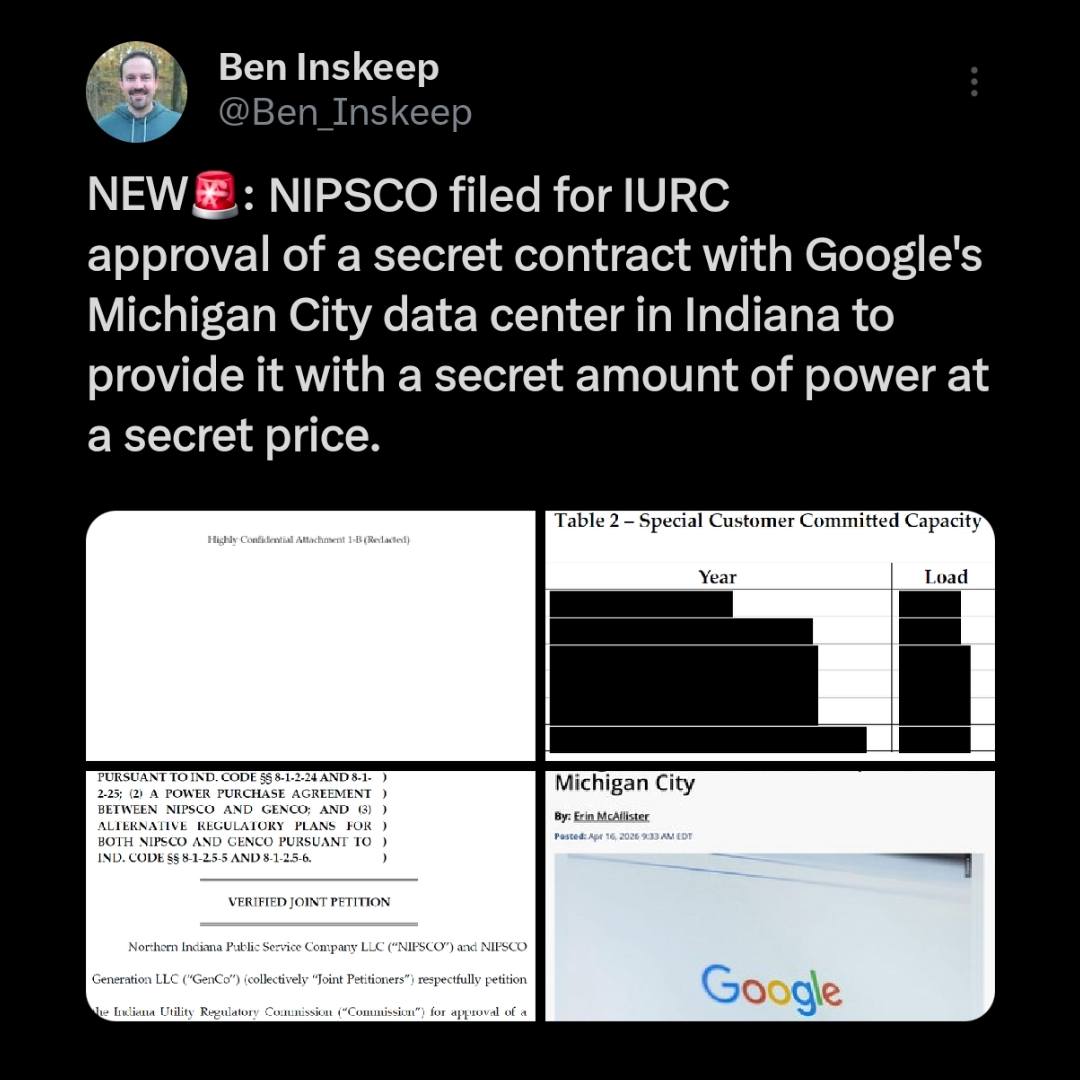 Both AES Indiana (Cause No. 46396) and NIPSCO (Cause No. 46393) filed new Indiana Utility Regulatory Commission cases requesting approval of arrangements each utility reached with Google for new data centers in Monrovia and Michigan City, respectively.
AES Indiana plans to serve 390 megawatts of initial data center capacity using 460 MW of battery storage and 130 MW of solar resources.
NIPSCO plans to serve a secret amount of data center capacity using 342 MW of battery storage and a secret amount of market purchases.
AES Indiana and NIPSCO transmission filings at MISO (Midcontinent Independent System Operator) suggest the ultimate sizes of the Monrovia and Michigan City data centers, respectively, could be 1,200 MW and 300 MW, which collectively could use more electricity than 1 million Hoosier households.
CAC’s Take: Although we are still reviewing these new cases, we have already found major issues suggesting that Google will not be paying its fair share of costs, contrary to the utilities’ assertions. Furthermore, while it's good to see that Google is favoring battery storage over new natural gas plants to provide the capacity needed for their data centers, the energy used to power Google’s data centers will come from the grid. That means dirty coal and gas plants will need to operate more often, leading to a large increase in pollution as a result of Google’s developments. This underscores our concern about the sustainability of massive AI data centers, even when a new fossil fuel power plant isn’t constructed to serve them.
~ CenterPoint’s Pleas to Allow Costly Coal Plant to Retire Went Unheeded by the Federal Government, Letter Shows ~
 CenterPoint begged the U.S. Department of Energy (DOE) in February not to re-issue an emergency order forcing it to keep coal-fired Culley Unit 2 open, according to a letter obtained by CAC.
The February 17, 2026, letter from CenterPoint’s Indiana Region President Mike Roeder to U.S. DOE Secretary Chris Wright stated that maintaining the coal plant “will require substantial investment to support an inefficient and increasingly unreliable asset, rather than advancing affordable and reliable service for customers in southwestern Indiana,” and requested the DOE “abstain from issuing subsequent…Orders for Unit 2” that would require CenterPoint to continue operating it.
The U.S. DOE disregarded CenterPoint’s pleas, as on March 23, 2026, it issued another order directing CenterPoint keep the unit open through at least June 21, 2026.
To continue operating Culley Unit 2 past March, CenterPoint said a prolonged 10-week outage for a turbine overhaul is required at a staggering cost of up to $18 million, among other costly and major interventions needed to continue operating the Unit.
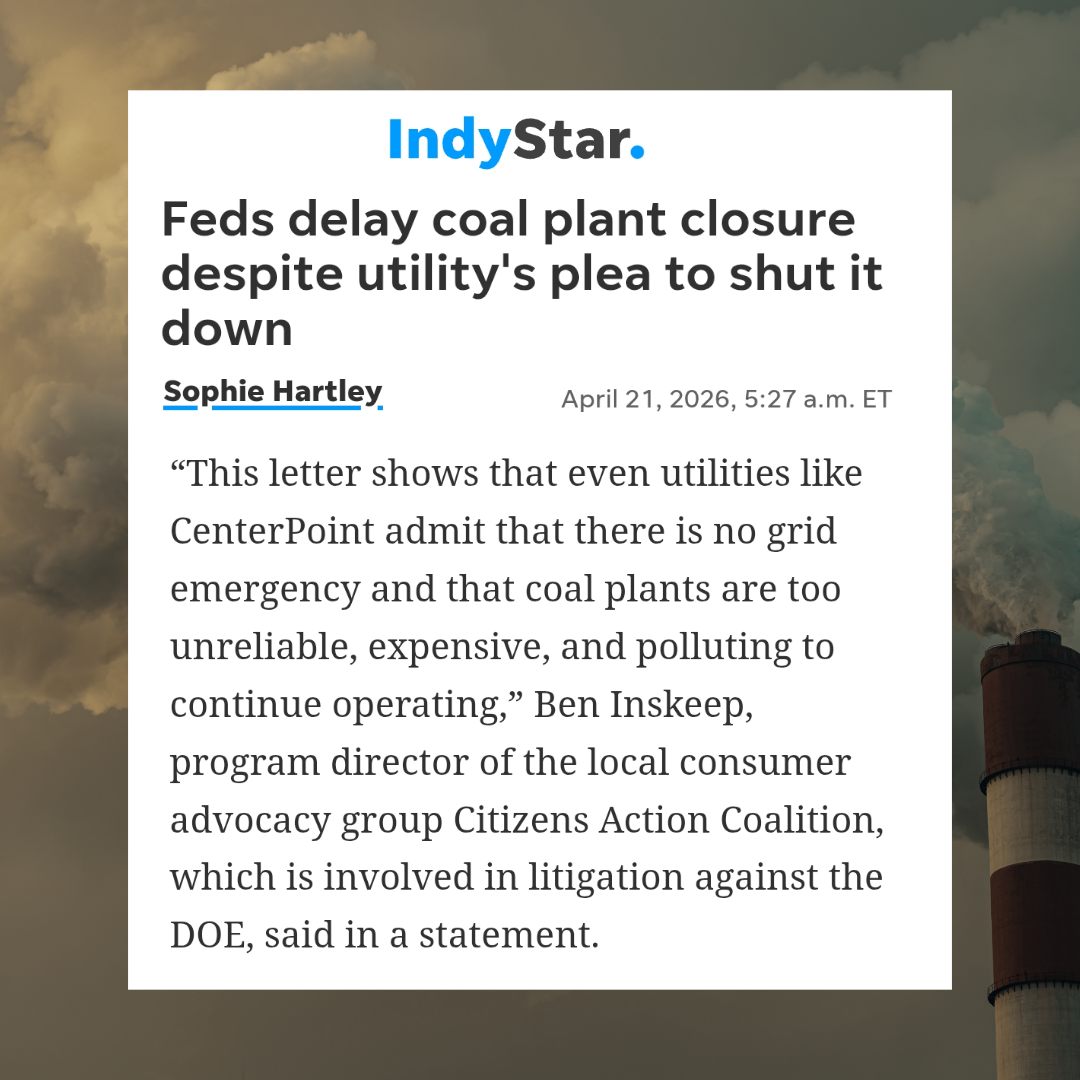
CAC’s Take: This letter shows that even utilities like CenterPoint admit that there is no grid emergency and that coal plants are too unreliable, expensive, and polluting to continue operating. CAC, with legal representation from Earthjustice and in conjunction with other advocacy organizations, is challenging the DOE’s unlawful orders, as well as the Federal Energy Regulatory Commission’s decision to force ratepayers across the Midwest to pay for these unlawful orders. The federal government says the coal plants are needed for AI data centers. That’s not true. But if it were, it begs the question of why the federal government isn’t making the AI data centers pay the costs of keeping the coal plants open instead of raising your utility bill to pay for them.
~ IURC Concludes Listening Tour, Working on Affordability Report ~
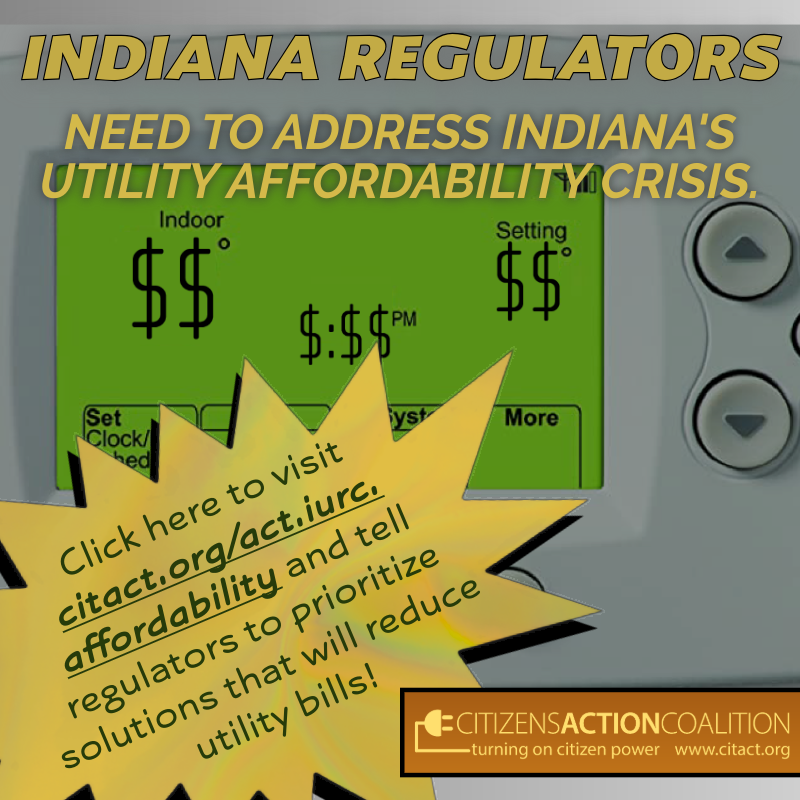 The Indiana Utility Regulatory Commission held 10 listening sessions on energy affordability across Indiana in March and April.
If you haven't already, please submit your comments about affordability to the IURC at citact.org/act.iurc.affordability.
The listening tour followed an all-day investigative inquiry in which each of the five investor-owned electric utilities made presentations and were questioned by IURC commissioners and the Utility Consumer Counselor. The IURC is anticipated to issue a report with recommendations by June.
It’s unclear what the next steps will be once the IURC releases its report, but recommendations could include opening formal docketed proceedings or rulemakings at the IURC, additional informal actions, or recommendations for the General Assembly to change law.
CAC’s Take: We hope the IURC will take meaningful action that directly addresses rising electric bills and prioritizes residential affordability in its decisions in key open cases, including the pending AES Indiana rate case.
~ IURC Improves Solar, Storage Interconnection Rules ~
In a move that went under the radar for many, the IURC adopted rule changes last year that will help some small-scale solar and storage systems connect to the grid with less red tape and at a lower cost. Specifically, the IURC approved increasing Level 1 interconnection from 10 kilowatts to 25 kW. This is important because solar and battery storage that falls under Level 1 can get connected to the grid faster, and there is no cost for Level 1 applications. Utilities like NIPSCO are now updating their tariffs accordingly.
CAC’s Take: CAC and Solar United Neighbors filed joint comments in 2024 recommending this specific change to the interconnection rules, so we appreciate the IURC’s willingness to consider and incorporate our feedback and include this important change in its final rule. This change is particularly important because many rooftop solar systems have gotten bigger as prices fell, and adding a battery storage system to a rooftop solar system can also push the total system size above 10 kilowatts.
Data Center Digest
-
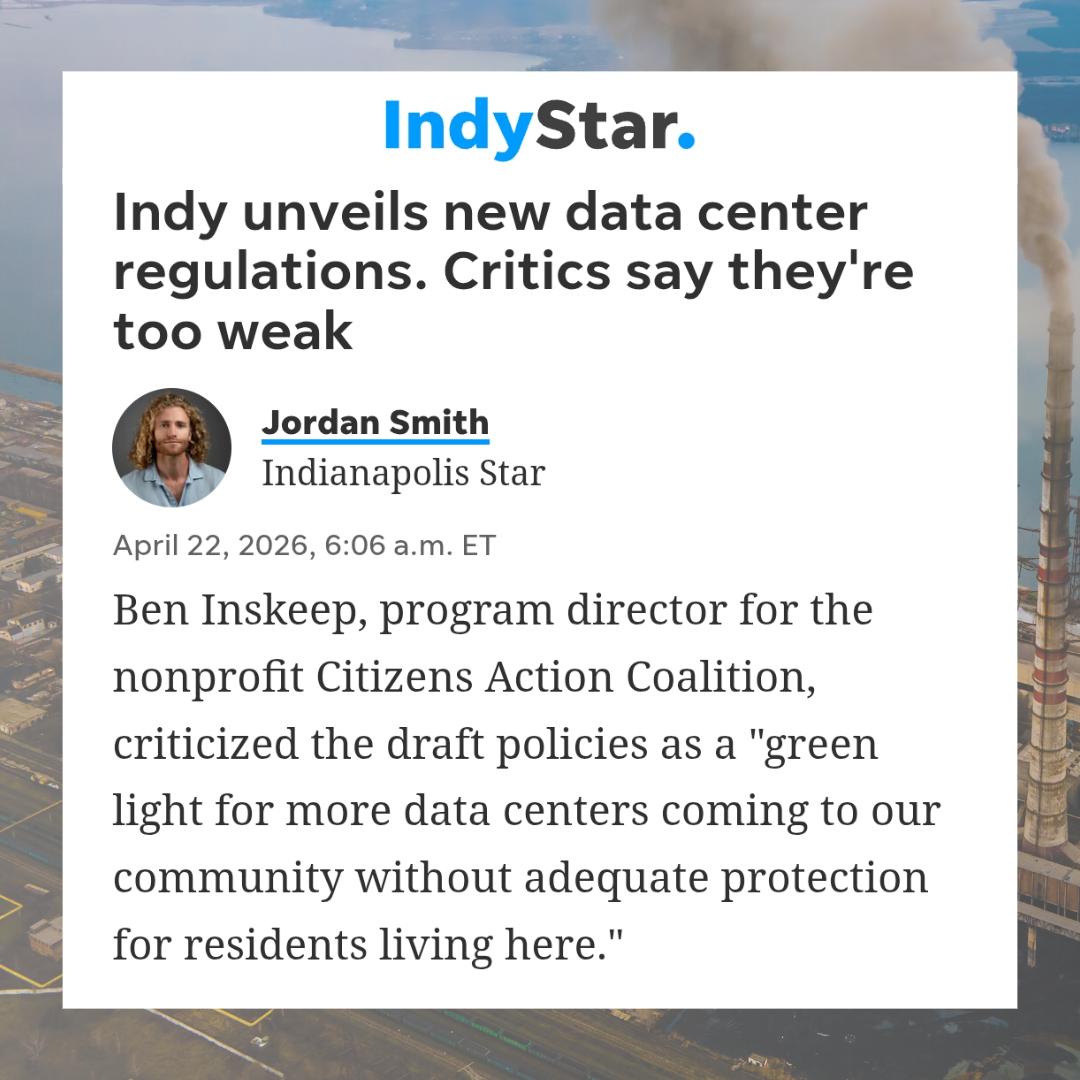
 The Department of Metropolitan Development in Indianapolis issued a draft data center ordinance and held two informational sessions in April. The proposed ordinance would allow data centers to locate as close as 200 feet away from a residence (not to mention schools, daycares, hospitals, and parks), blare 65-decibel noise 24/7/365, use hundreds of diesel generators with more than 1 million gallons of diesel stored onsite, allow data centers to consume millions of gallons of water per day, and generate massive amounts of pollution through the expansion of fossil fuel power plants.
 If you live in Indianapolis, please visit citact.org/act.indy.dc.moratorium to urge Indianapolis public officials to implement a data center moratorium instead of weak regulations!
-
 Amazon’s New Carlisle data center campus was directed to reduce its load by 50 megawatts from 6am to 11am on January 27, 2026, during Winter Storm Fern, according to a filing submitted by IDEM that was first reported by CAC. Five of Amazon’s back-up diesel generators had their pollution control equipment malfunction due to the cold.
The filing is significant because, to CAC’s knowledge, it is the first known example in the U.S. of a grid operator requiring a data center to reduce their grid usage by relying on backup diesel generators, rather than curtailment, during a grid emergency.
-
 A sanitary sewer system being constructed by Amazon for two of its ~30 data center buildings in New Carlisle is designed to use more than 1.6 million gallons of water per day on hot summer days, but much less on average, according to an IDEM filing.
 -
In St. Joseph County, four county commissioners sent a letter to Amazon asking them to renegotiate a property tax abatement for its sprawling New Carlisle data center campus, citing Microsoft’s decision to forgo an abatement on its Granger data center. The County previously approved a local property tax abatement for Amazon valued at $4 billion over 35 years.
-
The Indiana Economic Development Corporation has several new sales tax abatements for data centers “in processing” according to its Transparency Portal. The recipients of the exemptions are:
(1) Terra Industry LLC in Hillsdale (Vermillion County) for the creation of 20 jobs via a $42 million investment and
(2) Amazon Data Services, Inc. for an additional $1.25 billion investment for 50 jobs at its New Carlisle data center, beyond what was previously approved.
(3) A third sales tax exemption in processing – this one for Microsoft’s data center in La Porte for a $3 billion investment for 200 jobs – has been pending since at least late 2025 with no update.
-
Potentia announced that the Heartland Industrial Park under construction in Sullivan County has intentions to attract a $65 billion data center development, the Terre Haute Tribune Star reported. It is unclear who the prospective tenants of the data center will be, how the project will be financed, or how it will be powered.
-
DC Blox announced plans to develop a data center at the Thunderbird Commerce Center across the street from the Irvington Community Elementary School. The data center would include at least 56 backup diesel generators and use an unspecified amount of power.
-
The Metropolitan Development Commission voted 6-2 to approve the Indianapolis Martindale Brightwood Metrobloks data center proposal over widespread, vocal community opposition.
-
The Shelbyville Common Council approved annexing 429 acres on which a 900-MW Prologis data center campus will go. It also approved (1) a 30-year, 100% personal property tax abatement and (2) a 10-year, 50 percent real property tax abatement.
-
IDEM held a public hearing on the Phase 3 expansion of the Google Fort Wayne data center.
-
 La Porte City Council is considering annexing nine properties to make way for a second Microsoft data center located adjacent to a data center it recently started constructing. It is unclear how much power the two data centers will collectively use, and no contract with electric utility provider NIPSCO has been filed at the IURC yet.
 -
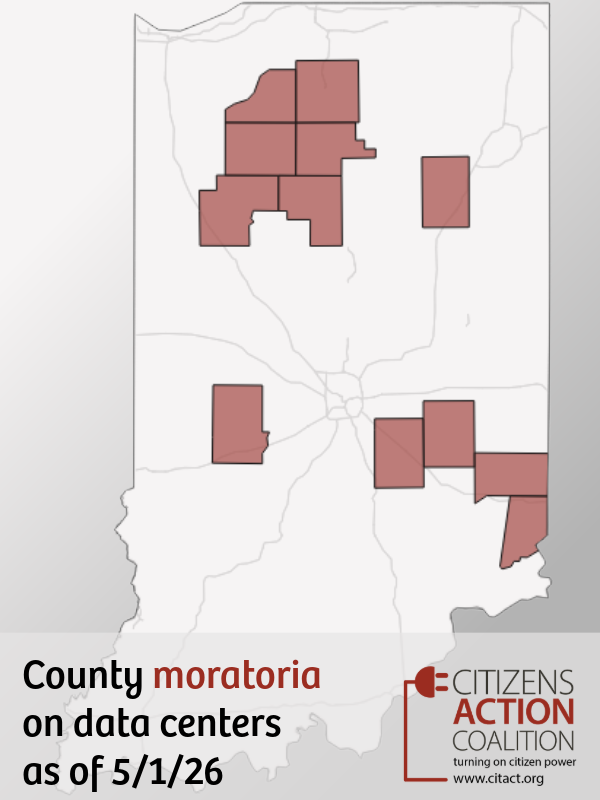
Twelve counties in Indiana have now enacted moratoria on data center development, according to CAC research. The twelve counties are Cass, Dearborn, Franklin, Fulton, Huntington, Marshall, Pulaski, Putnam, Rush, Shelby, Starke, and White. Many of the moratoriums are limited to a period of time (e.g., one year), and White County's moratorium has already expired. But some are going further, including Marshall County, which recently enacted a permanent ban on data center development.
CAC Shoutout
CAC gives a shoutout this month to our colleagues at the AI Now Institute. The AI Now Institute is a policy research institute on artificial intelligence that develops policy strategies to redirect away from the current trajectory of unbridled commercial surveillance, consolidation of power in very few companies, and a lack of public accountability.
AI Now has put together a free online training series on policy pathways at the local, state, and federal levels to stop, slow and restrict the rapid expansion of AI data centers across the US. The next event in the training series is Protecting Our Water Resources, Air Quality, and Public Health from Data Center Buildout on May 6 at 1pm Eastern.
CAC in the News
-
 CAC Organizer Bryce Gustafson was awarded the 2026 Hoosier Resilience Hero award from the Environmental Resilience Institute for his work over the past two years helping concerned Hoosiers understand the health and environmental implications of proposed hyperscale data centers for communities. Congratulations, Bryce!
 -
CAC's Executive Director, Kerwin Olson, was on a panel on WFIU’s Noon Edition about the key environmental issues facing Indiana and the United States this Earth Day. Kerwin explained that, “AI data center issues, to us, represent the single biggest threat to consumer affordability as well as climate change today.”
-
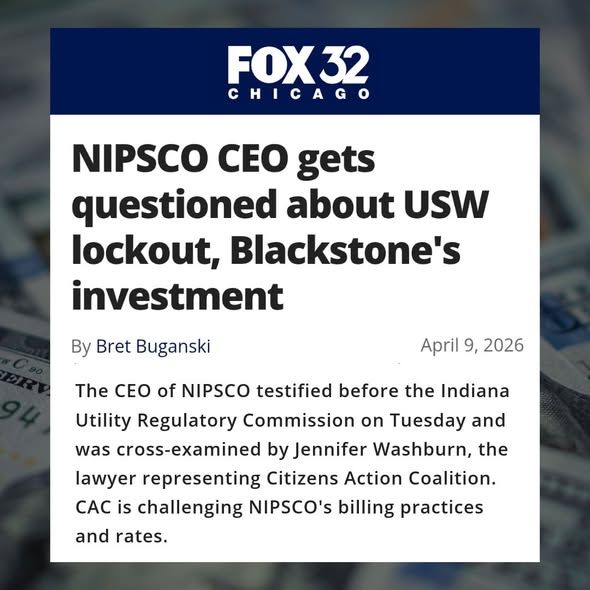 CAC Regulatory Director Jennifer Washburn cross-examined NIPSCO President Vince Parisi at the IURC hearing addressing a special contract with Amazon, Fox 32 reported. NIPSCO was pressed on having the highest residential rates in the state, the lack of evidence in the proceeding substantiating its claims about customers benefitting from data centers, the role of private equity investor Blackstone, and NIPSCO’s lockout of union employees, among other issues.
 -
CAC was featured on NPR Here and Now and was quoted in a Chicago Tribune article on the federal government’s unlawful orders directing two Indiana coal-fired power plants stay open. CAC Program Director Ben Inskeep summarized the latest actions as “another broken promise from these politicians and industry, and another utility rate increase for the rest of us.”
-
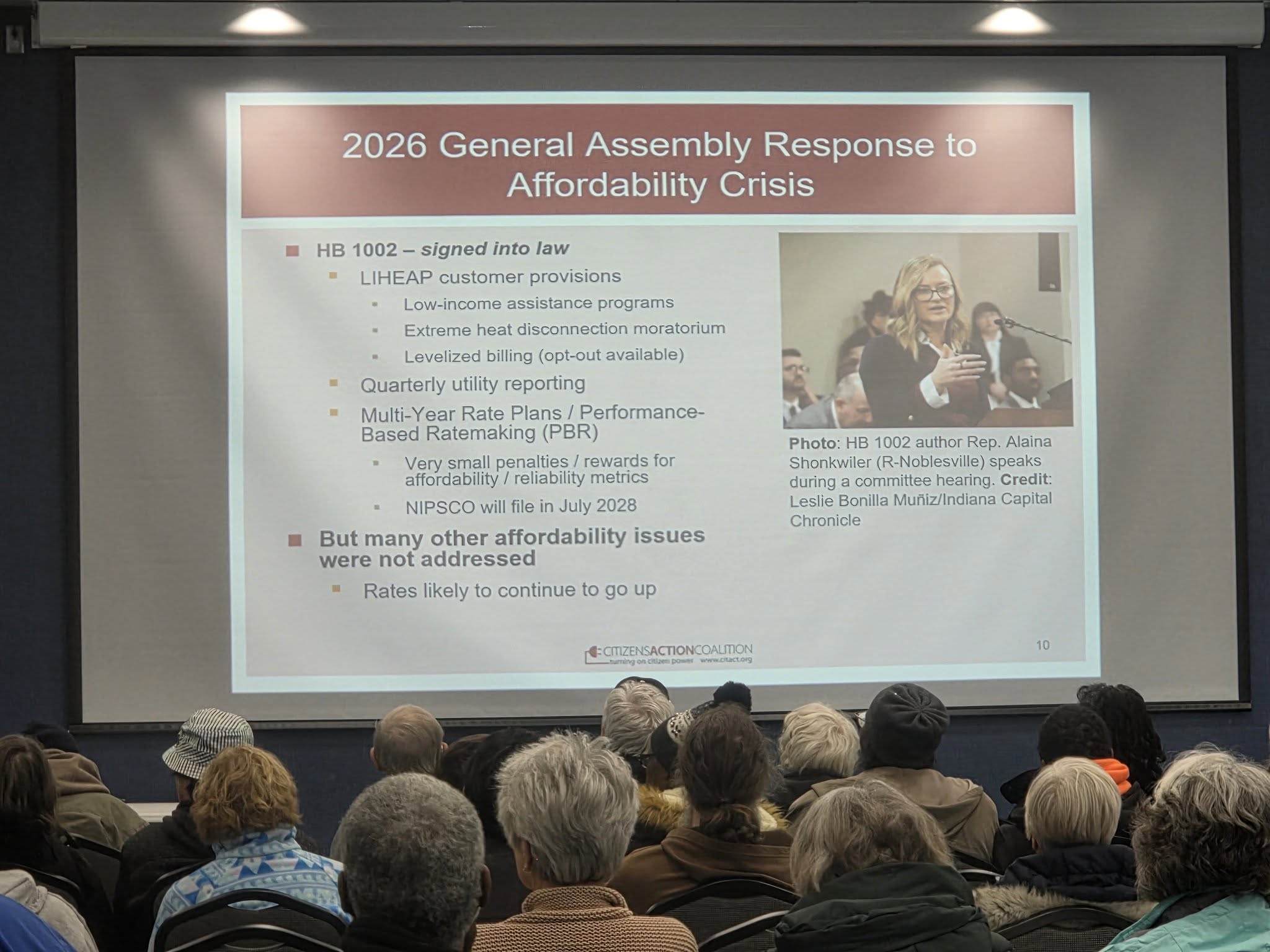 CAC held a town hall on April 7 in Merrillville on NIPSCO’s unaffordable electric and natural gas bills. The Chicago Tribune quoted CAC Director of Development Kelly Hamman praising Hoosiers in northwest Indiana for their strong organizing efforts: “We need to pressure state lawmakers and regulators so that we can work on policies that really lead to meaningful changes.”
 -
CAC lambasted the federal government’s latest attempt to gut federal coal ash cleanup rules in reporting by WFYI. “This proposal by the Trump administration would absolutely decimate those requirements and allow utilities to just leave these toxic messes in place, threatening public health, threatening Hoosiers' precious water, and all in the name of increasing utility profits,” said CAC Program Director Ben Inskeep.