2026 Week 6 Statehouse Report
Deadlines have passed in the Indiana Senate, and this coming Monday brings the deadline for bills to move out of the Indiana House. We are now at the mid-session point of the Indiana Legislature and bills have switched chambers. Any bill that hasn’t received a committee vote or a vote on the floor of its chamber of origin is now considered dead. An important note: while the bill itself may no longer be alive, that doesn’t restrict legislators from amending any language from those “dead” bills into legislation that is still alive and moving through the process.
 The CAC Team presented our Halftime Webinar this week, please take a look on YouTube for the update about the consumer and environmental legislation we're tracking and how you can make your voice heard during the second half of the session..
Much of our focus this week was on House Bill 1002: Electric Utility Affordability, authored by Rep. Alaina Shonkwiler (R-Noblesville). Though some efforts to improve the bill were rejected on the House floor this week, the bill is much improved from the introduced version, which we opposed. The bill in its current form has our support and we are commited to working to strengthen the bill further.
 HB1002 now includes multiple priority issues of CAC, which were also components of our Ratepayer Relief Plan released with our partners at Indiana Conservation Voters. The electric utilities will now be required to report consumer data to the Office of Utility Consumer Counselor (OUCC) on a quarterly basis, like customers in arrears, number of disconnect notices sent, number of disconnections, and other critical information that’s necessary to understand the affordability of monthly electric bills. The electric utilities will finally be required to offer desperately needed assistance programs to qualified low-income households.
The bill also puts in place a high-heat index disconnection moratorium for those same households. Indiana has had a winter disconnection moratorium in place for decades, but it is month-based rather than temperature-based. HB1002 was weakened by a 2nd reading amendment from the bill’s author, changing the moratorium from a month-based moratorium to a temperature-based moratorium that only applies when the heat index is projected to be at least 95 degrees. We strongly prefer those protections from disconnections to be clear, firm, easy to administer, and based on months versus temperature. Prior to the amendment, the moratorium protected vulnerable households from losing service from June 1st through September 26th. We will work to restore the stronger language.
Unfortunately, the bill still mandates that all ratepayers be forced into what is now referred to as “budget billing,” however the bill changed the term “budget billing” to “levelized billing,” and prohibits the utilities from using the term “budget billing” unless additional assistance or discounts are being provided. CAC does not support this mandate and is working to get it removed.
Lastly, the bill includes a measured approach into Performance Based Ratemaking (PBR) by establishing performance metrics designed to modestly incentive or penalize the utilities for their performance related to affordability and reliability, while also requiring the utilities to move to 3-year, multi-year rate plans instead of the traditional base rate cases that we’ve utilized for decades. While we have no objection to PBR generally, we continue to have concerns related to the implementation of the multi-year plans, most notably the continued abuse of adjustable-rate mechanisms, or trackers, by the monopoly utilities. We will work to include additional protections for consumers into the bill as it moves through the Senate.
Read more on HB1002 from the , Fox 32 (Chicago), and The Post Tribune. Also worth watching is last week’s episode of Indiana Lawmakers, which covers the Indiana Legislature’s work to lower utility bills, featuring our Executive Director, Kerwin Olson.
Passing the Senate this week by a vote of 36-12 was Senate Bill 7, which provides increased transparency in counties that are on the receiving end of toxic carbon waste from other communities. The bill was amended on the floor to specifically exempt CCS projects approved before July 1, 2026 (Wabash Valley Resources), but the bill is still a good effort, and we will work to improve the bill to include all CCS projects, regardless of timeline.
 Also passing the Senate this week by a vote of 29-19 was SB277, authored by Sen. Rick Niemeyer (R-Lowell). SB277 eliminates more than 250 environmental mandates and deregulates Indiana’s environment in the name of "efficiency." Of most concern to CAC is the elimination of any IDEM oversight related to the radioactive, hazardous and toxic waste resulting from the operations of nuclear reactors. SB277 also removes the authority of the IDEM Commissioner to call a public hearing to discuss the risks to public health and safety that come from nuclear reactors. The same language regarding nuclear deregulation is in SB258.
Our testimony on both bills spoke to the fact that the State of Indiana has absolutely zero experience when it comes to operating a commercial-scale nuclear reactor, so it makes no sense to remove the State's authority in that regard until we have a sense of what is necessary to protect public health. SB258 passed the Senate on Thursday by a vote of 36-9, and now heads to the House for further action.
Take action on the deregulation legislation and energy affordability:
We’re disappointed to report that many bills we support did not receive a hearing this year including:
- SB196: Community Energy Facilities (Sen. Greg Walker, R-Columbus)
- HB1084: Plug-in Solar Power Systems (Rep. Carey Hamilton, D-Indianapolis)
- SB74: Plug-in Home Solar Units (Sen. JD Ford, D-Indianapolis)
- HB1341: Eminent Domain (Rep. Tim Yocum, R-Terre Haute)
- SB260: Carbon Dioxide (Sen. Spencer Deery, R-West Lafayette)
A large number of data centers bills did not receive a hearing including:
- SB234: Energy Utility Matters (Sen. Vaneta Becker, R-Evansville)
- SB257: Electricity Rate Increases Due to Data Centers (Sen. Chris Garten, R-Charlestown)
- HB1245: IURC Study of Data Centers (Rep. Robin Shackleford, D-Indianapolis)
- SB79: Data Center Development (Sen. JD Ford, D-Indianapolis
- HB1043: Data Center Water Regulation (Rep. Alex Burton, D-Evansville)
House Bill 1333 is the only data center bill moving through the process. The bill has changed significantly from the introduced language that stripped the sales tax exemption for data centers. Instead, the bill sends a paltry 1% of the sales tax "savings" enjoyed by data centers to the local government entity from which the data center receives permitting approval. Additionally, the bill includes troubling pre-emption language for industrial projects to be developed on certain soil types. We testified in opposition to the bill, pointing out that data centers still receive sales tax exemption on equipment and other costs. The bill was not amended on the House floor and should be on the calendar for a vote on Monday.
House Bill 1368, which requires the Indiana Department of Natural Resources to seek primacy for Indiana to issue Class VI permits for Carbon Capture and Sequestration (CCS) passed the House this week 58-36, splitting the House GOP from its normally monolithic voting bloc. Currently, the Environmental Protection Agency has exclusive authority to issue Class VI permits. The bill now moves to the Senate where it will face further scrutiny.
 In the News:
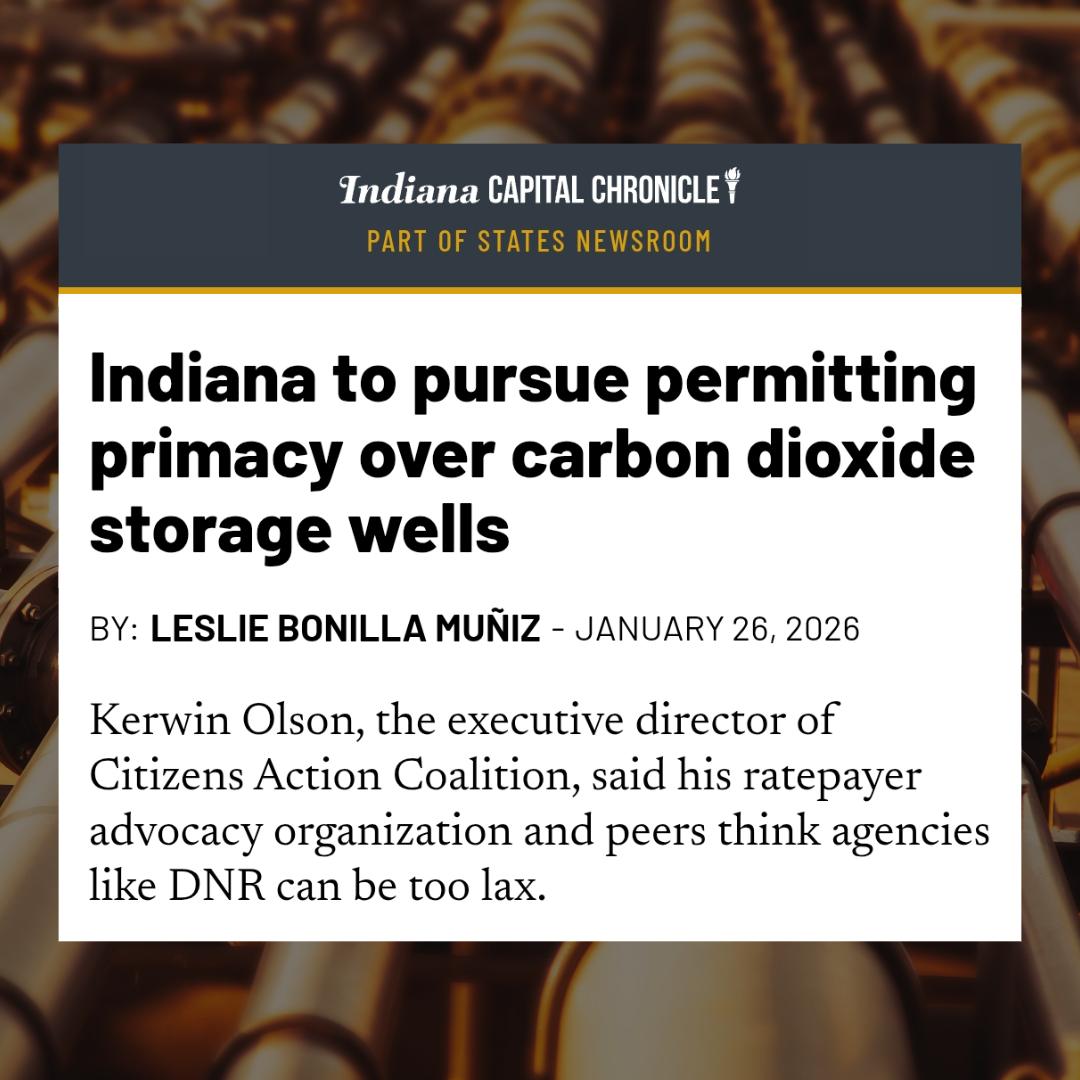
From the Indiana Capital Chronicle, 1/26/26:
"Kerwin Olson, the executive director of Citizens Action Coalition, said his ratepayer advocacy organization and peers think agencies like DNR can be too lax. 'Us and many others have sort of viewed Indiana environmental authorities as, you know, nothing more than pay-to-play sort of permit-issuing agencies,' he said.
"They worry the 'streamlined' timeline a firm may seek could come at a cost. There’s significant risk with these commercial facilities, and a thorough review with expertise is a good thing,' Olson said."
Coming up this week:
The House Utilities Committee will hear three bills: SB258, which we updated you about above; SB240, and SB241.
SB240, if passed, would allow for surplus interconnection service (SIS) to be included in utility Integrated Resource Plans, as of 2029. The bill was amended in Senate committee to apply only to utility owned facilities and makes it optional for utilities to seek information from third-party facility owners about possible SIS use. Additionally, the bill reduces the scope of issues the Utility Regulatory Commission must study related to SIS. We will testify in support, assuming the bill remains in the interest of ratepayers.
To follow these bills in real time, make sure you follow our social media for an up-to-date detailing of our work at the Indiana Statehouse: Facebook, X and Instagram. We tweet and post throughout the week about the progress of bills we mention in our reports.
Respectfully Submitted,
The CAC Team


